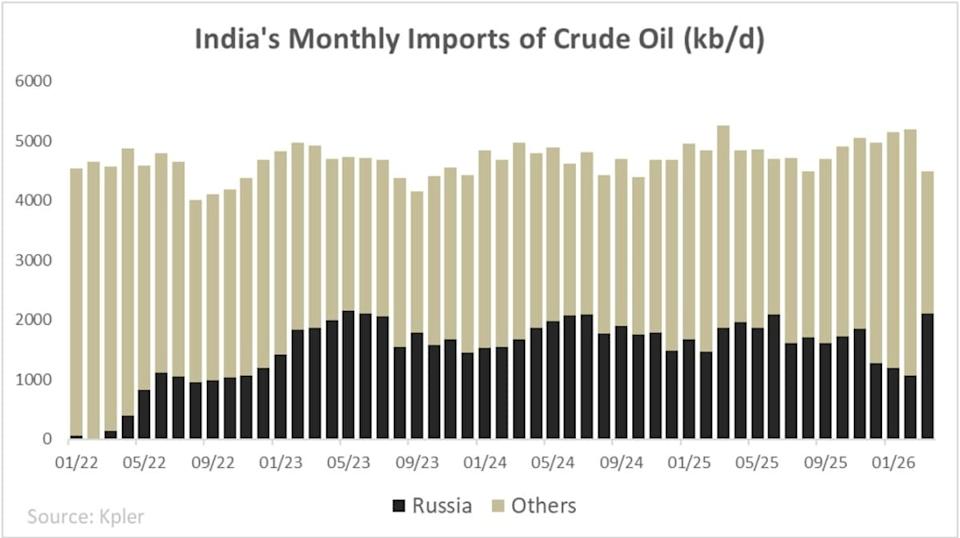
The temporary easing of U.S. sanctions on Russian crude has rapidly redrawn global oil flows, with India stepping back in as the dominant buyer of previously distressed barrels. Even as overall imports are about to ease seasonally, Russian volumes into Asia are surging—tightening the market and pushing Urals to a rare $8/bbl premium over Brent. Washington’s March 12 decision to allow sales of oil already loaded onto tankers had an immediate impact. Almost all of Russia’s floating storage was quickly absorbed, pulling hesitant buyers back in and exposing just how tight the market has become for medium-sour crude.
Since the US sanctions were imposed in October 2025, India, which had been gradually mounting its dependence on Russian crude, reversed course abruptly. Imports had fallen from 1.85 million b/d in November to 1.06 million b/d in February 2026. Substitution efforts had initially leaned on Middle Eastern suppliers. Saudi Arabia and Kuwait stepped in to replace sanctioned Russian barrels in late 2025, while politically motivated US exports briefly surged to 570,000 b/d in October (before dropping sharply to 160,000 b/d by March).
In March, crude oil volumes from Russia surged to a record 2.06 million b/d – almost doubling month-on-month and closing in on the all-time high of 2.15 million b/d seen in May 2023. This rebound comes despite a broader decline in total crude imports to India, which fell from 5.2 million b/d in February to 4.4 million b/d in March – a mix of a seasonal slowdown and crisis-driven adjustments, with March volumes down 16% year-on-year. India’s crude intake typically peaks between October and April, with refiners scheduling maintenance during the monsoon months from July to September.
In fact, the lower-than-usual export volume of 4.4 million b/d in March appears to be a notable achievement for New Delhi, given the circumstances. Following the disruption of flows through the Strait of Hormuz on February 28, India effectively lost access to its second-largest crude supplier – Iraq – which alone had been delivering around 1 million b/d before the crisis began. This was accompanied by a complete loss of Kuwaiti supplies, a substantial reduction in volumes from Saudi Arabia (which declined month-on-month from 1 million b/d to around 500,000 b/d, with further downside expected), and a significant drop in cargoes from the UAE.
In this context, the doubling of Russian crude volumes appears to be a tactical quick response to fill the gap left by the loss of Middle Eastern grades. A similar strategy is evident in the purchase of 1.6 million tonnes of Venezuelan crude, with six tankers scheduled to arrive in India in April. This way, while Russian Urals crude helps substitute for lighter Middle Eastern grades, Venezuelan oil is being positioned as a replacement for heavier Iraqi blends. All this proves that in a market where refinery configurations matter as much as price, Russian (and Venezuelan) barrels fit neatly into existing systems.
India’s buying spree includes the full spectrum of refiners. State-owned Indian Oil Corporation (IOC) has become the largest buyer in March, nearly doubling its intake month-on-month with 660,000 b/d, acting as a consistent outlet even as other refiners adjusted flows. Meanwhile, Hindustan Mittal Energy (HMEL), Mangalore Refinery and Petrochemicals (MRPL), and Hindustan Petroleum Corporation (HPCL) – which had completely halted Russian purchases in December – collectively accounted for around 15% of March imports. Private sector participation has also rebounded. The privately owned refining giant Reliance, after stopping purchases in January and taking just 150,000 b/d in February, ramped up to 360,000 b/d in March. Nayara Energy – itself partly owned by Russia’s Rosneft and broadly sanctioned – has been decreasing its Russian intake only due to the planned maintenance closure in April. Roughly 85% of the total Russian-proceeding imports were Urals, reinforcing its dominance in India’s slate.
At first glance, the doubling of Indian purchases might suggest that Chinese intake of Russian crude has softened. In reality, the opposite appears to be true. So far, 2026 is shaping up to be a peak year for Russian seaborne exports to China, with three-month average flows reaching around 1.85 million b/d—highlighting that Moscow has managed to expand its footprint across Asia rather than simply redirect volumes between its two largest buyers.
India and China are not alone in their March rush to buy Russian crude. Moscow has quietly expanded its customer base across Asia. The Philippines imported two ESPO cargoes totalling 200,000 tonnes in March – the first such purchases in five years. Brunei received ARCO and Varandey shipments (though its Hengyi refinery is majority Chinese-owned). Government-level negotiations are ongoing with Thailand, Vietnam, and Sri Lanka – countries historically dependent on Gulf crude for 60–99% of their supply.
The window for these trades remains narrow. The sanctions relief applies only to cargoes loaded before March 12, many of which had been sitting in floating storage. That storage buffer is rapidly shrinking: from 19 million barrels at the end of January to just 8 million barrels by late April, with most volumes already positioned in Asian waters. These barrels are most likely to be absorbed between China and India, leaving little room for smaller buyers to compete.
At the same time, Russian export infrastructure is under pressure. Ukrainian drone strikes on March 23 hit the Baltic ports of Ust-Luga and Primorsk. Ust-Luga, which shipped 480,000 b/d in March (33% to India), appears to have halted operations entirely since the attack. Primorsk, exporting 910,000 b/d (32% to India), resumed activity within days, with five tankers loaded since March 25. These disruptions point to potential supply constraints in May, though the extent depends on how quickly Russia can restore damaged infrastructure. With Ukrainian attacks on energy assets continuing despite Easter ceasefire proposals from President Zelenskyy, the risk of further interruptions remains high.
What is unfolding is a structural reshuffling of crude flows. Russian barrels, once discounted and politically constrained, are now actively competing and retaking lost market share amongst key Asian buyers. As floating storage is largely gone and infrastructure risks mount, the market is tightening around a shrinking pool of accessible medium-sour crude. For India and its regional peers, the message is clear: Russian barrels are back – and the room to manoeuvre is shrinking fast.
By Natalia Katona for Oilprice.com
More Top Reads From Oilprice.com
Oilprice Intelligence brings you the signals before they become front-page news. This is the same expert analysis read by veteran traders and political advisors. Get it free, twice a week, and you’ll always know why the market is moving before everyone else.
You get the geopolitical intelligence, the hidden inventory data, and the market whispers that move billions – and we’ll send you $389 in premium energy intelligence, on us, just for subscribing. Join 400,000+ readers today. Get access immediately by clicking here.