


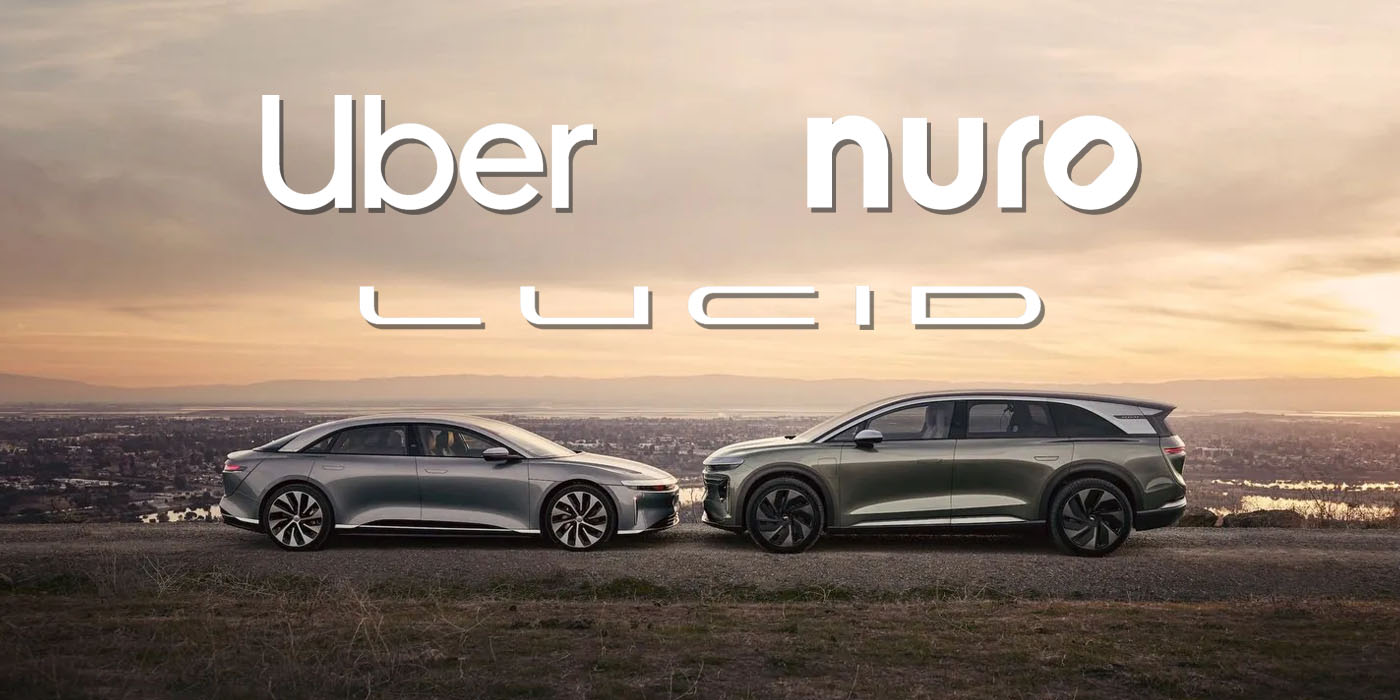
A new SEC filing reveals that Uber Technologies has become a major shareholder of Lucid Group, holding 37.7 million shares of Class A common stock — an 11.5% ownership stake that makes the ride-hailing giant one of Lucid’s largest investors outside the Saudi Public Investment Fund.
The filing, a Form 3 submitted to the SEC on April 20 with an event date of April 14, confirms that Uber has crossed the 10% ownership threshold after pouring a total of $500 million into the struggling EV maker as part of their expanding robotaxi partnership.
From $300M to $500M — and 11.5% of the company
Uber’s stake in Lucid has been building in stages. The ride-hailing company first announced a $300 million investment alongside a commitment for 20,000 Lucid Gravity robotaxis in July 2025. That initial investment closed in September 2025 and gave Uber a significant but undisclosed position in Lucid’s share register.
Then on April 14, 2026, Uber committed an additional $200 million, bringing its total investment to $500 million. The same announcement expanded the robotaxi vehicle commitment from 20,000 to at least 35,000 Lucid vehicles — a 75% increase in the fleet commitment.
The SEC Form 3 filing shows Uber now holds exactly 37,753,583 shares of Lucid Class A common stock through its wholly-owned subsidiary SMB Holding Corporation. Based on Lucid’s approximately 327.7 million shares outstanding, that represents an 11.5% stake — triggering the 10% beneficial ownership disclosure requirement.
Lucid’s $1.05 billion capital raise
Uber’s expanded investment was part of a broader $1.05 billion capital raise that Lucid announced on April 14. The total package included Uber’s $200 million, a $550 million commitment from Ayar Third Investment Company (an affiliate of the Saudi PIF), and a $300 million registered public offering of 36 million shares priced at $8.112 per share to underwriters.
The PIF’s investment came in the form of convertible preferred stock, while the public offering added further dilution for existing shareholders. The same day also saw Lucid name Silvio Napoli as its new CEO, replacing interim chief Marc Winterhoff.
With the additional shares from the public offering and Uber’s new investment, Uber’s ownership percentage will likely shift as the full dilution plays out. But the direction of travel is clear: Uber is becoming an increasingly entrenched stakeholder in Lucid’s future.
The robotaxi bet
The investment is not a passive financial play — it is tied directly to what could become one of the largest robotaxi deployments in the world. Uber, Lucid, and autonomous driving company Nuro are building a three-way partnership where Lucid provides the vehicles, Nuro supplies the Level 4 autonomous driving system (called Nuro Driver), and Uber contributes its ride-hailing network and fleet management.
Uber recently began early test rides with select employees in the San Francisco Bay Area using Lucid Gravity SUVs equipped with Nuro’s autonomy stack and safety drivers. A commercial launch in San Francisco is planned for later this year, with expansion to “dozens of global markets” over the following six years.
The 35,000-vehicle commitment will include both the Lucid Gravity SUV and the upcoming Lucid Midsize — a vehicle with a planned starting price under $50,000 that Lucid hopes will dramatically expand its addressable market.
For Uber, the logic is straightforward. The company does not want to build its own vehicles or develop its own autonomy software. Instead, it is assembling partnerships — Waymo for near-term autonomous rides, and now Lucid/Nuro for a dedicated robotaxi fleet that Uber will operate directly on its platform.
Stock in freefall despite $1 billion in fresh capital
The paradox for Lucid investors is brutal. Despite securing $1.05 billion in new capital and dramatically expanding its robotaxi partnership with one of the world’s largest mobility companies, LCID shares have plunged from $9.96 on April 2 to $6.75 on April 20 — a 32% decline in less than three weeks. Analysts at TD Cowen and Baird both lowered their price targets on the stock.
The market’s message is clear: dilution fears outweigh the partnership excitement. Lucid is still burning cash at a significant rate, delivering roughly 2,000 vehicles per quarter, and remains years away from profitability. The $1.05 billion raise, while extending Lucid’s runway, required issuing tens of millions of new shares at prices that keep falling.
Lucid reports total liquidity of $5.5 billion, including a roughly $2 billion delayed draw term loan facility from the PIF. That is a substantial war chest — but the market is pricing in the likelihood that more dilution is coming before Lucid reaches scale.
Electrek’s Take
The SEC filing makes something tangible that was previously abstract: Uber now owns more than one-tenth of Lucid. That is not a casual partnership — it is a deep financial entanglement that gives Uber significant influence over Lucid’s direction and a material interest in its survival.
The 35,000-vehicle commitment, if fulfilled, would transform Lucid’s production trajectory. For context, Lucid delivered approximately 10,000 vehicles total in 2025. A robotaxi fleet order of that magnitude over six years would roughly double or triple its annual output.
The risk, of course, is execution. Nuro’s Level 4 system needs to prove itself. Regulatory approval in multiple markets is uncertain. And Lucid needs to actually ramp production to meet demand it does not yet have from the consumer side, let alone fleet orders. But Uber putting $500 million on the table, and now owning 11.5% of the company, suggests it sees something in Lucid’s technology platform that the stock market is not yet pricing in.


FTC: We use income earning auto affiliate links. More.
electrek.co
#Uber #UBER #owns #Lucid #LCID #interesting


