


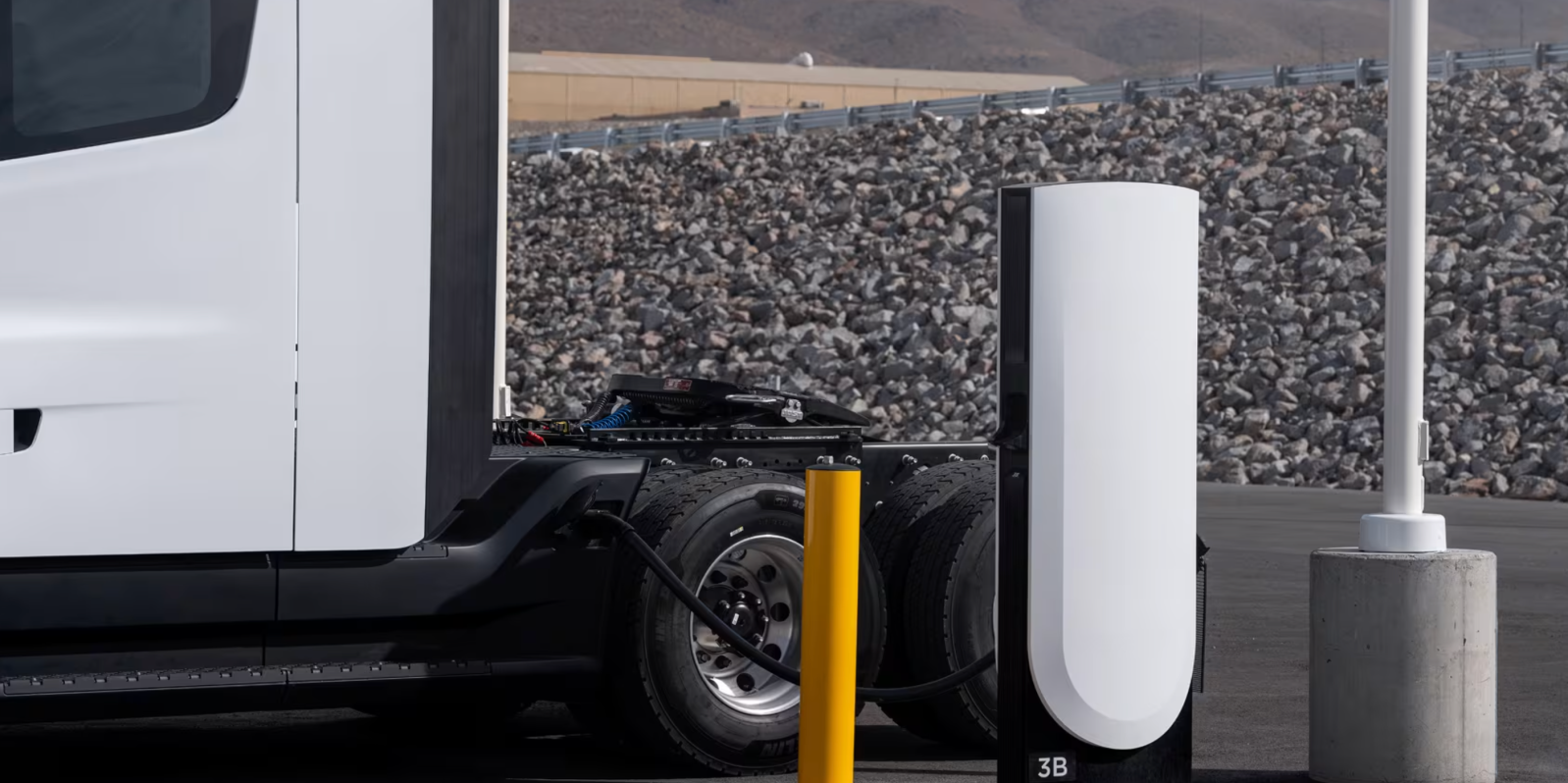
Tesla has launched a new “Semi Charging for Business” program that allows fleet operators and businesses to purchase and install their own Megacharger and a brand-new product called the Basecharger — a lower-power 125 kW charger designed for depot and overnight use.
The online configurator reveals a starting price of $188,000 for two Megacharger posts, excluding taxes and installation, with Tesla charging an all-inclusive fee of $0.08 per kWh for revenue-generating sites.
Two chargers, two use cases
Tesla is now offering two distinct Semi charging products through its new business program, mirroring the Supercharger for Business program it launched last month with a $940,000 price tag for an 8-stall V4 site.
The Megacharger is Tesla’s ultra-fast charging solution for Semi trucks. Delivering up to 1.2 MW of power, it can add up to 60% of range in just 30 minutes — enough to top up during a driver’s mandated rest break. The system consists of a power cabinet that shares its 1,200 kW output across two charging posts, with each post capable of drawing up to 1.2 MW when used individually.
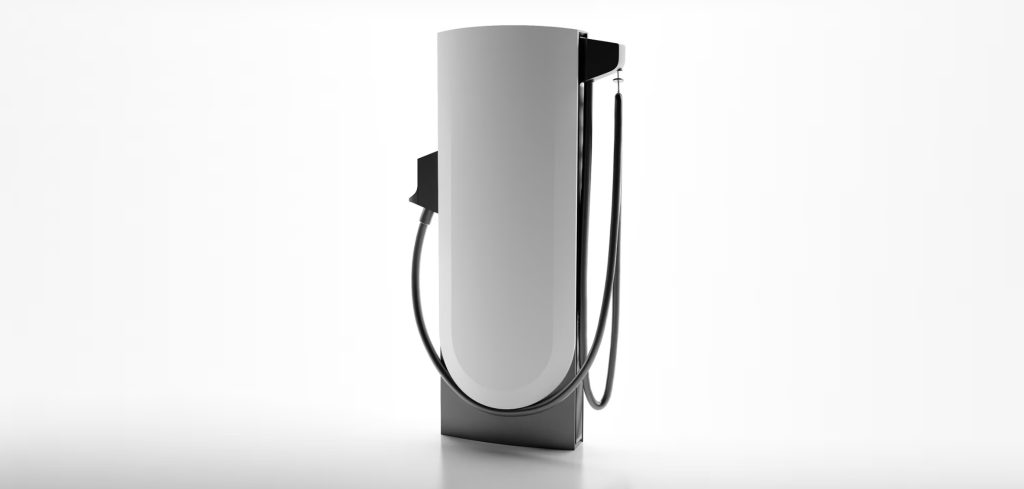
The Basecharger is the new product here. Tesla describes it as lower-power charging designed for longer stops at depots and overnight use. Delivering 125 kW of power, the Basecharger can add up to 60% of range in four hours. Notably, Tesla lists Basecharger deliveries as estimated to begin in early 2027, while the Megacharger is already being deployed at locations across the country.
The Basecharger fills an important gap. Not every charging scenario requires 1.2 MW of power. Trucks parked overnight at a depot or distribution center can charge slowly and cheaply, preserving the expensive high-power infrastructure for en-route stops where speed matters.
Pricing and how to order
Tesla’s online configurator provides transparent pricing for the first time. A minimum purchase of two Megacharger posts is required, and the starting estimated purchase price for that configuration is $188,000, excluding taxes and installation.
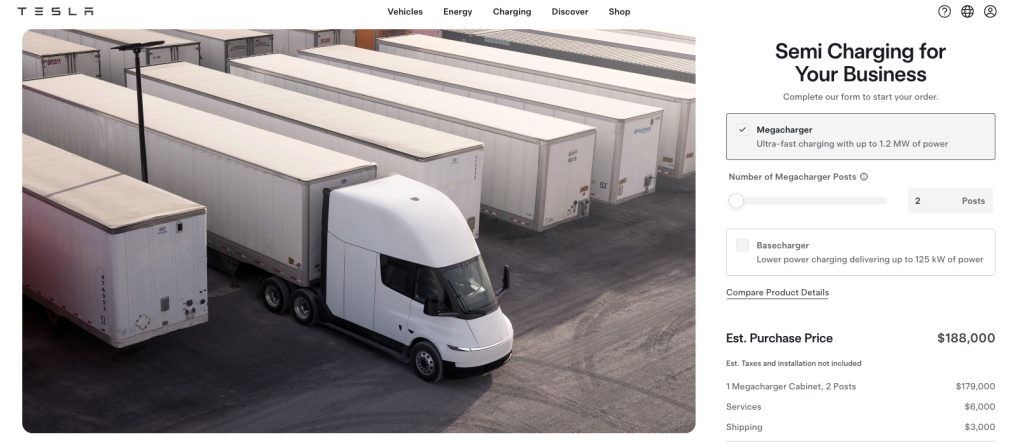
For businesses planning to charge third-party vehicles and generate revenue, Tesla charges an all-inclusive fee of $0.08 per kWh delivered. That’s notably lower than the $0.10 per kWh fee Tesla charges on its Supercharger for Business program, which suggests Tesla is pricing aggressively to accelerate Semi charging infrastructure deployment.
The Basecharger is unsurprisingly much cheaper, and starting at $40,000, it is highly competitive for still a somewhat powerful charger.
The ordering process follows a similar structure to Supercharger for Business: complete an order form, hire your own preferred installer with a Tesla Design Engineer available to guide the process, then manage the site through Tesla’s portal for utilization monitoring, pricing adjustments, and performance tracking. Tesla also promises over-the-air software updates throughout the chargers’ lifetime.
Full technical specs
Both products use the MCS 3.2 (Megawatt Charging System) standard and support open protocols including ISO 15118-2 and OCPI — meaning they’re not locked into Tesla’s ecosystem. Payment terminals are optional on both units.
The Megacharger cabinet weighs 1,100 kg and measures 1175 x 1390 x 1925 mm, with greater than 96% efficiency and cable runs of up to 100 meters between cabinet and post. Each Megacharger post supports 1,100 amps of continuous current across a 0–1,000 VDC range, with a 3-meter cable.
Megacharger cabinet
| Max DC output | Up to 1,200 kW, shared by 2 posts |
| Output voltage range (DC) | 180–1,000 VDC |
| Cabinet-to-post cable distance | Up to 100 m |
| Size (H x W x D) | 1,175 x 1,390 x 1,925 mm |
| Weight | 1,100 kg |
| Efficiency | >96% |
| Cooling | High efficiency, low noise, ventilation not required |
Megacharger post
| Max output power | 1.2 MW |
| Continuous current | 1,100 A |
| Voltage range | 0–1,000 VDC |
| Cable length | 3 m |
| Size (H x W x D) | 334 x 891 x 1,946 mm |
| Weight | 100 kg |
| Communication | ISO 15118-2, OCPI capable |
| Payment terminal | Optional |
| Charging standard | MCS 3.2 |
The Basecharger is a more compact unit at 340 x 1200 x 2000 mm and 100 kg, delivering 150 amps of continuous current across a 180–1,000 VDC range with a longer 6-meter cable — practical for depot layouts where trucks may not park directly next to the charger.
Basecharger
| Max output power | 125 kW |
| Continuous current | 150 A |
| Voltage range | 180–1,000 VDC |
| Cable length | 6 m |
| Size (H x W x D) | 340 x 1,200 x 2,000 mm |
| Weight | 100 kg |
| Communication | ISO 15118-2, OCPI capable |
| Payment terminal | Optional |
| Charging standard | MCS 3.2 |
Competitive context
Tesla is entering a competitive market for megawatt-class truck charging. Kempower has already deployed MCS-capable infrastructure in California, delivering up to 1.2 MW through its Mega Satellite MCS dispensers at EV Realty’s truck fleet hub in San Bernardino. ABB and ChargePoint have also announced MCS support, though neither has deployed at scale in the US.
Tesla’s advantage is vertical integration. The company builds the trucks, builds the chargers, and operates a growing network — now at 66 planned Megacharger locations with the first public station open in Ontario, California. The partnership with Pilot Travel Centers to install Megachargers at select truck stops adds another layer. Now, by selling the hardware directly to businesses, Tesla is effectively crowdsourcing its charging network buildout.
The MCS 3.2 standard compliance is worth noting. Unlike Tesla’s early Supercharger days with a proprietary connector, the Semi charging products use an open industry standard from day one. Daimler, Volvo, and Scania all plan to deploy MCS-compatible electric trucks, meaning third-party fleet operators could theoretically charge non-Tesla trucks at these stations.
Electrek’s Take
This is a smart move by Tesla, and the Basecharger is the more interesting product of the two. We’ve been tracking Tesla’s Megacharger rollout closely, and the biggest challenge for fleet electrification has never been the en-route fast charging — it’s been depot charging. Most commercial trucks spend the majority of their downtime parked at depots, distribution centers, and warehouses, and those locations don’t need 1.2 MW chargers. They need reliable, affordable, lower-power charging that can top up trucks overnight.
At 125 kW, the Basecharger is essentially a heavy-duty version of level 2 charging for passenger EVs, but DC — enough to fully charge a Tesla Semi overnight without the massive electrical infrastructure required for megawatt-class charging. The cost is significantly lower than the Megacharger’s $188,000 starting price.
The $0.08/kWh Tesla fee for revenue-generating sites is also aggressive. That’s 20% cheaper than what Tesla charges Supercharger for Business operators.
But notably, the Tesla fee is higher than what Tesla originally claimed it would sell electricity at for Tesla Semi customers back when it first unveiled the truck in 2017. We always noted that the $0.07 per kWh was never realistic, and now Tesla has confirmed it by having its network fee be higher than the overall cost it used to claim.
Combined with the open MCS 3.2 standard, Tesla is clearly positioning Semi Charging for Business as infrastructure that can serve the entire electric trucking industry — not just Tesla Semi customers.


FTC: We use income earning auto affiliate links. More.
electrek.co
#Tesla #launches #Basecharger #Semi #reveals #Megacharger


