


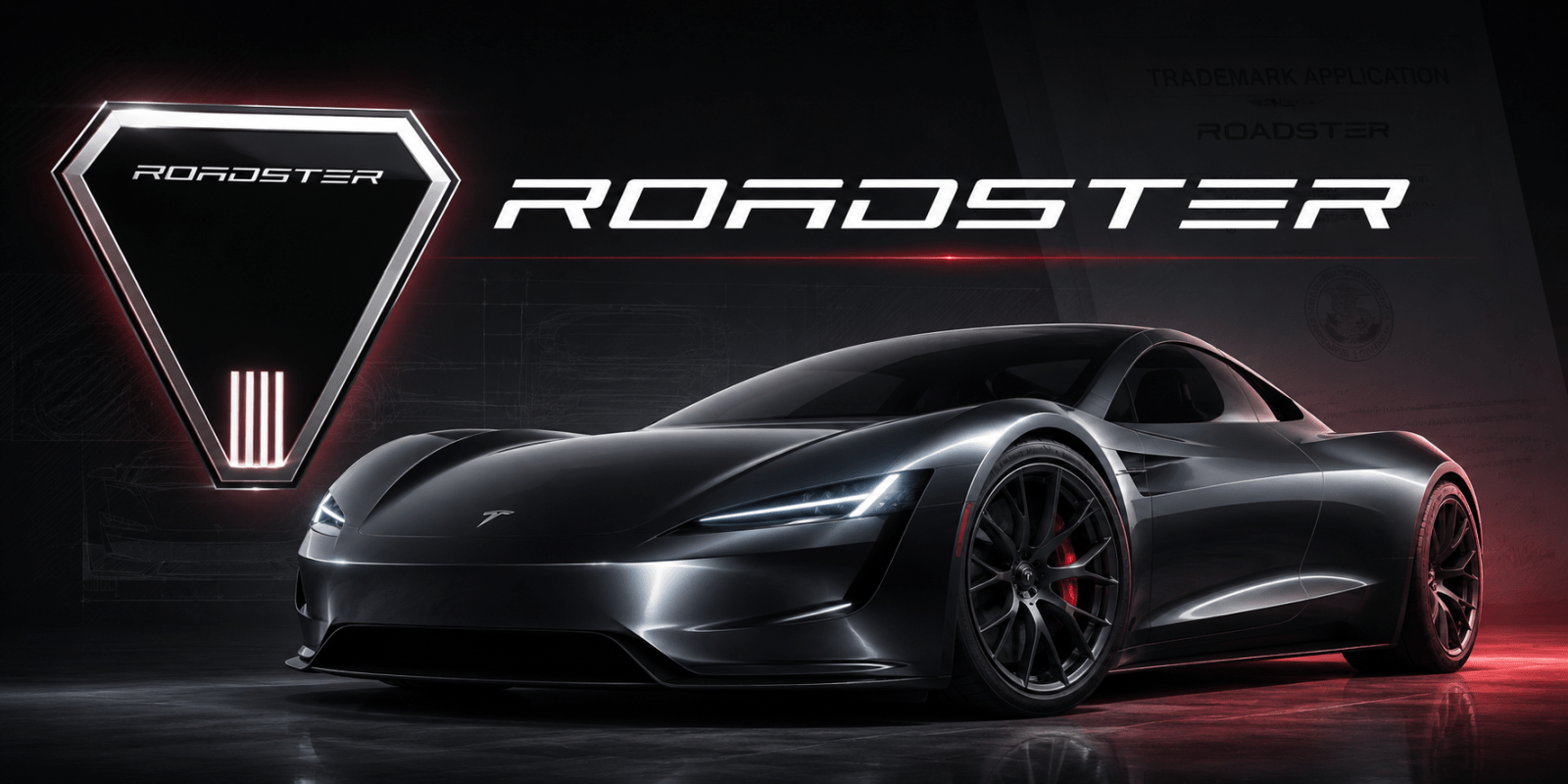
Tesla has filed two new trademark applications for the Roadster with the United States Patent and Trademark Office, revealing a stylized wordmark and a distinctive triangular badge that departs from the automaker’s standard branding approach.
The filings are the clearest signal yet that Tesla is preparing to bring the long-delayed electric supercar to market — nearly nine years after the prototype was first unveiled.
The filings
Tesla submitted both applications on February 3, 2026, on an “intent to use” basis, meaning the company has declared a plan to put these marks into commercial use but hasn’t deployed them yet.
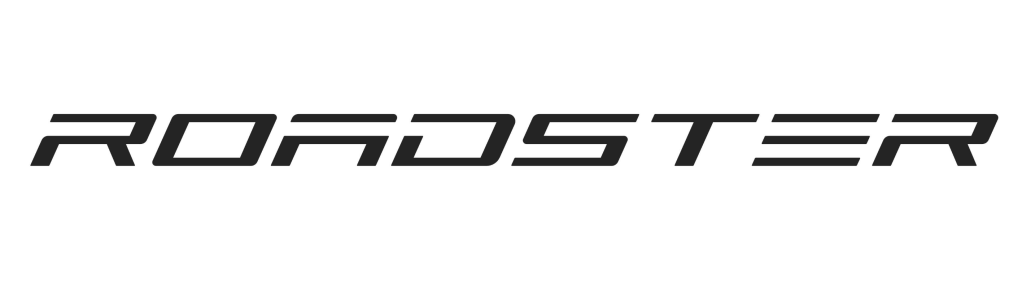
The first filing (serial number 99630872) covers a stylized “ROADSTER” wordmark — all-caps, stretched, and angular with segmented letterforms that lean into a futuristic, high-performance aesthetic. It’s classified under IC012 for electric land vehicles.
The second filing is more interesting. It describes a diamond-shape design composed of lines, per the filing’s own language, evoke “speed, propulsion, heat, or wind.” This is a departure from Tesla’s typical flat wordmark approach and suggests the Roadster will carry its own distinct visual identity — separate from the badge system used on the Model 3, Model Y, Model S, Model X, and Cybertruck.
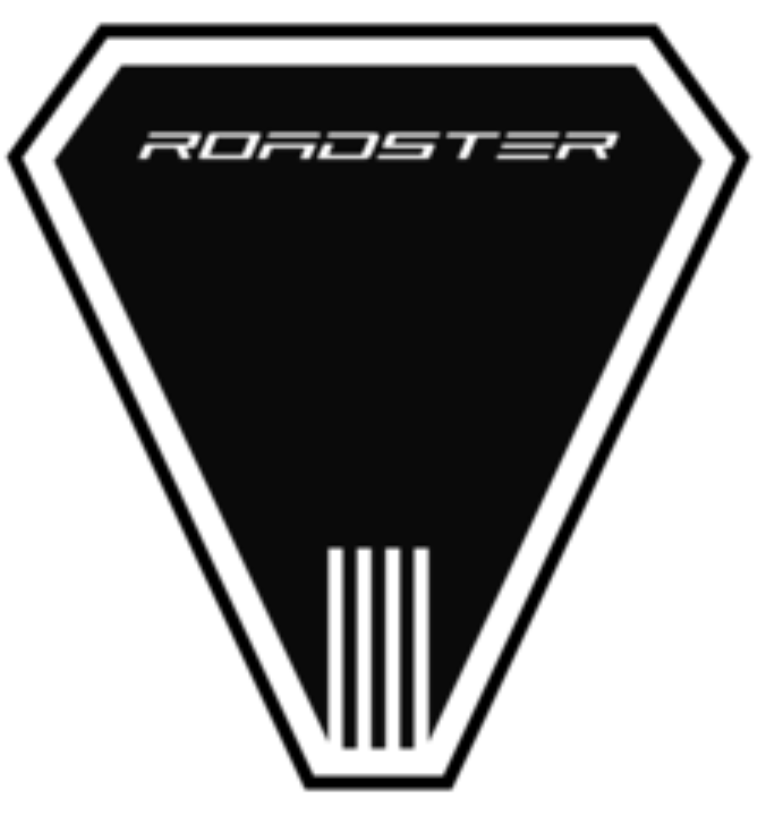
That second mark is notable because, aside from the Cybertruck’s angular two-part logo, Tesla has never given one of its vehicles a unique standalone badge. The Roadster appears to be getting the kind of bespoke branding treatment normally reserved for supercar marques.
What “intent to use” actually means
“Intent to use” trademark applications carry legal weight. Companies that file them are required to demonstrate actual commercial use within a defined window — typically three years, with extensions — or risk losing the registration entirely.
The fact that Tesla filed these in February 2026, while simultaneously approaching a reveal window, is consistent with a company that is genuinely preparing to bring these marks to market, not just parking them speculatively. As we first reported in February, the filings also included what appeared to be an updated vehicle silhouette, sleeker and squarer at the roofline compared to the 2017 concept.
However, Tesla has also given up on trademarks that never resulted in commercially launched products.
The never-ending delay timeline
Of course, with the Tesla Roadster, every signal of progress has to be weighed against a nearly decade-long track record of broken promises.
The prototype debuted in November 2017 with production promised for 2020. Reservation holders put down between $50,000 and $250,000 in deposits. What followed was a masterclass in moving the goalposts: Musk pushed the timeline to 2021, then 2022, then 2023, then 2024. In November 2025, Tesla officially delayed the demo to April 1, 2026, with production pushed to 2027 or 2028.
In March 2026, Musk claimed the unveil would happen by end of April. That didn’t happen either. During the Q1 2026 earnings call, Musk revised the timeline again to “maybe in a month or so,” citing the need for testing and validation — pushing the reveal to late May or early June 2026.
That represents at least the eighth time Musk has moved the goalposts on the Roadster since 2017. The first customers who put down deposits will have waited a full decade before getting their cars — if it happens at all.
Production, by Musk’s own framing, would follow 12 to 18 months after the demo — pointing to a real-world delivery start somewhere in mid-to-late 2027 or into 2028.
Electrek’s Take
The trademark filings are real, they carry some legal obligations, and there are signs that suggest Tesla is doing genuine production preparation work for the Roadster.
That’s the good news.
But we’ve been here before. Tesla has filed trademarks, posted job listings, and dropped hints about the Roadster for years while delivering nothing but delays.
The real question is whether the Roadster can still matter. When the concept debuted in 2017, a 0-60 in 1.9 seconds and 600+ miles of range was jaw-dropping. In 2026, the EV performance landscape has shifted significantly. Rimac has been delivering the Nevera for years, Porsche has iterated on the Taycan, and Chinese competitors are pushing performance boundaries at fraction of the cost. Tesla needs to deliver something that justifies almost a decade of waiting — and the deposits that have been sitting in its accounts this whole time.
We’ll believe the Roadster is real when we see it on a stage. Until then, these trademarks are the most concrete sign we’ve had — but the bar for concrete signs on this project is remarkably low.


FTC: We use income earning auto affiliate links. More.
electrek.co
#Tesla #files #Roadster #trademarks #unique #badge #ahead #launch


