


In police stations across Jammu and Kashmir, the walls that once bore the faces of wanted militants now display posters of drug peddlers and dealers. Notorious names, such as Huzaif Shabir Dar of Budshahnagar and Basit Ahmad Baba of Qamarwari, have replaced insurgents on the most wanted lists. The shift is stark—and the response is increasingly public.
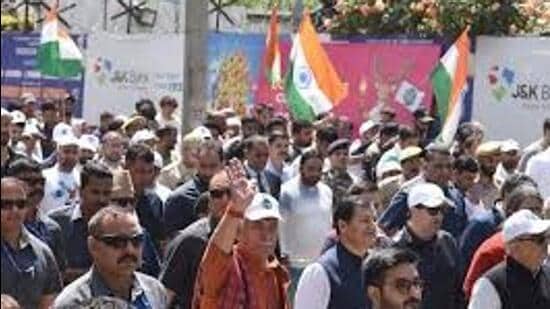
During the launch of Lieutenant Governor (LG) Manoj Sinha’s 100-day drug awareness programme in Jammu on April 11, the initiative was framed as a security and social priority. By early May as it entered the Kashmir Valley, the march had evolved into a mass movement. “Drug trafficking and terror funding are two hands of the same enemy,” Sinha said in Budgam on May 5. “The neighbouring country (Pakistan), known as the world’s foremost incubator of terrorism, is pushing drugs to harm our youth. The palaces built with drug money will be razed to the ground,” he said.
Grassroots groundswell
For the first time, the campaign has moved beyond administrative policy to become a mass movement. Since the launch of the Nasha Mukt J&K Abhiyaan on April 11, nearly 50 to 60 lakh people have participated in awareness programmes. From village chaupals to city centres, the drive is being fuelled by grassroots intelligence. The administration is now working with panchayats, mohalla committees, and even local lambardars (village headmen) to identify local black spots and supply chains.
“I have lost my nephew to drug addiction. I don’t want any other family to face what we have faced,” said Tariq Ahmad of Baramulla’s old city. “My nephew was brilliant, but he became addicted. Many families are silently suffering. This campaign should have been launched years ago; for the first time, we feel the government is serious.”
Students are also leading the charge. Sohaib, a student of Burn Hall School who joined the mega-rally in Srinagar, said: “Drugs are ruining the younger generation. Common people want this menace eradicated; it has been spreading its tentacles for too long.”
Social activist Farooq Ahmad echoed this sentiment, highlighting the link between addiction and crime. “It’s disheartening to see a young man turn to theft to raise money for drugs. The action the government is taking now will bear fruit, but people must come forward to help.”
Scale of crisis
Data from the Institute of Mental Health and Neurosciences (IMHANS), Kashmir, shows the Valley has 67,468 substance-dependent individuals. Heroin remains the most preferred opioid, with 53.5% of users sharing needles—a critical public health risk. Srinagar leads the caseload with over 6,100 registered patients, followed by Budgam and Baramulla.
Since the LG’s padyatra (foot march) began in the Kashmir division on May 3, enforcement has reached a fever pitch. In just the first 21 days of the overall campaign (April 11–May 2), authorities recorded 481 first information reports (FIRs) and sent 518 smugglers to jail.
While enforcement has intensified, experts warn against turning a complex social challenge into a “statistical performance.” A senior police officer noted that the real concern is synthetic opioids like heroin and pharmaceutical derivatives like Tramadol. “This is fundamentally different from cannabis use. If enforcement frameworks do not differentiate, they risk flattening a hierarchy of harm,” he said, adding: “Enforcement must focus on financiers and inter-regional supply chains, not just over-criminalising those at the margins.”
On April 2, the UT notified new rules ensuring victims are treated as patients for rehabilitation, while traffickers face the full weight of the Narcotic Drugs and Psychotropic Substances (NDPS) Act.
Cause unites rivals
The campaign has bridged political and religious divides. Peoples Democratic Party (PDP) MLA Waheed-ur-Rehman Parra and National Conference (NC) spokesperson Tanvir Sadiq have both backed the mission, though they urge the law to take its course without punishing innocent family members during demolitions. To date, high-value commercial complexes and residential properties belonging to alleged kingpins have been razed in Anantnag and Srinagar.
The religious leadership has also stepped in. Grand Mufti Nasir-ul-Islam issued a fatwa (religious decree) declaring assets bought with drug money as haram (forbidden). “All religious institutions, mosques, and shrines are barred from accepting donations from drug dealers,” the decree stated.
100-day countdown
The padyatra utilises human chains and public pledges to mobilise rural and urban youth alike.
Date Location Focus Area
May 3–5 Anantnag (South Kashmir) Launch at TRC Ground; rural outreach in Bijbehara and Waghama.
May 6–15 Budgam (Central Kashmir) Launch of Parents Brigade; inspections of local pharmacies.
May 16–June 10 Srinagar (Urban centre) Mega rallies at Lal Chowk and Dal Lake; targeting synthetic hubs.
June 11 – July 5 Baramulla & Kupwara Focus on border supply lines and narco-terrorism links.
July 6 – July 20 Culmination in Srinagar Final evaluation of the 100-day blitz.
Numbers that count
13.5 lakh: Estimated number of drug addicts across J&K.
39 structures: 24 houses and 15 commercial structures (in Anantnag and Baramulla) linked to drug proceeds have been razed since the campaign began.
Mobility crackdown: Authorities have recommended cancelling 325 vehicle registrations and 300 driving licences of those involved in trafficking.
www.hindustantimes.com
#Policy #people #LGled #antidrug #crusade #takes #root #Kashmir


