


Support CleanTechnica’s work through a Substack subscription or on Stripe.
Despite our vast distances in Australia, most trucks operate along transport corridors north–south on the east coast. With a will and some investment, this corridor can be electrified. Here are a couple more stories of progress along the route to electrification. It is certainly not China speed and can get a bit frustrating, but it is happening nonetheless. To quote Twiggy Forrest, “Yes we can.”
Reading Larry Evans’ article this morning inspired me to put fingers to keyboard.
In Australia’s vast west, Centurion announced that its Off-Grid Battery Electric Vehicle Project is now fully operational. Operating out of Perth’s airport, Centurion has two charging sites, North and South. These support 30 electric eActros 300 electric trucks — 25 rigid trucks and 5 prime movers. Ten of these have only recently been added. The 15 dual-port slow and fast chargers are powered by 4.4 MW of rooftop solar backed up by 10.3 MWh of battery storage — and, in an emergency, backup generation using hydrotreated vegetable oil. Now that’s recycling! You can read more about it here.

According to Google: “Hydrotreated Vegetable Oil (HVO) is a premium, renewable synthetic diesel fuel produced by hydro-processing waste fats and vegetable oils. It acts as a ‘drop-in’ replacement for conventional diesel, reducing greenhouse gas emissions by up to 85–99%.”
Centurion emphasizes that it is a fully off-grid charging infrastructure. The project has been developed in partnership with the Australian Renewable Energy Agency (ARENA) under the Future Fuels Program. “The $36 million project was delivered in partnership with Daimler Truck, Cape Dunstans, Switch Batteries and bp Australia, and made possible through $15.8 million in funding from ARENA,” the media release notes. Learnings will be shared with the wider trucking community.
“The project is now fully operational, and it marks a significant milestone in progressing our decarbonisation journey,” said Justin Cardaci, CEO of Centurion. “Completing this important infrastructure milestone and having the full electric truck fleet operational is a great outcome for Centurion. It shows that with the right partnerships and investment, sustainable freight solutions are achievable today. We’re not only reducing emissions but also providing electric trucks fuelled by green energy that can deliver a high-quality reliable service for our customers.”
Who is Centurion? From its website: “Since being founded in 1971, Centurion has developed into a full logistics solutions provider delivering a comprehensive range of distribution, warehousing, and project services. Centurion’s extensive transport fleet of over 2,000 vehicles and specialised equipment coupled with an unsurpassed branch network in key centres across Western Australia, the Northern Territory and Queensland ensures a flexible and reliable supply chain solution. Our Western Australian footprint covers over 400,000 square meters including Perth, the Pilbara, the Kimberley, Murchison and the Goldfields.”
In a recent media release, Janus Electric tells us it has done the math and found electrifying Australia’s heavy freight fleet could happen far faster and at significantly lower cost than widely assumed. This would free up 10 billion litres of diesel annually. With diesel costing AU$2.50 a litre, that’s a lot of money. The key is electrifying the trucks as part of the normal engine replacement cycle. The technology already exists and is ready to be deployed at scale.
Janus has already converted approximately 30 trucks across Australia, with over 100 binding orders in the pipeline. Nine battery swap stations are currently operational. There have also been some initial deployments in the USA. CleanTechnica reported on what Janus is doing back in 2022.
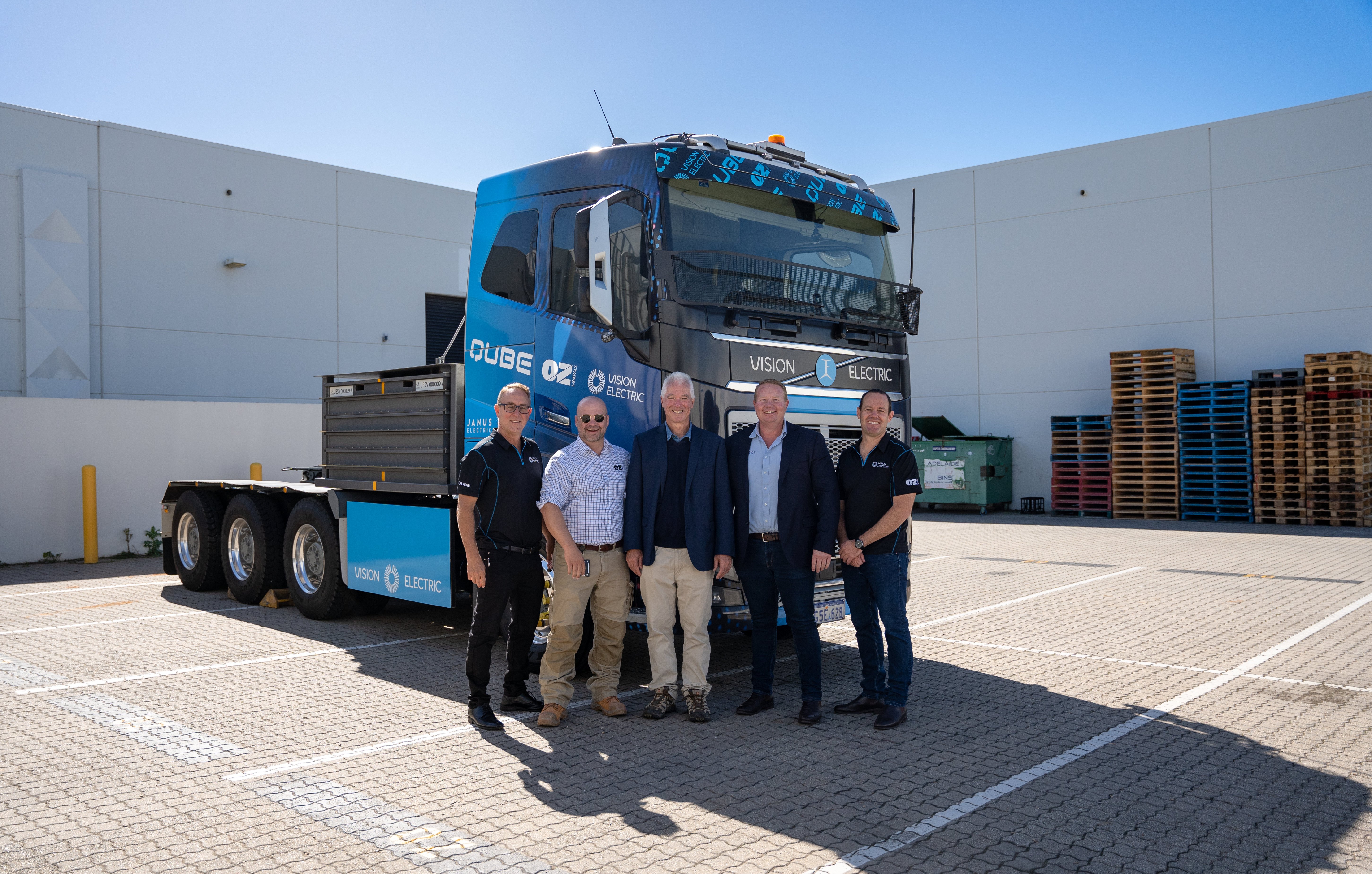
Semi trailer engines are typically replaced every five years in Australia. So, on average, 20% of the fleet could be electrified each year. Theoretically, Australia’s 128,000 articulated heavy trucks could be transitioned within 5 years, not decades as opponents proclaim. Janus notes that a conversion to electric is cheaper than the purchase price of new diesel truck.
The maths is compelling. Heavy freight vehicles consume around 30% of the 32 billion litres of diesel that Australia imports each year. The national security argument is also compelling. Diesel supply chains are fragile, exposed to geopolitical disruptions and global oil price shocks. The future is obvious — road freight is expected to grow 35% by 2040.
“Electrifying heavy freight is often assumed to require replacing entire fleets of trucks, which would take decades and be prohibitively expensive,” Mr Hutt, Chief Executive Officer of Janus Electric, said. “What this analysis shows is that if trucks were converted when diesel engines reach their normal replacement cycle, the transition could occur far faster and at significantly lower cost than many people expect.”
Janus Electric can covert a prime mover to electric in six days at a cost of AU$175,000. A diesel engine replacement would be expected to cost approximately $100,000. At present, “a new heavy-duty electric truck typically costs around two to two-and-a-half times the price of an equivalent diesel model.” So, we still have an upfront price gap, which would be recovered rapidly by the cost disparity between electricity and diesel.
Janus has already demonstrated “commercial freight operations, with more than 3,500 battery swaps completed and over 600,000 kilometres travelled by converted trucks.” Janus is developing battery swap stations that will swap out a battery in approximately four minutes. Swaps could be scheduled at the same time as driver rest periods to minimise downtime.
“The technology exists, the economic case is proven, and the strategic imperative is clear,” Mr Hutt said. “With the right policy settings, Australia could accelerate the transition and significantly reduce its reliance on imported diesel.” Janus is suggesting these three policy initiatives:
- incentives for fleet operators to convert existing trucks when engines are due for replacement
- public co-investment in battery swap infrastructure along major freight corridors including the Hume, Pacific and Nullarbor highways
- a national electrified freight corridor strategy prioritising Australia’s busiest freight routes.
According to the truck industry council, “Heavy-duty trucks and articulated vehicles (semi-trailers) are significant contributors to greenhouse gas (GHG) emissions in Australia, producing approximately 19.8 million tonnes of CO2 equivalent (Mt CO2e) annually.”
Furthermore, “While trucks account for only roughly 4% of total vehicles on the road, they are responsible for around 38% of transport emissions and consume 23% of the fuel.”
Fortescue Metals, Janus Electric, and Centurion all have the same message: The technology is here, the benefits are obvious, time to get hauling, rubber ducky!
Sign up for CleanTechnica’s Weekly Substack for Zach and Scott’s in-depth analyses and high level summaries, sign up for our daily newsletter, and follow us on Google News!
Have a tip for CleanTechnica? Want to advertise? Want to suggest a guest for our CleanTech Talk podcast? Contact us here.
Sign up for our daily newsletter for 15 new cleantech stories a day. Or sign up for our weekly one on top stories of the week if daily is too frequent.
CleanTechnica uses affiliate links. See our policy here.
CleanTechnica’s Comment Policy
cleantechnica.com
#Battery #Electric #Trucks #Australian #Roads


