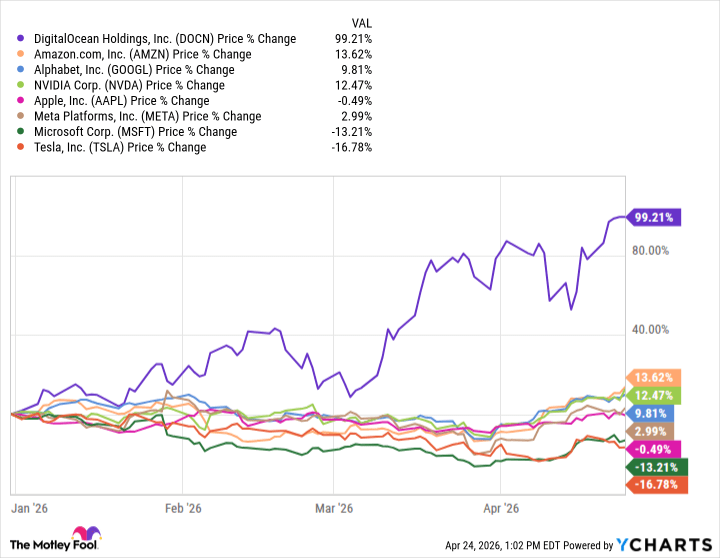
The “Magnificent Seven” moniker was coined by Wall Street in 2023 to describe a group of seven powerhouse technology companies. They are known for consistently producing better returns than the rest of the market thanks to their dominance in industries like consumer hardware, enterprise software, cloud computing, and artificial intelligence (AI).
But the Magnificent Seven stocks are off to a rough start to 2026, with just three of them outperforming the S&P 500 index so far. In fact, they are being crushed by a tiny stock called DigitalOcean(NYSE: DOCN), which has doubled this year already.
Will AI create the world’s first trillionaire? Our team just released a report on the one little-known company, called an “Indispensable Monopoly” providing the critical technology Nvidia and Intel both need. Continue »
You might be wondering why I’m comparing a $10 billion minnow like DigitalOcean to an elite group of trillion-dollar giants. It’s because DigitalOcean technically competes with Magnificent Seven companies like Microsoft, Alphabet (Google), and Amazon in the cloud computing business. It offers a growing portfolio of AI tools and services, which are supercharging its revenue growth, so here’s why its stock probably isn’t done going higher.
Image source: Getty Images.
Betting big on AI
Amazon Web Services, Microsoft Azure, and Google Cloud dominate the cloud industry, but they typically go after the largest customers with the highest spending potential. Acquiring small and medium-sized business (SMB) customers won’t have a big impact on their revenue, so they don’t target them as aggressively.
DigitalOcean, on the other hand, exclusively works with start-ups and SMBs. It offers them affordable and transparent pricing, highly personalized service, and a simple dashboard that makes deploying cloud tools easy, even without in-house technical staff. Now, the company is applying the same blueprint to help its clients tap into the power of AI.
DigitalOcean operates data centers equipped with advanced graphics processing units (GPUs) from Nvidia and Advanced Micro Devices, which are the primary chips used in AI development. It rents computing capacity to its SMB customers, allowing them to start with just one chip and scale as needed, which is ideal for small AI workloads, such as running Web-based customer service chatbots.
DigitalOcean says its data center computing capacity is up to 75% cheaper to rent than the equivalent infrastructure from hyperscale cloud providers, so demand is through the roof. In fact, the company raised $800 million from investors in March to fund the construction of more data centers.
Accelerating revenue growth thanks to AI
DigitalOcean’s total revenue grew 15% to $901 million in 2025. But in the fourth quarter, the company reported $120 million in annual run-rate revenue (ARR) from its AI products, specifically, which soared by an eye-popping 150% year over year.
Although DigitalOcean has over 650,000 customers, a small group of 21,000 so-called “digital native enterprises” (DNEs) account for roughly 62% of its annualized revenue. These are technology-first businesses that use tools like AI to scale much faster than traditional SMBs, making them more likely to become very high spenders over time.
During Q4, revenue from DNEs spending at least $500,000 annually with DigitalOcean grew by 97%, and revenue from those spending at least $1 million annually soared by a whopping 123%.
Demand for AI data centers is heavily outstripping supply, so DigitalOcean will attract more of these DNEs as it brings new infrastructure online. That’s why management expects the company’s overall revenue growth to accelerate to 21% in 2026 and then to 30% in 2027.
DigitalOcean stock might still be cheap
Despite the blistering gains in DigitalOcean stock of late, it still looks attractively valued. It’s trading at a price-to-sales (P/S) ratio of 11.1 as I write this, which is above its long-term average of 8.1, but the picture looks very different on a forward basis.
If the company grows in line with management’s expectations, it will deliver around $1.4 billion in revenue during 2027, placing its stock at a forward P/S ratio of just 6.9.
DigitalOcean stock would have to climb by 17% before the end of next year in order for its P/S ratio to trade in line with its long-term average of 8.1. But it would have to soar by 61% to maintain its current P/S ratio of 11.1, which I think is more likely given the company’s significant AI-driven momentum.
Therefore, investors seeking cloud and AI exposure beyond the Magnificent Seven might want to consider adding this up-and-coming powerhouse to their portfolio.
Should you buy stock in DigitalOcean right now?
Before you buy stock in DigitalOcean, consider this:
The Motley Fool Stock Advisor analyst team just identified what they believe are the 10 best stocks for investors to buy now… and DigitalOcean wasn’t one of them. The 10 stocks that made the cut could produce monster returns in the coming years.
Consider when Netflix made this list on December 17, 2004… if you invested $1,000 at the time of our recommendation, you’d have $498,522!* Or when Nvidia made this list on April 15, 2005… if you invested $1,000 at the time of our recommendation, you’d have $1,276,807!*
Now, it’s worth noting Stock Advisor’s total average return is 983% — a market-crushing outperformance compared to 200% for the S&P 500. Don’t miss the latest top 10 list, available with Stock Advisor, and join an investing community built by individual investors for individual investors.
Anthony Di Pizio has no position in any of the stocks mentioned. The Motley Fool has positions in and recommends Advanced Micro Devices, Alphabet, Amazon, Apple, DigitalOcean, Meta Platforms, Microsoft, Nvidia, and Tesla. The Motley Fool has a disclosure policy.
Analyst Report: EOG Resources, Inc. finance.yahoo.com #Analyst #Report #EOG #ResourcesContentsBetting big on AIAccelerating revenue growth thanks to AIDigitalOcean stock might…