Some people say artificial intelligence has gone too far.
For example, AI can now create realistic images and audio known as “deepfakes” that fool the public, chatbots can store information from “conversations” with users (1), and 80% of surveyed Gen Zers reported that they would marry an AI (2).
Must Read
But Larry Fink, billionaire CEO of BlackRock [NYSE:BLK], argues that AI hasn’t gone far enough. He believes that AI is the future, and he’s putting his money where his mouth is.
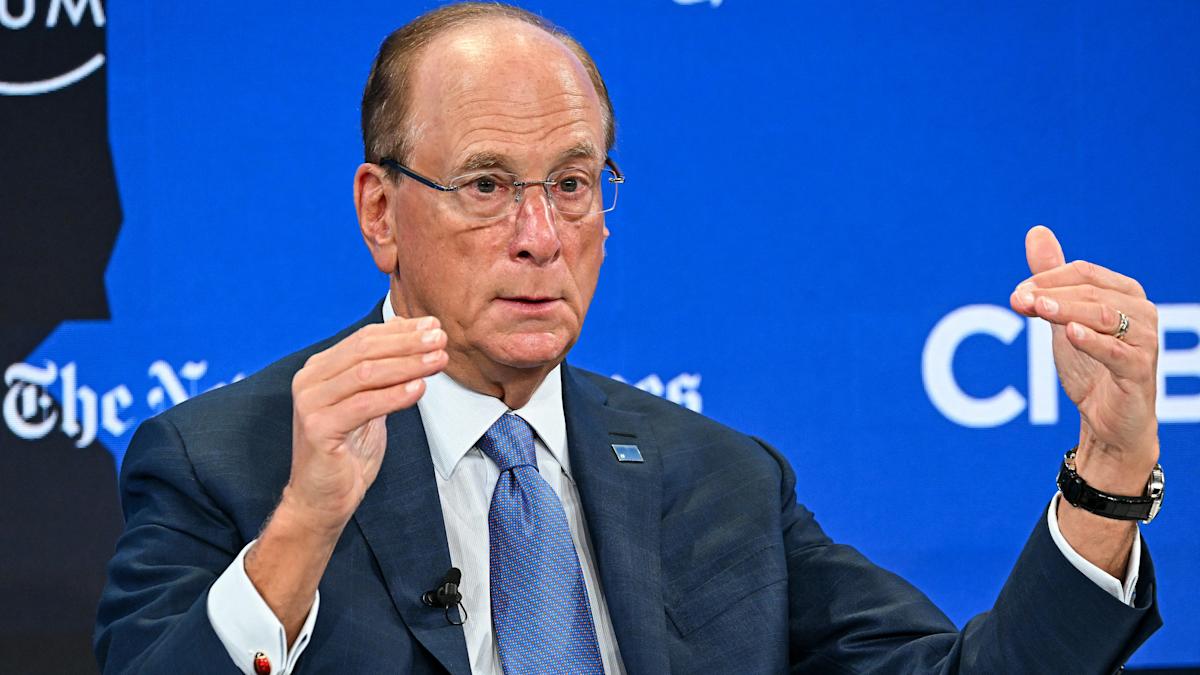
“I don’t believe we’re moving fast enough,” Fink said at the Milken Institute Global Conference on May 5, according to Business Insider (3). “There is not an AI bubble. There is the opposite.”
BlackRock is all-in on AI
At the Milken conference, Fink announced that BlackRock will partner with a hyperscaler to expand on AI infrastructure, including building data centers and investing in energy. Fink has not yet revealed the name of the hyperscaler, and BlackRock reportedly hasn’t responded to Business Insider’s request for comment.
Fink is a known AI advocate, and BlackRock has a history of investing in AI infrastructure. In 2024, the asset management giant acquired private market asset manager Global Infrastructure Partners for $12.5 billion (4).
In March 2025, BlackRock and Global Infrastructure Partners joined forces with MGX, Microsoft [NASDAQ:MSFT], Nvidia and xAI to invest in data centers (5).
“AI infrastructure will play an increasingly critical role in driving economic growth across every industry and every region of the world,” Satya Nadella, chairman and CEO of Microsoft, said in the BlackRock press release (6). “We’re thrilled to welcome these new companies to the AI Infrastructure Partnership as we invest together to build the infrastructure of the future (7).”
Are we experiencing an AI bubble?
Fink’s words — and actions — express that he does not believe in an AI bubble and that he’s not worried about such a bubble popping. But many investors and industry experts disagree with his stance.
Four tech hyperscalers — Alphabet, Amazon, Meta and Microsoft — plan to spend more than $650 billion on AI in 2026 (8). But OpenAI has reported $25 billion in annualized revenue (9), while Anthropic claims its annualized revenue run rate is over $30 billion (10).
That’s quite the gap in planned spending versus revenue.
Ganesh Sitaraman, director of the Vanderbilt Policy Accelerator, and Asad Ramzanali, the director of artificial intelligence & technology policy at the Accelerator, wrote an article for Time Magazine on the inevitability of the AI bubble bursting (11).
Read More: This $1B private real estate fund is now accessible to non-millionaires. Start investing with just $10
In the article, they explain that these big tech companies are not only putting their own cash toward these investments, but are also tapping into capital from equity investments, issuing corporate bonds, using asset-backed securities and more.
What does this boil down to for everyday Americans?
“If you use banks, have a retirement account, or depend on the financial system in any way, you too are bearing some of the risk,” Sitaraman and Ramzanali wrote. “Your 401(k), life insurance plan, pension plan, and bank provide much of the money that turns into loans or investments in each of those financial mechanisms.”
What happens to your portfolio if Fink is wrong?
We’ve covered some of the ways AI may have taken things “too far.” But AI is also involved in overcoming significant problems in the world.
For example, the U.S. Food and Drug Administration has approved the use of AI in ultrasounds to more accurately predict babies’ delivery dates, which leads to safer births (12). AI can also protect medical professionals from dangerous substances by using ultraviolet robots to clean and disinfect hospital rooms.
This means investing in certain AI stocks could help propel this helpful technology forward.
However, as with any sector, the trick is to not invest too much of your portfolio in AI. If you carry some AI stocks, then you’re in a good position if Fink ends up being correct about there being no AI bubble to pop. And if an AI bubble does pop, you won’t lose your whole retirement fund.
It’s crucial to diversify your portfolio by investing in multiple sectors. Buying AI and tech stocks may be fine, but you should also consider financials, healthcare, communication services and more.
Speaking with a financial advisor will help you make wise investing decisions that don’t keep you up at night, fretting about a possible AI bubble burst.
You May Also Like
Join 250,000+ readers and get Moneywise’s best stories and exclusive interviews first — clear insights curated and delivered weekly. Subscribe now.
Article Sources
We rely only on vetted sources and credible third-party reporting. For details, see our ethics and guidelines.
Stanford Institute for Human-Centered Artificial Intelligence (1); Forbes (2); Business Insider (3); Reuters (4); BlackRock (5),(6),(7); Yahoo Finance (8); The Information (9); Bloomberg (10); Time (11); Contemporary OB/GYN (12).
This article originally appeared on Moneywise.com under the title: Larry Fink says there’s the ‘opposite’ of an AI bubble, and the world isn’t ‘moving fast enough’ on AI infrastructure
This article provides information only and should not be construed as advice. It is provided without warranty of any kind.