

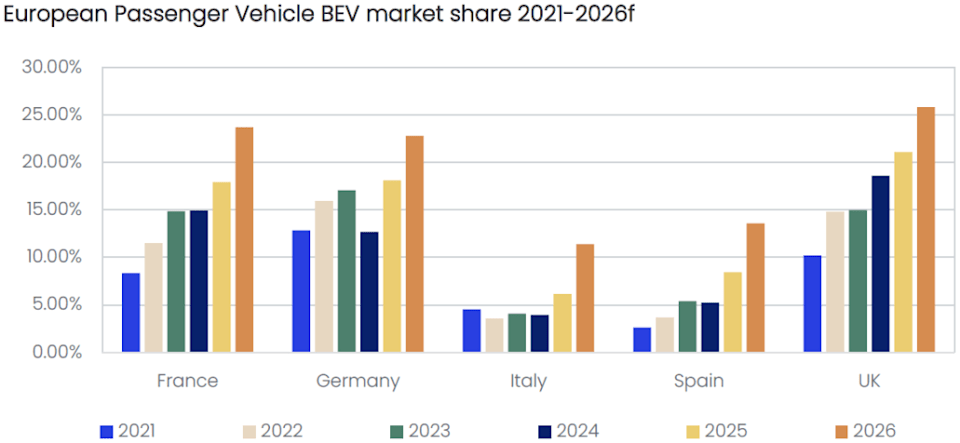
Europe has established a policy framework to electrify its car market and curb its reliance on imported energy, and on the first count, it is delivering. In 2025, a fifth of all vehicles sold in Europe were electric, while 2026 is forecast to end closer to a quarter. March provided the clearest signal yet as Battery Electric Vehicles (BEVs) outsold Internal Combustion Engines (ICEs) in Germany for the first time, while in Italy, a traditionally ICE-heavy market, BEV sales grew by 66% in Q1 to reach an 18% market share. The picture across Europe’s five largest markets shows how broad the shift has become.

However, the transition is also delivering another result at the same time: the OEMs best positioned to meet this new demand are not the ones the framework was designed to protect. Under the EU’s fleet emissions system, manufacturers that miss their CO2 target must either pay fines or pool with over-compliant peers to effectively borrow their surplus compliance. BYD Auto is now the most over-compliant major automaker in Europe, with emissions well below the EU target, while in contrast, Volkswagen’s pool remains above target and has the largest gap of any major manufacturer. Nissan already joined with BYD in 2025, rather than risk fines. If these gaps persist, others are likely to follow, leaving European carmakers paying Chinese competitors for the right to keep selling cars in Europe.
Part of this is structural: BYD only builds Electric Vehicles (EVs) and Plug-in Hybrid Electric Vehicles (PHEVs), making compliance far more automatic than it is for manufacturers that are still reliant on profitable ICE fleets. But that structural advantage is itself the product of a decade of Chinese industrial policy that Europe chose not to match, and there is little sign it is narrowing: Chinese OEMs are scaling faster than European OEMs can transition. In February 2026, BYD had broken into the top three EV brands in Europe, behind Volkswagen and BMW. In effect, the regulatory system designed to force a European EV transition is rewarding the manufacturers best able to supply affordable EVs and those are increasingly Chinese.
The Iran war is sharpening this dynamic. March’s record BEV figures already partly reflect the consumer response to higher petrol prices: online EV enquiry platforms reported rising interest across Europe as energy prices soared. However, registration pipelines are long. Vehicles registered in March were largely ordered weeks or months earlier, so the full demand-side impact is likely to show up more clearly in Q2 and Q3 data. The real question now is not whether the oil shock will accelerate electrification, but rather who will be the ones to capture the incremental demand. Based on current trends, a meaningful share will go to Chinese OEMs—either directly through imports, which have continued to rise despite EU tariffs, or through Chinese-localized production now coming online, including plants in Hungary. Meanwhile, Volkswagen has announced roughly 50,000 job cuts by 2030, citing transition costs alongside a weakening position in China and the US. European OEMs are being forced to finance an expensive structural shift from a deteriorating financial base, competing against firms that entered the European market on commercial terms rather than under the regulatory pressure that created it. Projected out to 2030, the resulting redistribution of market share is striking.

finance.yahoo.com
#Iran #war #driving #Europe #Chinese #EVs


