Amazon (AMZN) just completed a massive new deal, and Goldman Sachs thinks investors need to see the bigger picture.
For perspective, Amazon has entered into an agreement to acquire Globalstar, allowing Amazon Leo to offer direct-to-device (D2D) services to its low Earth orbit satellite network and extend cellular coverage for customers in remote locations, a company press release shared. Amazon and Apple also confirmed their agreement, which will enable Amazon Leo to power satellite services for some Apple devices.
Following the news, Goldman reiterated its buy rating and left its 12-month price target for Amazon stock at $275. With shares of the e-commerce giant trading at $249.02 in the report, that points to a 10.4% upside from current levels.
Instead of treating it as a one-off M&A headline, Goldman Sachs views the move as a major play in satellite-based connectivity, and a warning shot to rivals.
Amazon has already dropped more than $100 billion into its satellite effort, Leo, formerly known as Project Kuiper.
The firm argues that the AI behemoth is marching toward commercialization, with the Globalstar deal giving it access to even more assets, more spectrum, and a stickier partnership with Apple.
The development adds to the tremendous head of steam Amazon stock’s been building of late.
Amazon stock has outperformed the broader market, gaining 16.4% over the past month and 17.6% over the past six months.
Project Leo is Amazon’s attempt at building a satellite network that essentially works like a cell tower in the sky.
That’s huge because it brings in customers who previously couldn’t access traditional networks and puts them into the ecosystem.
This proverbial “internet bridge” can reach rural users, businesses, and governments that are typically outside normal coverage areas.
More AI Stocks:
Globalstar’s acquisition speeds these efforts and then some, feeding into Amazon’s broader strategy in connecting to Amazon Web Services (AWS). That would enable customers to push satellite data straight into storage, AI tools, analytics, and a whole host of other stuff.
For perspective, Amazon’s cloud service generated $35.6 billion in sales out of the company-wide total at $213.4 billion in Q4 2025 (16.7% of total sales).
Separately, Synergy Research Group said AWS held a 28% share of the global cloud infrastructure market in the same quarter, keeping its lead over Microsoft and Google.
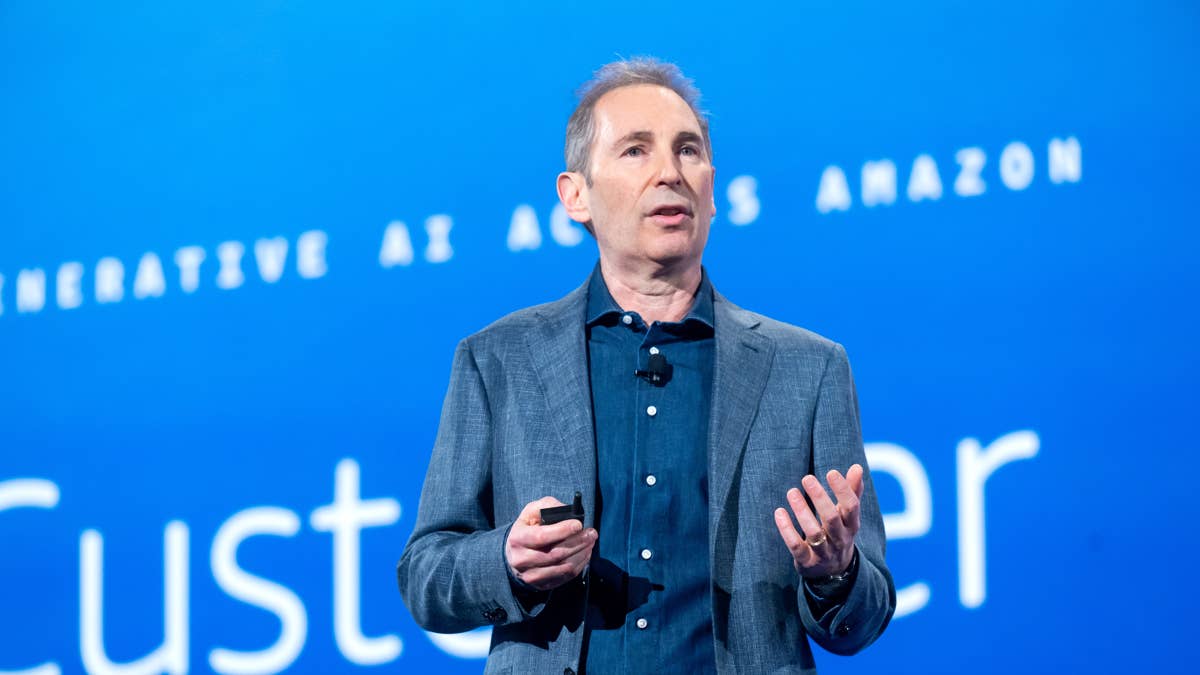
Amazon will acquire Globalstar and expand its Apple satellite partnership. Noah Berger/Getty Images
Amazon’s Globalstar deal looks incredibly smart on paper, but it isn’t a slam dunk.
Here’s what could go wrong.
The biggest problem is still the launch cadence. Amazon has launched just 243 of the 3,236 satellites it proposed, so the purchase alone doesn’t solve the bottleneck.
The price tag is a big issue, as the deal’s valuation sits at nearly 40 times 2026 sales for a capital-intensive business.
Amazon is planning roughly $200 billion in 2026 capex, according to CNBC, mostly attributable to AWS and AI, adding another pricey project to a packed spending cycle.
The classic deal risks remain, including litigation, regulatory approvals, and unknown liabilities, which could delay closing.
Amazon will buy Globalstar for $90 per share in a mix of cash and stock in a $11.57 billion deal, according to Reuters, granting access to the latter company’s powerful satellite assets, infrastructure, and spectrum portfolio.
It covers Globalstar’s existing mobile satellite services (MSS) spectrum licenses, as well as its non-geostationary orbit (MGSO) and direct-to-device (D2D)-capable satellites.
The Apple piece is equally, if not more, important.
With the acquisition, Amazon will assume its current agreement with Apple, powering Emergency SOS on iPhone 14 or later and Apple Watch Ultra 3, the press release shared.
In addition, it will enter into an expanded agreement, under which Amazon Leo will offer satellite services for Apple devices going forward.
That gives Amazon a live use case with a blue-chip partner, paving the way for other companies of similar scale to follow suit.
The positives are straightforward.
Amazon buys a shortcut by scooping up scarce spectrum, an operating low-Earth-orbit network, and live D2D capability, along with other infrastructure that will power Leo’s rollout of its mobile service by 2028.
Amazon can expand its reach beyond traditional wireless coverage, opening the door to more voice, text, and data services.
Project Leo aligns with Amazon’s broader AWS strategy, effectively de-risking spectrum rights, supercharging plans, and improving returns on the constellation.
Wall Street’s consensus on Amazon stock remains bullish, with analysts assigning an average price target of of $281.18, which implies an 12.22% upside from current levels.
The broader range suggests both optimism and caution, with a high target of $360 and a low of $175.
In addition, Amazon stock trades at 32.4 times forward earnings, roughly 100% above the sector median, according to Seeking Alpha. Historically, such elevated valuations are not new, and compared to its five-year average, the stock is trading at a 34% discount.
ContentsCompany: Appian Corp. (APPN)Activist: Fivespan PartnersWhat’s happeningBehind the scenes We recently published 12 Stocks Jim Cramer Discussed As He Said…