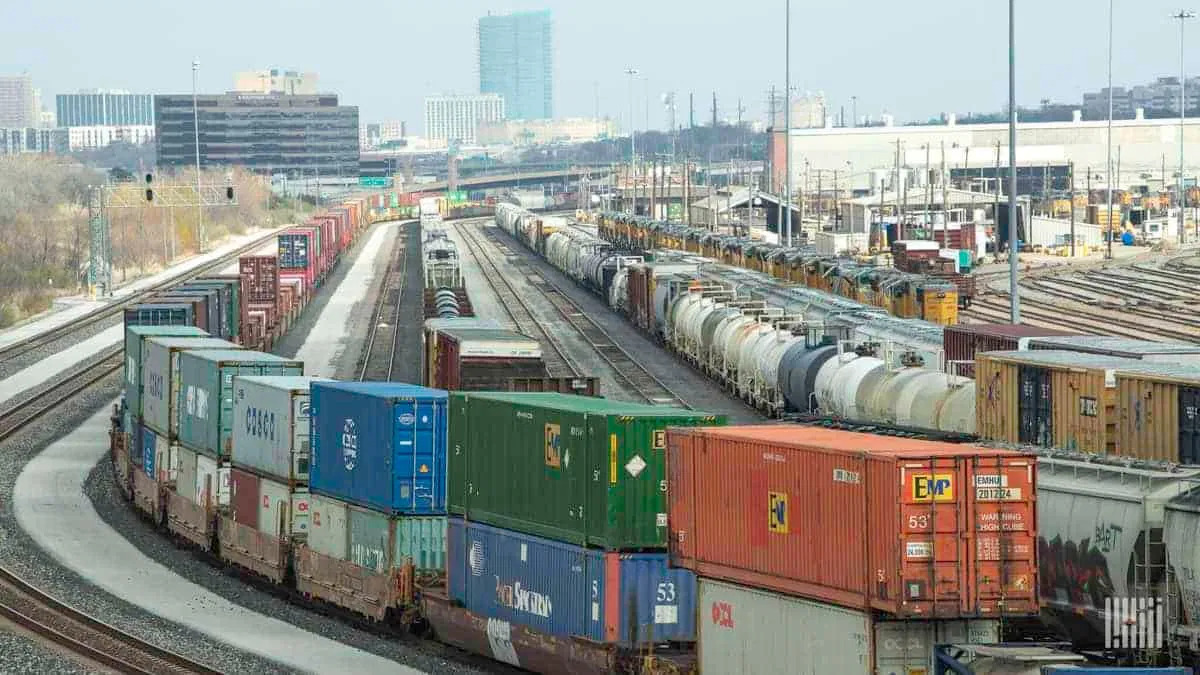
Data from U.S. railroads in March signaled that the goods economy is finding solid footing after an extended period of uneven performance.
A broad recovery takes shape
Analysis by the Association of American Railroads showed March 2026 delivered the strongest monthly performance for U.S. freight rail in years. Total U.S. rail carloads averaged 230,401 per week, representing the highest March result since 2019 and the strongest monthly average since October 2022. Year-over-year, carloads rose 1.7%, marking the third consecutive month of gains and extending a recovery trend that began at the start of the year.
First quarter carloads reached 2.68 million units, climbing 4.2% from the same period a year ago. It’s the strongest first-quarter performance since 2019, suggesting that the improvement in rail volumes is not a temporary blip but rather a sustained shift in underlying economic activity.
Broad improvement saw 12 of the 20 major carload categories post year-over-year gains in March, continuing a pattern established in January. This widespread improvement indicates that the goods economy is stabilizing across multiple sectors simultaneously, rather than experiencing isolated rebounds driven by temporary restocking or concentrated activity in a single industry.
Intermodal, linking U.S. consumers and global supply chains, demonstrated renewed strength in March. Originations averaged 280,076 units per week, the second-highest March level on record and a 1.4% increase y/y. It also was the second consecutive monthly increase for intermodal traffic after an extended lull.
While year-to-date intermodal volumes remain slightly below last year’s unusually strong levels, March’s improvement highlights the resilience of consumer-linked freight flows. The intermodal network continues to play an essential role in long-haul domestic logistics, and the easing of downside pressure suggests that the extended normalization period following pandemic-era disruptions may finally be drawing to a close.
Grain emerged as the single largest contributor to March’s volume growth. U.S. railroads originated more than 97,000 carloads, a 10.3% increase over March 2025. First-quarter volumes reached their highest level for any first quarter since 1993, driven by robust export demand and steady global consumption despite the off-and-on changes in U.S. tariff policy. Grain mill products climbed 6.2%, with biofuel production playing a central role in driving grain processing, supporting rural investment and generating rail-dependent co-products that move over long distances.
Chemical shipments continued to outperform, reaching a record weekly average of 35,580 carloads in March, up 5.5% year-over-year. First-quarter volumes set a new record as producers benefited from domestic natural gas prices that provide both energy and feedstock. As global manufacturers reassess their supply chain strategies, chemicals moving by rail point to sustained domestic production capacity and strong export demand.
Petroleum and petroleum improved by 7.7%; waste and nonferrous scrap recorded one of the strongest percentage gains at 12.6%. Coke shipments similarly surged, increasing 12.3%, while motor vehicles and parts added 2.6%. Stone, clay, and glass products gained 2.7%, and iron and steel scrap rose 2.6%, continuing the steady transition toward electric-arc furnace steelmaking that relies more heavily on recycled inputs. Food products increased 1.3%; lumber and wood products edged up 1.4%, while farm products excluding grain gained 1.3%.
Not all categories shared in the recovery. Primary metal products declined 8.7%, reflecting reduced long-haul movements tied to sharply lower steel imports rather than a fundamental deterioration in domestic industrial activity.
Metallic ores fell 12% consistent with shifts in domestic steel production patterns. Crushed stone and sand declined 3.8%; pulp and paper products retreated 4.6%, and primary forest products dropped 6.9%. Carloads not elsewhere classified fell 3.3% while nonmetallic minerals slipped 1.9%.
Coal remained the largest drag on total carloads but displayed signs of stabilization. March loadings totaled 236,000 carloads, down 1.5% y/y. However, average weekly volumes reached their highest level in six months, and year-to-date coal volumes are actually up 3.3% compared to the same period last year. Coal accounted for 16.6% of U.S. electricity generation in 2025, and rail continues to move more than 70% of coal shipments.
In March, carloads excluding coal averaged 171,338 per week, the strongest March level since 2008 and the highest monthly level since August 2019. The year-over-year increase reached 2.9%. Year-to-date volumes are up 4.5% and stand at their highest level since 2015. These numbers point to genuine stabilization and renewed momentum, conditions that typically precede economic expansions rather than contractions.
The AAR Freight Rail Index, which captures rail traffic most sensitive to broader economic conditions, provides insight for understanding whether current momentum reflects cyclical fluctuations or structural improvement.
The index edged down 0.3% in March after two months of gains. On the surface, this pullback might appear concerning. In context, however, it remains constructive. Average FRI levels during the first quarter reached their highest point in nearly five years, consistent with steady expansion in freight-intensive sectors such as manufacturing, construction inputs, and export-oriented production.
Short-term volatility in the index often reflects timing effects or weather-related shifts rather than meaningful changes in direction. Viewed as a leading indicator, the FRI suggests that the recovery in rail traffic is not backward-looking. Instead, it reflects activity still working its way through production pipelines and supply chains.
The AAR said that the rail recovery unfolds against a complex macroeconomic backdrop that offers both support and potential headwinds.
Manufacturing indicators have turned decisively positive. Output rose 1.3% year-over-year in February, and the ISM Manufacturing PMI reached 52.7% in March, its highest reading in more than three years. The PMI has now remained above the 50% expansion threshold for three consecutive months, signaling a return to growth after two years of uneven output. If sustained, AAR said, this manufacturing recovery would provide broad-based support for rail across multiple commodity groups.
The service sector remains solid, reinforcing demand through consumer and business activity critical for intermodal and finished goods movements.
However, significant risks remain on the horizon. Inflation continues to run above the Federal Reserve’s target, creating uncertainty about the path of monetary policy. Renewed geopolitical tensions, particularly in the Middle East amid an ongoing war with Iran, have reintroduced volatility into energy markets. Rising diesel prices feed directly into supply chains, creating cost pressure even when volumes improve.
Natural gas prices experienced a spike in late January and early February when an intense Arctic storm drove U.S. heating demand sharply higher at the same time that widespread wellhead and gathering-system freeze-offs knocked a significant portion of U.S. natural gas production offline. The combination of surging demand and temporarily-curtailed supply kept prices elevated into early February, when temperatures moderated and production recovered. Notably, unlike gasoline and diesel prices, U.S. natural gas prices did not spike in March, preserving the competitive advantage of domestic chemical producers.
Labor market signals present an increasingly mixed picture. Job growth has oscillated between gains and losses over the past year, with March’s preliminary 178,000 job increase following a sharp February decline. Unemployment edged lower, and layoffs remain low, pointing to moderation rather than deterioration. Wage growth continues to support consumer spending, but a prolonged period of flat employment could eventually weigh on goods demand.
Consumer spending has held up despite challenges, though growth remains modest and goods spending has softened relative to services. For rail, any sustained slowdown in consumer activity would likely surface first in intermodal volumes.
Rail traffic in March 2026 delivered a clear message: the freight economy has regained momentum, and that momentum is broad rather than fragile. Volumes are improving even as inflation, energy costs, and labor dynamics remain unresolved, pointing to an economy that is rebalancing rather than either overheating or stalling.
The combination of record chemical shipments, the strongest grain volumes since the early 1990s, and carloads excluding coal reaching levels not seen since 2008 paints a picture of genuine improvement across the industrial and agricultural sectors. Intermodal’s return to growth suggests that consumer-linked supply chains are stabilizing after an extended normalization period.
Yet the data also signal discipline. Growth is visible but conditional, shaped by energy markets that remain sensitive to geopolitical risk, inflation dynamics that have proven stubbornly persistent, and labor trends still in flux. Railroads sit at the intersection of production, trade, and energy, and March demonstrated that this intersection has become noticeably busier.
As these macroeconomic forces continue to evolve, rail traffic will remain one of the clearest early indicators of whether growth is truly firming or merely pausing before the next challenge emerges. For now, the numbers point to an economy finding its footing, even if the margin for error remains thin.
Subscribe to FreightWaves’ Rail e-newsletter and get the latest insights on rail freight right in your inbox.
Read more articles by Stuart Chirls here.
Related coverage:
Maryland Senate expects to pass two-person train crew bill
APM Terminals wraps up $73M rail expansion at Port of Los Angeles
Rail jobs at lowest level since 2022: BLS
Mercedes-Benz sets $4B investment in plant served by Norfolk Southern
The post Best month in years marks broad US rail recovery appeared first on FreightWaves.