


Fifteen families were evacuated after a multi-storeyed building developed cracks in the Chalaunthi area of Shimla on Friday night, officials said.
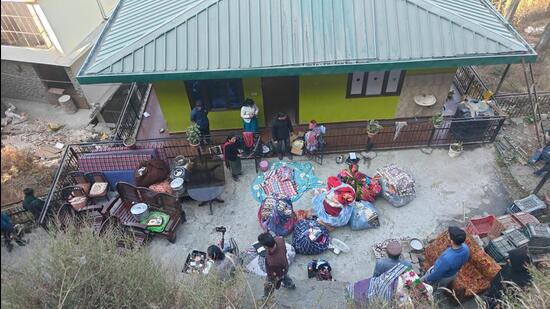
The evacuation began around 10pm when the cracks in the building’s walls suddenly widened, triggering panic among residents. With no immediate alternative shelter, many families, including children and the elderly, were forced to spend several hours on the street with their belongings in freezing temperatures.
Occupants of the building claimed that minor cracks had first appeared a few days ago but worsened rapidly on Friday. Residents have alleged that ongoing four-lane road construction in the vicinity is the primary cause of the damage, suggesting that heavy excavation and vibrations have destabilised the hillside.
State panchayati raj minister Anirudh Singh visited the site on Saturday morning to assess the damage. He directed the district administration to ensure the safety of the perimeter and confirmed that temporary lodging and food arrangements have been made for the affected families.
“The administration and concerned officials are present on the ground. Those who have suffered losses must be fairly compensated,” he told reporters. He added that an inquiry would be conducted to determine if construction activities had contributed to the structural failure.
A similar incident occurred less than 3km away at Mathu Colony in Shimla’s Bhattakufar area that led to a five-storeyed residential building collapsing following heavy rain on June 30, 2025. While the building had been evacuated hours earlier, residents blamed deep excavation by National Highway Authority of India contractors for rendering the foundation untenable.
On November 22, 2025, a 15-ft deep sinkhole opened up on the Dhalli-Bypass road at Bhattakufar. A Class 8 student narrowly escaped death after falling into the pit while boarding a bus.
At the root of the current crisis is the 2.5-km twin-tube tunnel being bored between Bhattakufar and Sanjauli. A December 2025 report by the Geological Survey of India (GSI) cited that vibrations from heavy blasting, coupled with existing leakages in water pipelines, have created cavities in the fragile phyllite rock mass. Following the GSI’s findings and the November road collapse, Shimla deputy commissioner Anupam Kashyap ordered an indefinite halt to all blasting and excavation work. The blasting permission for the executing firm was revoked, and a criminal case for negligence was registered against the contractors.
The incident has again highlighted the geological vulnerability of Shimla, which sits in seismic zone V.
Meanwhile, experts from the public works department (PWD) are conducting a stability audit to decide if the structure is fit for habitation or if it poses a risk to neighbouring buildings and the road below.
www.hindustantimes.com
#families #evacuated #multistoreyed #building #develops #cracks #Shimla


