



 BBC
BBCRuth Clegg,Health and wellbeing reporterand
Holly Jennings
“It’s like a switch that goes on and you’re instantly starving.”
Tanya Hall has tried to stop taking weight loss medication multiple times. But every time she stops the injections, the food noise comes back. Loudly.
Weight loss jabs, or GLP-1s, have done for many what diets could never do. That constant background hum, telling them to eat even when they are full, has been turned off.
The drugs have given those who never thought they could lose weight a new body shape, a new outlook and in many cases, a completely different life.
But you can’t continue taking them forever, can you? Or can you? Well, that’s one of the issues, no-one quite knows.
They are new drugs – which mimic GLP-1, a natural hormone that regulates hunger – and the potential side effects from using them in the long term are only just beginning to emerge.
And with an estimated 1.5 million people in the UK paying for the injections privately, staying on them for a long time is not a cheap endeavour.
So what happens when you try to stop? Two women, with two very different stories but the same goal – to lose weight and keep it off – tell us what it’s been like for them.
 Tanya Hall
“It was like something opened up in my mind and said: ‘Eat everything, go on, you deserve it because you haven’t eaten anything for so long’.”
Tanya, a sales manager for a large fitness company, first started taking Wegovy to prove a point. She was overweight, felt like an “imposter” and thought her opinion was not valued by her industry because of her size.
Would she be taken more seriously if she were slimmer?
Ultimately, she says her suspicions were proved right. After she started using the jabs, people would come up to her and congratulate her on her weight loss. She felt she was treated with more respect.
However, during the first few months of the treatment, Tanya struggled to sleep, felt sick all the time, had headaches and even started to lose her hair, which might not be directly due to the drug but is a potential side effect of rapid weight loss.
“My hair was falling out in clumps,” she recalls. But in terms of weight, she was getting the results she’d hoped for. “I’d lost about three and a half stone.”
Now, more than 18 months down the line, what started as a bit of an experiment has turned into a complete life change. She’s lost six stone (38kg) and she’s tried to come off Wegovy several times.
But each time, within just a few days, she says she eats so much food she’s left “completely horrified”.
Should she stay on the medication, and live with all the side effects that come with it, or jump into the unknown?
Wegovy’s manufacturer, Novo Nordisk, said that treatment decisions should be made together with a healthcare provider and that “side effects should be taken into account as part of this”.
Stopping weight loss drugs can feel like “jumping off a cliff”, observes lifestyle GP Dr Hussain Al-Zubaidi.
“I often see patients who will come off it when they’re on the highest dose because they’ve reached their target and then they stop.”
According to Dr Al-Zubaidi, that can be like being hit by an “avalanche or a tsunami”. The food noise comes back as quickly as the next day.
He says the evidence so far suggests that, between one and three years after stopping the medication, people will see a “significant proportion of weight” go back on.
“Somewhere in the region of 60 to 80% of the weight that you lost will return.”
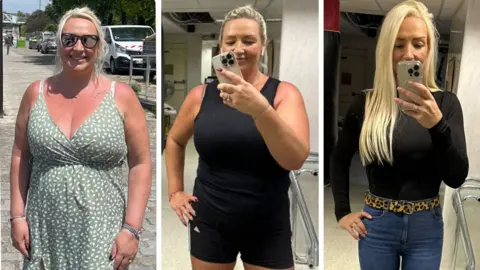
Ellen Ogley is determined not to let that happen. She decided to start taking weight-loss medication because she had reached a “key turning point” in her life. She was so overweight she had to sign a waiver to say she might not make it through a vital operation.
Starting on Mounjaro was her “final shot to get it right”, she says.
“I was an emotional binge eater,” she says.
“If I was happy, I would binge. If I was sad, I was binging. It didn’t really matter, I had no filter whatsoever.”
But when she started using the jabs, “all that switched off”.

Life without food noise gave Ellen the space to redesign her relationship with eating. She started to read up on nutrition and create a healthy diet that helped fuel her body.
She was on the medication for 16 weeks before she began to taper, cutting down over a period of six weeks. She lost 3st 7lb (22kg).
As she lost more weight, she found she could exercise more and when she was feeling “low”, instead of “going to to the cupboards and filling my face”, she would go for a run.
But when Ellen stopped taking Mounjaro, she began to see her weight creep up, which she says “messed my head up a little bit”.
This is why the right support is crucial, Dr Al-Zubaidi says. The UK’s medicine watchdog, Nice, has recommended that patients receive at least a year of ongoing advice and tailored action plans after they’ve stopped treatment, helping them to make practical changes to their lives so they can keep the weight off and most importantly, stay healthy.
But for those who pay for the drugs privately, like Tanya and Ellen, this kind of support is not always guaranteed.
For the past few months, Tanya’s weight has stayed the same, and she feels the medication is having little impact. But she’s not going to come off it, she says.
She’s finally at a weight she feels comfortable with and each time she’s tried to stop, the fear of putting the weight back on quickly becomes too great and she finds a reason to go back on the medication.
“For the first 38 years of my life, I was overweight – now I’m six stone (38kg) lighter,” says Tanya.
“Therefore, there’s part of me that feels like there’s an addiction to keep it going because it makes me feel the way that I feel, it makes me feel in control.”
She stops for a second. Maybe it’s the other way round, she muses, maybe it’s the drug that controls her.
 Ellen
Ellen“It’s all about having an exit strategy,” Dr Al-Zubaidi explains. “The question is: what are these people’s experiences once they come off the injection?”
He is worried that without additional support for people making the transition, society’s unhealthy relationship with food means little will change.
“The environment that people live in needs to be one that promotes health, not weight gain.
“Obesity is not a GLP-1 deficiency,” he says.
In some respects, many people enter a game of weight-loss roulette when it comes to stopping their weight-loss medication. Factors like lifestyle, support, mindset and timing all play into how futures post-GLP-1s unfold.
Tanya is staying on the medication and is fully aware of the pros and cons of this decision.
Ellen feels that chapter has now closed. She’s lost more than eight stone (51kg) now.
“I want people to know that life after Mounjaro can be sustainable as well,” she says.
Eli Lilly, the company which makes Mounjaro, says “patient safety is Lilly’s top priority”, and that it “actively engages” in monitoring, evaluating and reporting information to regulators and prescribers.
www.bbc.com
#stop


