


- U.S. EV sales will fall by 2.1% in 2025, Cox Automotive says.
- This decade, electric car sales soared as more models hit the market and awareness grew.
- Policy whiplash put an end to that growth story in 2025. So what comes next?
This was a rocky year for the electric vehicle industry in the United States. People rushed to buy electric cars this summer and fall before the $7,500 EV tax credit expired, leading to a record third quarter in which well over 400,000 Americans bought electric cars.
Once that longstanding policy bit the dust on Sept. 30, thanks to Republicans’ “Big Beautiful Bill,” EV demand and market share in this country both dropped hard. Now we have a good sense of where electric vehicle sales will net out in 2025, courtesy of estimates from Cox Automotive out this week.
After years of incredible growth, U.S. EV sales are on track to fall slightly this year, the firm says. Preliminary data indicate that 230,000 electric cars will be sold by the close of Q4 2025, a 46% drop from Q3 and a 37% decline year-over-year. The electric share of the car market dropped to 5.7% in the quarter.
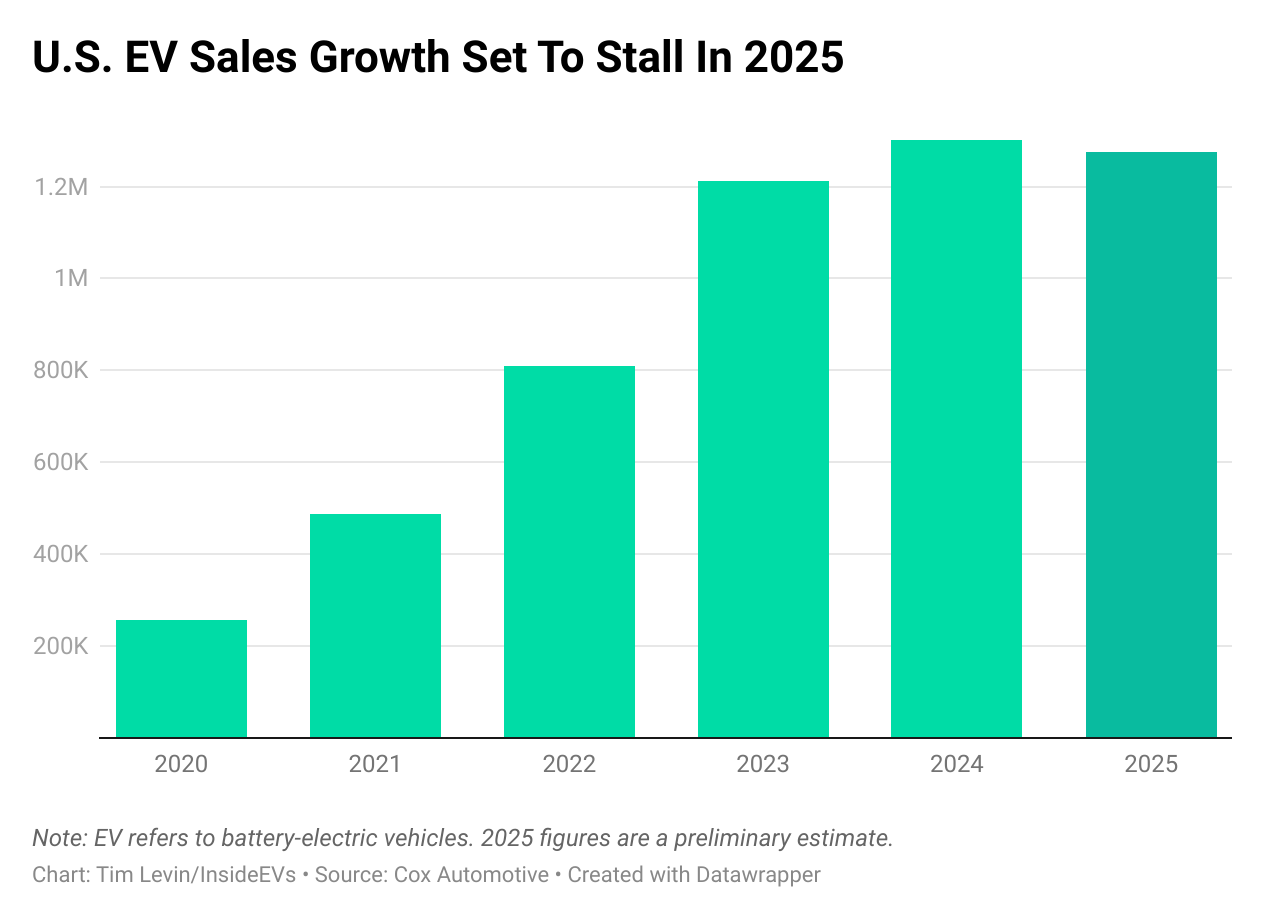
U.S. EV sales 2020-2025
Photo by: Tim Levin/InsideEVs
Last year, Americans bought a record 1.3 million electric vehicles. Cox expects that to fall 2.1% to around 1.275 million in 2025. The firm says 7.8% of all cars sold this year will be battery-electric, down from 8.1% in 2024. Meanwhile, overall vehicle sales are on pace to grow 2% this year.
“Despite Q3’s record performance, the sharp Q4 pullback resulted in an overall year-over-year decline” for EVs, Stephanie Valdez Streaty, Cox’s director of industry insights, said on a Wednesday conference call. “The year was defined by extreme volatility driven by policy changes.”
It’s not a huge drop. And maybe the situation isn’t as dark as some headlines would have you believe. But it’s a notable shift, particularly when you consider the trajectory of EV sales over the last several years. Electric car sales soared this decade, propelling them from an extremely niche technology to something verging on mainstream.

The Tesla Model 3 and Model Y juiced EV sales in the late 2010s and early 2020s.
In 2020, about a quarter-million new EVs hit the road in the United States. As more electric options came online and awareness took off, sales skyrocketed. They jumped by around 90% to 488,000 in 2021, largely on the back of the Tesla Model 3 and Model Y. Sales grew another 65% in 2022, hitting 810,000 units. Sales crossed the 1 million mark in 2023 for the first time. Last year, even as the EV industry hit speed bumps, full-year sales grew by over 7%.
Even before President Donald Trump and a Republican Party that’s hostile to anything remotely climate-related took office, cracks were forming in the EV market. Factors like high purchase prices and fears around charging infrastructure slowed down sales growth and shocked an industry that had plowed hundreds of billions of dollars into catching Tesla.
But the policy whiplash ultimately pushed growth into the negative. At the end of 2024, Cox expected EV sales to reach around 1.6 million units the following year. They fell far short of that.
Along with ending the EV tax incentive years before its planned expiration date, this year the federal government neutered Corporate Average Fuel Economy rules, did away (many say illegally) with state-level regulations that forced car companies to increase zero-emission vehicle sales over time. Slapdash tariffs that cost carmakers billions didn’t help them plan for the future either.
“Manufacturers had built aggressive timelines around Biden-era regulations. When those policies shifted, it created uncertainty,” Valdez Streaty said in an email.
With virtually all of the pro-EV carrots and sticks eliminated, carmakers started cancelling models that didn’t look like they’d pencil out. The Acura ZDX, Nissan Ariya and Polestar 2 were all discontinued in recent months.
Acura canceled the ZDX electric crossover this fall after just one model year.
Photo by: Acura
This week, in a decision that shook the auto world and underscored the challenging environment, Ford killed the F-150 Lightning. The electric version of one of America’s most popular trucks was supposed to get the country hooked on EVs. Now its cancellation is a sure sign that America’s EV market has entered a new era—one where automakers need to temper their expectations and take a harder look at what exactly they’re bringing to the market.
Expect choppy waters for the foreseeable future as carmakers adjust their strategies and react to the new normal. Cox expects 2026 EV sales to be roughly flat again: 1.3 million units and around 8.5% market share.
But automakers aren’t abandoning EVs completely. And analysts still expect battery-powered cars to displace gas-burning ones over the long run as the technology gets better and cheaper.
“The policy changes created a reset moment, but the transition continues—just on a different timeline than anticipated,” Valdez Streaty told InsideEVs.
Contact the author: Tim.Levin@InsideEVs.com
insideevs.com
#Chart #Shows #Happened #EVs #America


