


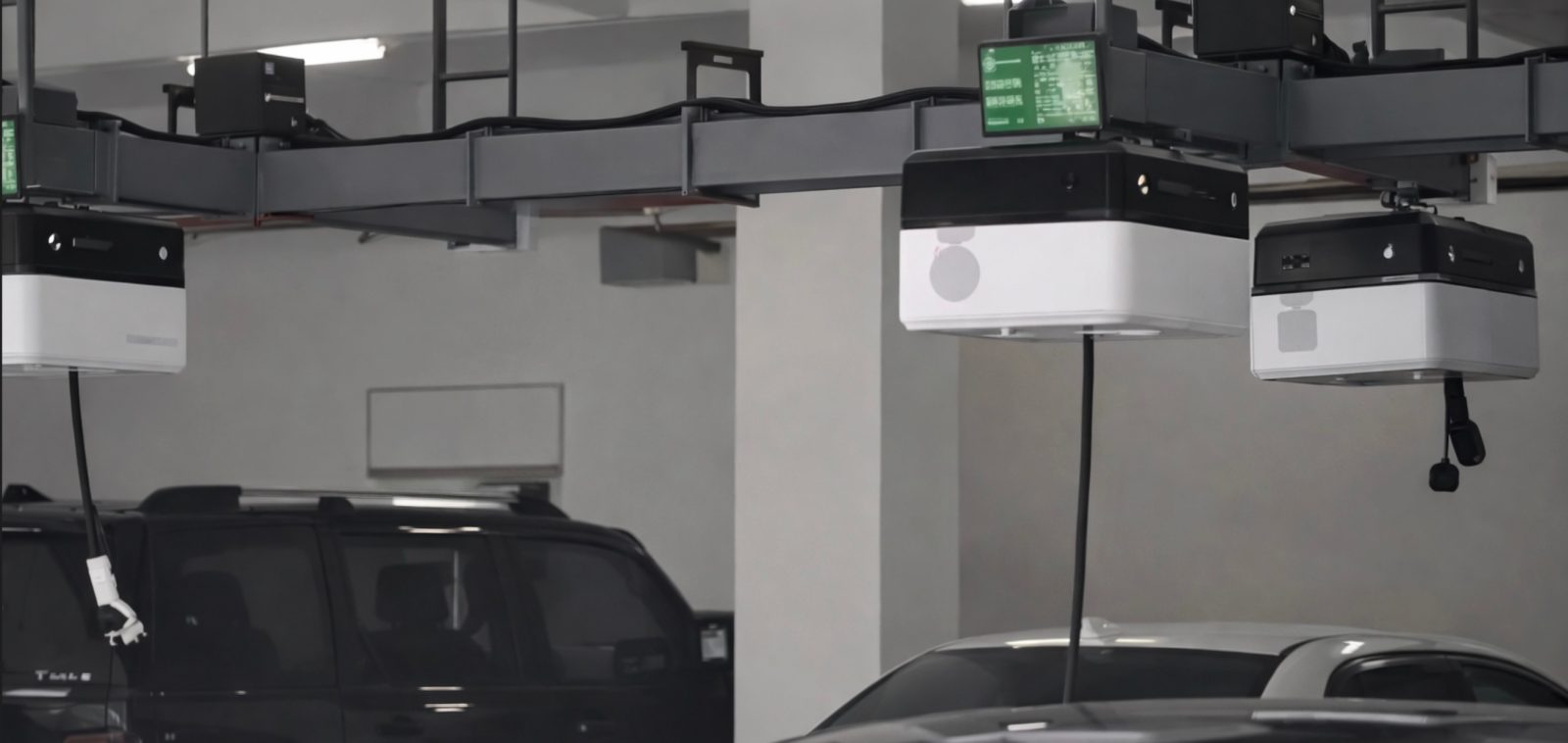
China is living in the future when it comes to EV charging. Instead of drivers hunting for an open charging spot in a parking garage, overhead rail-mounted charging robots now travel along ceiling tracks and come to the car. The concept, already deployed in garages across multiple Chinese cities, turns every parking space into a potential charging spot without the cost of installing individual chargers at each one.
A video circulating on social media this week shows one of these systems in action: a compact robotic unit gliding along a ceiling-mounted rail in an underground parking garage, stopping above a parked EV, and lowering a charging connector to plug in automatically. No app, no waiting in line, no dedicated charging bay required.
How the overhead rail system works
The concept is straightforward but clever. A robotic charging unit is suspended from a track mounted to the parking garage ceiling. The track serves as both a power conduit and a rail for movement, allowing the robot to slide to any parking space along its path. When an EV owner requests a charge, typically through a WeChat mini-program or QR code scan, the unit travels to their vehicle, uses vision systems and sensors to locate the charging port, and lowers a connector to plug in automatically.
The key advantage is infrastructure efficiency. Instead of wiring every parking space with its own charger, expensive and complex in underground garages where electrical upgrades can cost thousands of dollars per spot, a single overhead rail system can serve an entire row of spaces from one electrical connection.
The trade-off is speed. Because the rail doubles as a power delivery system, charging rates are limited compared to dedicated DC fast chargers. This is a Level 2 AC solution, not a BYD-style 1,000 kW ultra-fast charger. But for vehicles parked for hours at a time in office or mall garages, or overnight in apartment complexes, slow and steady gets the job done.
Who’s building these systems
Several Chinese companies are racing to commercialize overhead rail-based charging, but a few stand out.
Li Auto and CGXi are developing what they call the world’s first rail-based unmanned robotic charging arm. Li Auto CEO Li Xiang confirmed during the Li i8 launch event in July 2025 that the system was in active testing. The robot moves along a sled-style rail and integrates sensor arrays and vision systems to identify the charging port’s location and orientation on any vehicle.
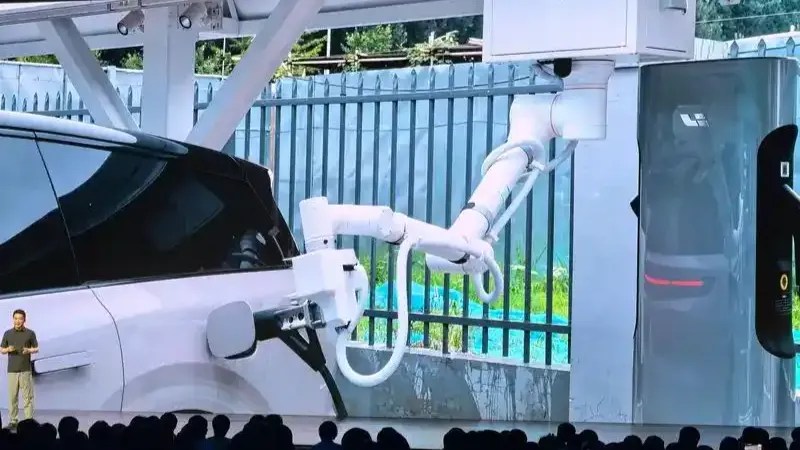
Wawa Charging uses a system called the HAVA Robot — an 18-degree-of-freedom flexible robotic arm that rides on an H-shaped overhead track. The company claims a single unit can serve eight or more parking spaces, and describes it as the world’s first commercial fully automatic charging robot.
Meanwhile, an academic system called SkyvoltRobot, documented in a 2024 ScienceDirect paper, laid out the engineering framework for overhead track-mounted charging robots, providing the theoretical foundation that commercial deployments are now building on.
These rail-based systems represent just one segment of China’s broader mobile charging robot boom. Ground-based robots from companies like CATL subsidiary CharGo, NaaS Technology, GGSN, and VMR are also scaling rapidly. CharGo’s CEO expects 20% of all new energy vehicles to be charged by robots by 2030. Beijing alone plans to deploy 1,000 mobile charging robots across 150 parking lots.
The numbers behind China’s charging robot push
The market is growing fast. The global mobile charging robot market hit $81 million in 2025 and is projected to reach $300.9 million by 2034, with China commanding roughly 34% of global market share. Some analysts project the broader robot charging station market will hit $13.8 billion by 2029.
China’s charging infrastructure already dwarfs every other country: 14.4 million charging points serving 31.4 million EVs as of mid-2025, according to government data. But the ratio of roughly one charger for every 2.2 EVs still leaves gaps, particularly in parking garages where installing fixed chargers is expensive and disruptive. That’s exactly where mobile and overhead solutions fit.
The government is backing the push. China’s plan to install 100,000 ultra-fast public charging stations by 2027 includes requirements for smart charging with dynamic pricing, solar integration, and storage — and mobile robots checking in on parked vehicles in garages fit neatly into that framework.
Western competition is emerging — slowly
The overhead concept isn’t exclusively Chinese. US-based Westfalia Technologies launched its WEPLUG system in May 2025 — a 50 kW DC overhead gantry-based charger designed for automated parking structures, fleet depots, and corporate campuses. WEPLUG uses a vision-guided robotic arm that lowers a connector into a driver-inserted adapter, operating from a single utility connection to serve multiple spots. Gravity, the Google-backed charging startup, has also installed ceiling-mounted 500 kW chargers in parking garages, though those are fixed units rather than mobile robots.
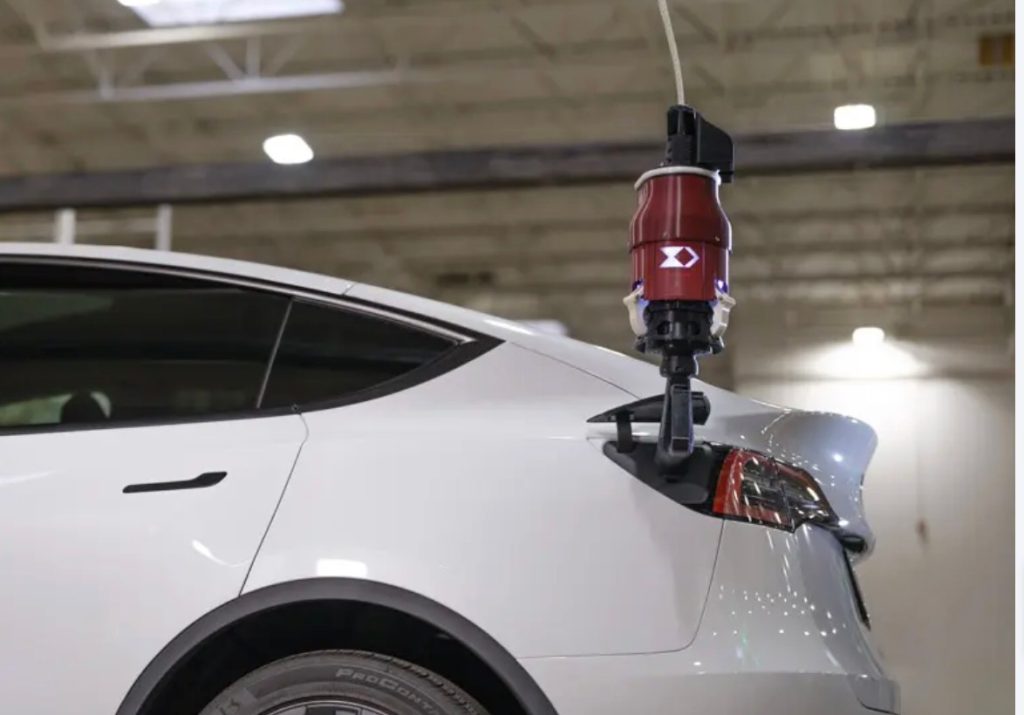
NYC’s lamppost-mounted Voltpost Air represents another creative approach to getting chargers off the ground and out of the way. But none of these Western systems match the scale or speed of deployment happening in China.
The gap is familiar. Just as Chinese automakers moved faster on affordable EVs while Western manufacturers debated timelines, Chinese charging infrastructure companies are deploying robotic solutions at commercial scale while Western counterparts are still in pilot phases.
Electrek’s Take
The overhead rail charging robot is the kind of practical, unsexy innovation that China excels at. It doesn’t have the raw power numbers of BYD’s 1,000 kW chargers or the sci-fi appeal of autonomous driving robots navigating garage floors, but it doesn’t have to.
It’s a unit on a ceiling rail that plugs in your car while you shop. And that simplicity is exactly why it works.
The “charger finds car” model solves a real pain point. Anyone who has circled a parking garage looking for the one open charging spot, only to find it occupied by an ICE vehicle, understands the frustration. Overhead rail systems eliminate that entirely. Every spot becomes a charging spot, at a fraction of the infrastructure cost.
And that cost is no joke. Newer parking garages that require the power conduits to already be there save a lot of costs, but everything else, you are looking at 6 figures+ investments to deploy any meaningfull charging capacity.
We’ve covered charging robots from VW, Hyundai, and NaaS over the years, but the overhead rail approach has a distinct advantage: no floor space consumed, no traffic conflicts with vehicles, and far simpler navigation than ground-based autonomous robots that need to avoid pedestrians and cars.
The real question is whether this stays a China-only phenomenon or gets adopted globally. With CharGo’s CEO projecting 20% of NEVs charged by robots by 2030, and Beijing deploying 1,000 units across 150 lots, China is building the playbook. Western parking operators should be paying attention.


FTC: We use income earning auto affiliate links. More.
electrek.co
#Chinese #robots #ride #ceiling #rails #charge


