Novo Nordisk was the first company to make a GLP-1 drug for weight loss and became Europe’s most valuable company.
But its troubles are stacking up and today the stock trades at just a quarter of what it did at its peak less than two years ago.
Pricing pressure, fierce competition, and pipeline setbacks have all hit the Danish drugmaker in recent months.
Despite being first to launch a GLP-1 drug for weight loss, Novo’s market share has eroded, and the company now only captures about 40% of the market, while rival Eli Lilly holds 60%, according to most estimates.
Novo is clear-eyed about the challenges it faces, especially around pricing. After the company pre-released its 2026 forecast earlier this month and predicted declining sales, CEO Mike Doustdar told CNBC: “People should expect that it goes down before it comes back up.”
He’s repeatedly said that new medicines, the Wegovy pill, and increased volumes will drive long-term growth.
These charts show the scale of the challenges Novo is facing.
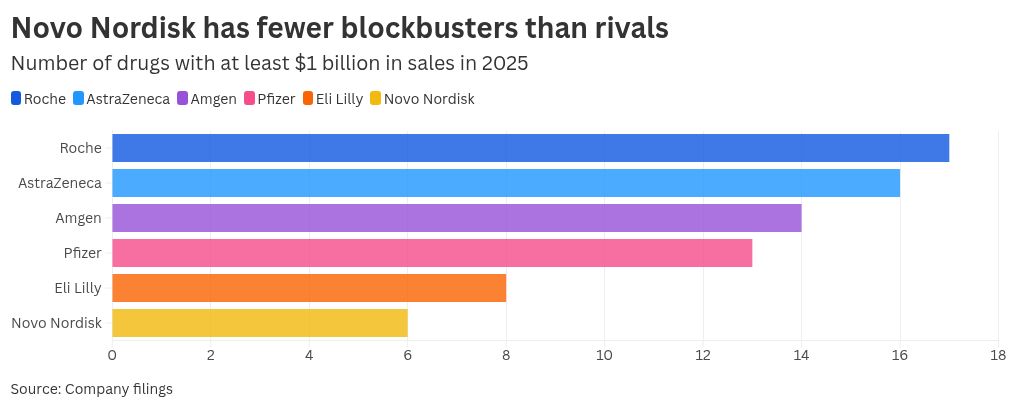
Novo Nordisk is often referred to as a diabetes and obesity pure play. Its portfolio included six branded drugs with annual sales of at least $1 billion in 2025, fewer than comparable current and future rivals.
Eli Lilly boasts eight so-called blockbuster drugs, and its portfolio also includes oncology and gene therapies.
The combined sales of Ozempic and Wegovy, Novo’s two biggest drugs, amounted to about $32 billion, or about 67% of total sales, last year. Combined sales of Lilly’s two biggest drugs, Mounjaro and Zepbound, were about $37 billion, or about 56% of the company’s total sales over the same period.
Novo also sells insulin, including blockbusters Tresiba and NovoRapid, as well as some drugs for rare diseases like hemophilia, but none come close to bringing in what its GLP-1 drugs do.
Among large-cap pharma companies hoping to enter the market for weight loss drugs in the coming years, such as AstraZeneca, Roche, Amgen, and Pfizer, through its acquisition of Metsera, the number of blockbuster drugs was significantly higher.
Novo Nordisk has also come under pressure as prices for GLP-1 drugs are coming down in its most important market, the U.S.
The U.S. has accounted for more than half of Novo’s total sales since 2023, and falling prices there are weighing on both the company’s topline and profitability. Last year, Novo and Lilly reached a deal with the Trump administration to lower prices on their GLP-1 drugs on Medicare and Medicaid and offer the treatments directly to consumers at a discount.
“In 2026, Novo Nordisk will face pricing headwinds in an increasingly competitive market,” said CEO Mike Doustdar, as the company’s full-year earnings report was published earlier this month.
Novo stock is down 75% since peaking at just over 1,000 Danish kroner a share in mid-2024.
The stock is up a little over 10% over the last five years. That compares to Eli Lilly’s 400% rise and the European blue-chip index Stoxx 600‘s 55% gain over the same period.
Investors were last rattled on Monday when Novo reported disappointing results of a trial pitting its next-generation weight loss drug, CagriSema, against Eli Lilly’s tirzepatide, also known as Zepbound, sending the stock down over 16% on the day.
“Confidence in the share is at rock bottom,” said Jyske Bank analyst Henrik Hallengreen Laustsen on Tuesday.
Earlier this month, Novo Nordisk said it expected sales and profits to drop by between 5% and 13% in 2026. If that comes to be true, it would be the first time annual sales have declined since 2017, in local currencies.
Analysts surveyed by FactSet expect sales to come in about 8% lower in 2026 compared to 2025. Much of that is due to increasing competition from both Eli Lilly and compounding pharmacies that are selling copycat versions of Novo’s branded drugs for a lower price.
Longer term, other large-cap pharma companies are planning to enter the market, and are pitching investors more differentiated weight loss drugs to be able to secure a slice of the market share for themselves.
Novo is hoping CagriSema can beef up future sales, but after the latest trial results, analysts are increasingly doubting its commercial potential.
Novo said it is optimistic about the drug, and that further trials would assess its full weight-loss potential.
The Wegovy pill is another potential growth driver for Novo and had a strong launch. However, it remains to be seen how it will fare if Lilly launches its rival pill, expected to hit the market in the second quarter, and what effects lower prices might have on volumes.

www.cnbc.com
#charts #show #scale #Novo #Nordisks #woes