


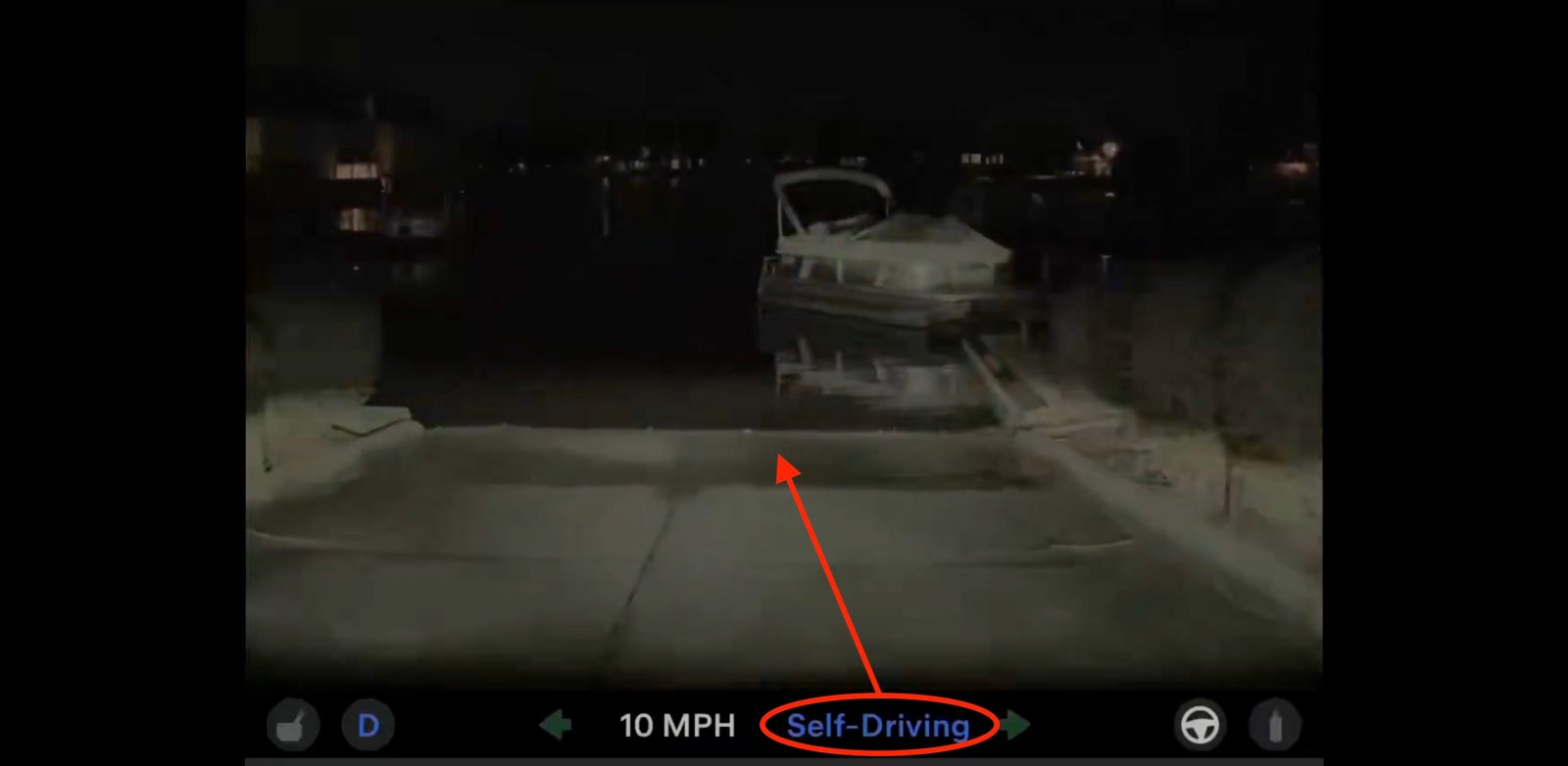
A Tesla owner says his car tried to drive him into a lake while using the automaker’s latest “Full Self-Driving” software. The incident, captured on video and posted to social media, has gone viral with over 1 million views, adding to a growing list of dangerous FSD edge cases that raise serious questions about the system’s readiness.
Daniel Milligan posted the video to X on Saturday, tagging both Tesla and Ashok Elluswamy, Tesla’s head of Autopilot AI, writing: “My Tesla tried to drive me into a lake today!” The vehicle was running FSD version 14.2.2.4 (build 2025.45.9.1), one of the latest updates Tesla has pushed to its fleet. The post racked up over 1.2 million views, 9,000 likes, and hundreds of reposts within hours:
Another dangerous FSD incident in a long line
The lake incident is the latest in a pattern of alarming “Full Self-Driving” failures that Electrek has been tracking for years. In May 2025, a Tesla on FSD suddenly veered off road and flipped a car upside down in a crash the driver said he could not prevent. In December, a Tesla driver in China crashed head-on into another vehicle during a livestream demonstrating FSD features, the system initiated a lane change into oncoming traffic.
Two Tesla influencers attempting Elon Musk’s much-hyped coast-to-coast FSD drive didn’t even make it out of California before crashing into road debris.
The FSD v14.2.2.4 build involved in the lake incident rolled out in late January 2026. Tesla did not publish new release notes for this version compared to the prior v14.2.2.3, characterizing it as a polished and fine-tuned build. The v14.2 series did upgrade Tesla’s neural network vision encoder for higher resolution features and added handling for emergency vehicles, but dangerous edge cases clearly persist.
Under regulatory scrutiny
The incident arrives as Tesla’s FSD system faces mounting regulatory pressure. In October 2025, NHTSA launched a broad investigation into 2.88 million Tesla vehicles after connecting 58 incidents to FSD, including 14 crashes and 23 injuries. The investigation specifically focuses on FSD running red lights and driving into opposing lanes of traffic, the kind of fundamental failures that should not be happening in a system Tesla charges $99 per month for.
NHTSA also opened a separate probe into Tesla’s failure to properly report Autopilot and FSD crashes to regulators in a timely manner. There have been over 50 deaths related to crashes involving Tesla’s driver-assistance systems (Autopilot and FSD).
Meanwhile, Tesla’s “unsupervised” Robotaxi program in Austin has proven to be anything but unsupervised. Today, we released a status update on the Robotaxi program 8 months after the launch.
Electrek’s Take
It’s almost as if Tesla has been training the latest FSD update on this episode of The Office.
We keep saying it and incidents like this keep proving it: Tesla’s “Full Self-Driving” should not be marketed as such. A system that tries to drive you into a lake is not “full self-driving” by any reasonable definition of those words.
The problem is not just that FSD makes mistakes, all driver-assistance systems have limitations. The problem is the gap between what Tesla sells and what FSD actually delivers.
Tesla moved FSD to a subscription-only model in February, effectively admitting the system is a service rather than the asset it was sold as for years. Musk has been promising “unsupervised” FSD since 2016, and yet here we are in 2026 watching videos of Teslas attempting to swim.
As we noted in our FSD v14 review, the system is the most impressive Level 2 system on the market, but it remains far from what Tesla has been selling customers for nearly a decade. With NHTSA investigations piling up and incidents continuing to go viral, regulators will eventually need to decide whether Tesla can keep calling this “Full Self-Driving” while people’s cars try to take them for an unexpected swim.
I think we are approaching the end of this era, and Tesla switching to a subscription-only service heralds it.
If it only offers a monthly subscription rather than a package with future capabilities, it doesn’t have to promise it will become unsupervised.


FTC: We use income earning auto affiliate links. More.
electrek.co
#Tesla #Full #SelfDriving #drive #owner #lake #viral #video #shows


