


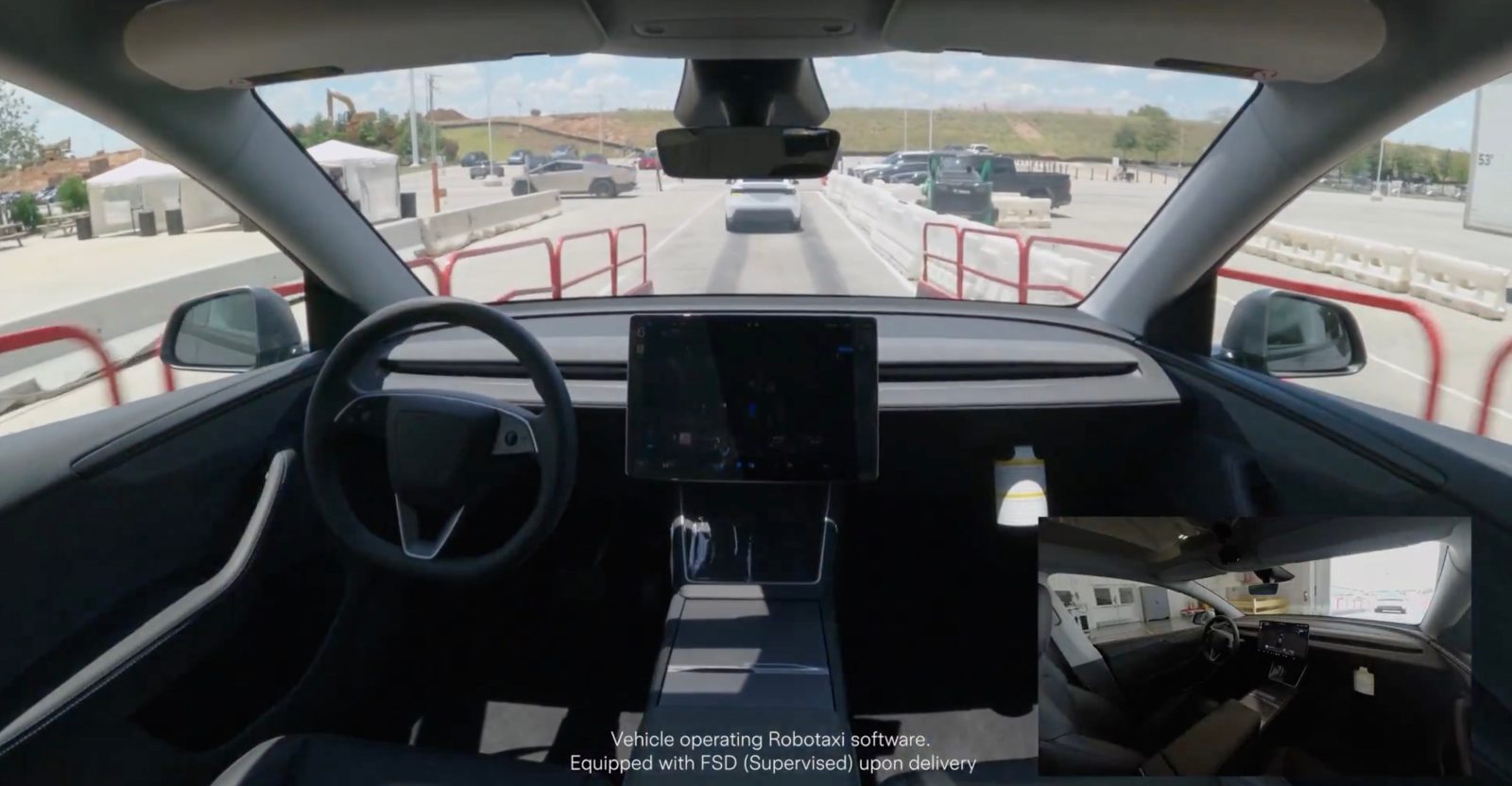
Eight months ago, Tesla made headlines around the world when it claimed to have completed the “world’s first autonomous delivery of a car”, a Model Y that “drove itself” from Gigafactory Texas to a customer’s home about 30 minutes away. Tesla never did it again. Not once.
The June 27, 2025 marketing stunt was a masterclass in manufactured milestones. Tesla’s official account posted a video showing a Quicksilver Model Y navigating parking lots, highways, and city streets to reach its new owner’s home in the Austin area.
Ashok Elluswamy, Tesla’s head of AI, claimed the vehicle reached 72 mph and that the company “literally chose a random customer who ordered a Model Y in the Austin area.” CEO Elon Musk celebrated it on X, noting it happened a day ahead of his own self-imposed deadline.
The media picked it up. The stock got a bump. And then — nothing.
If you claim to have solved autonomy, can autonomously deliver vehicles from your factory, and claim that it is more efficient, why wouldn’t you keep doing it?
The one-time stunt playbook
As we reported in January, not a single additional customer has received their Tesla through an autonomous delivery. Every Model Y buyer in Austin, or anywhere in Texas, where regulations don’t prevent this, still picks up their car the old-fashioned way. The “autonomous delivery” was not the beginning of a new era in car logistics, it was a one-time demonstration for the cameras, timed for maximum stock impact.
This fits a pattern we’ve documented extensively. Tesla executes a flashy one-off, lets the media cycle and social media do the amplification work, and quietly moves on before anyone asks why it never happened again. The 2016 “Paint It Black” autonomy demo, which was later revealed to have been staged, was an early version of this strategy. The June 2025 autonomous delivery was its most refined execution yet.
The same pattern repeated in January 2026 when Musk announced “unsupervised” Robotaxi rides in Austin just before the Q4 earnings call. The stock jumped 4%. Then the unsupervised rides vanished within a week. When the “unsupervised” rides did briefly appear, Tesla had simply moved the safety monitors to trailing chase cars.
To this day, Tesla’s “unsupervised robotaxi rides” are limited to a small section of the Austin Robotaxi service area.
The propagandists play their part
These stunts don’t work without amplification, and Tesla has cultivated a network of online influencers who reliably provide it. Omar Qazi, who runs the Whole Mars Catalog account (@WholeMarsBlog) on X, identified by the Wall Street Journal as the person whose tweets Musk most frequently responds to, is one of the most effective.
When Tesla posted its autonomous delivery video in June, Qazi quote-tweeted it with: “Waiting for Fred Lambert to explain to me how this is just ‘smoke and mirrors’.”
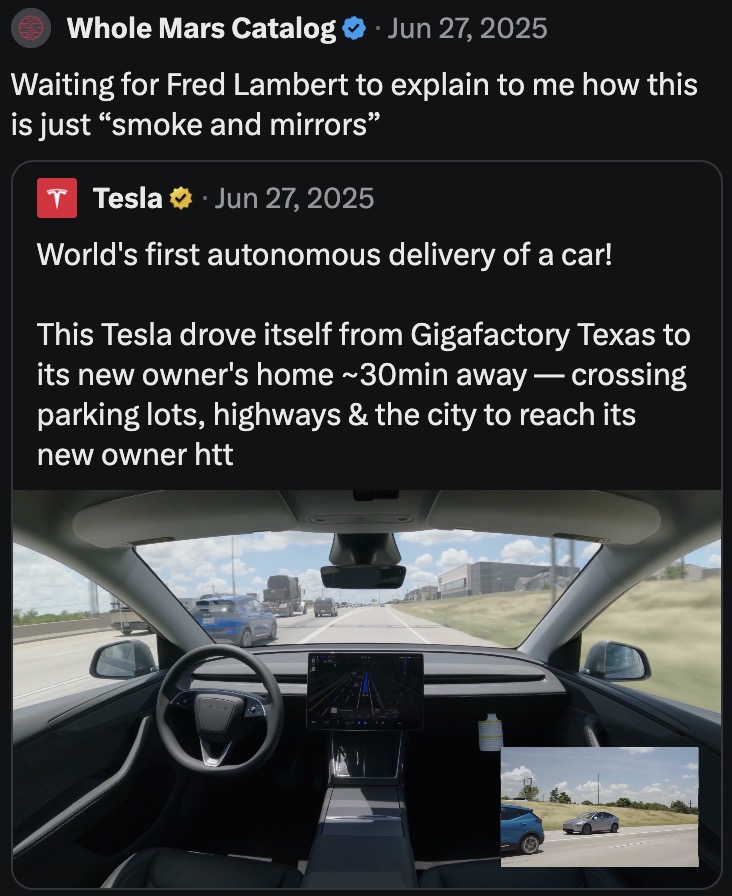
The “smoke and mirrors” referenced my article ahead of Tesla’s Robotaxi launch in Austin in June 2025, in which I argued that the program was all about optics rather than the true commercial launch of Tesla’s autonomous driving effort.
Well, Omar, here’s your explanation, eight months later: it was smoke and mirrors. Tesla did it once, declared victory, and never did it again. That is the definition of a demonstration, not a capability. If Tesla could autonomously deliver cars at scale, it would be doing it, the logistics savings alone would be worth millions. The fact that it chose not to tells you everything about where the technology actually stands.
Qazi is not an outlier. He’s part of an ecosystem of Tesla-aligned accounts that serve a specific function: they amplify every Tesla announcement as a breakthrough, attack anyone who questions the narrative, and create the social proof that keeps retail investors believing Tesla is years ahead on autonomy. Whether they genuinely believe it or are performing belief is ultimately irrelevant, the effect on public perception is the same, and Tesla clearly benefits from it.
Where Tesla’s autonomy actually stands
In fact, Tesla’s Robotaxi situation proved even worse than I described in my June article.
The contrast between Tesla’s demonstration-based approach and what actual autonomous vehicle companies are doing is stark. Waymo now provides over 450,000 paid rides per week across six U.S. cities, Phoenix, San Francisco, Los Angeles, Austin, Atlanta, and Miami, with plans to expand to over 20 more, including Tokyo and London, in 2026. Waymo has logged over 200 million fully autonomous miles on public roads and just raised $16 billion at a $126 billion valuation.
Tesla, by comparison, has roughly 42 Robotaxis in Austin with 19% availability and a crash rate nearly 4 times worse than human drivers, 14 crashes across an estimated 800,000 cumulative miles, almost entirely with human supervisors. The service shuts down when it rains. Musk promised 500 cars in Austin, half the U.S. population covered, and expansion to 8–10 cities by end of 2025. None of it happened.
Meanwhile, a California judge ruled in December that Tesla lied about its FSD marketing, Tesla changed the meaning of “Full Self-Driving” to abandon its original promise of autonomy, and Musk himself admitted Tesla needs 10 billion miles of data for safe unsupervised driving, a threshold the fleet won’t hit until mid-2026 at the earliest. And yet, Tesla just rolled its first steering wheel-less Cybercab off the assembly line, betting everything on software that doesn’t work yet.
Electrek’s Take
The autonomous car delivery from June 2025 was the clearest example yet of Tesla’s approach to autonomy: execute a carefully controlled demonstration, harvest the headlines and stock bump, and never repeat it. The fact that it’s been eight months and Tesla hasn’t delivered a single additional car this way confirms what we warned about at the time: this was a marketing event, not a technology deployment.
Moving supervisors from the driver’s seat to the passenger’s seat, or to trailing cars, shows that Tesla’s approach to autonomy prioritizes optics over safety.
Otherwise, the supervisors would be behind the wheel until Tesla can prove they are not needed at all.
This is the game of “smoke and mirrors.”
The broader problem is that this strategy works. Tesla’s stock remains inflated by autonomy expectations that are not grounded in the company’s actual capabilities. Real autonomous vehicle companies like Waymo are providing hundreds of thousands of rides per week while Tesla does one-off stunts and lets influencers do the rest. The gap between Tesla’s autonomy marketing and Tesla’s autonomy reality has never been wider — and the propagandists have never been busier trying to paper over it.
In a better market, transparency and safety would be rewarded over optics.


FTC: We use income earning auto affiliate links. More.
electrek.co
#Tesla #claimed #autonomous #car #delivery #months
![From $189 a month: 5 of the best EV lease deals in October [Updated]](https://i1.wp.com/electrek.co/wp-content/uploads/sites/3/2024/11/Ford-Saudi-Arabia-Mach-E-side.jpeg?quality=82&strip=all&w=1400&ssl=1 "From $189 a month: 5 of the best EV lease deals in October [Updated]")

