


Support CleanTechnica’s work through a Substack subscription or on Stripe.
Two weeks ago, Consumer Reports released its latest new car reliability study based on input from 380,000 vehicle owners. When all the results were tabulated, Consumer Reports found that hybrids, such as the Toyota Prius, have 15% fewer problems on average than conventional cars powered solely by gasoline engines, while battery electrics and plug-in hybrids have about 80 percent more problems on average than conventional cars.
“Many of the problems with EVs and plug-in hybrids are because they are newer designs compared to gas technology, so some kinks still continue to be worked out,” said Jake Fisher, senior director of auto testing at Consumer Reports. “By comparison, hybrids have been around for nearly three decades, and the technology is tried and true.”
Some of the plug-in hybrids with the worst reliability rating were those from Stellantis, which announced this week that the Jeep Wrangler 4xe, Jeep Grand Cherokee 4xe, and Chrysler Pacifica Hybrid (it’s really a plug-in hybrid, but the company was afraid to put any “plug-in” badges on the exterior of the car for marketing reasons) will not be offered for sale to customers in North America for the 2026 model year.
“Stellantis continually evaluates its product strategy to meet evolving customer needs and regulatory requirements,” a Stellantis spokesperson told The Drive via email. “With customer demand shifting, Stellantis will phase out plug‑in hybrid (PHEV) programs in North America beginning with the 2026 model year, and focus on more competitive electrified solutions, including hybrid and range‑extended vehicles where they best meet customer needs. This approach reinforces the company’s commitment to offering advanced propulsion systems that maximize efficiency and provide options from internal combustion to hybrid range‑extended, and fully electric solutions.”
Chrysler Pacifica PHEV Is No More
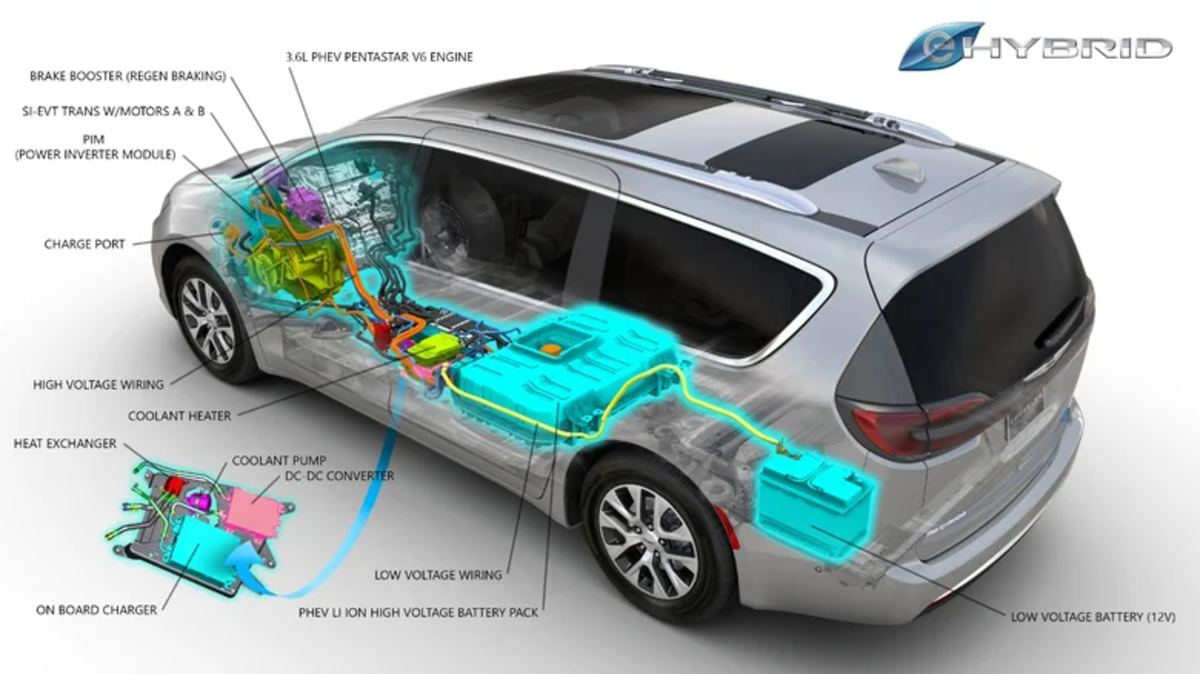
The news will be unwelcome to many people. The Chrysler Pacifica in its standard form is pretty much a gas hog, but the PHEV model has an EPA rating of 30 mpg (combined city/highway), which is considerably better than the standard car. We have one longtime CleanTechnica reader in Nova Scotia who has been using one in his business for years and is quite happy with it. (Gas prices in Canada are significantly higher than they are in the US.)
He has been patiently waiting for the battery electric version of the Pacifica to arrive, and according to the announcement from Stellantis, that may actually happen — someday. When that day will come depends on whether any significant demand for battery electric cars develops in North America, and especially in the US.
Canadian Prime Minister Mark Carney has suggested his government might consider relaxing import duties on Chinese made cars, which could give a boost to EVs in Canada, but the Canadian new car market is small compared to the US one. It is unlikely Stellantis would offer models there that are not also available south of the border.
Already Gone
The Wrangler 4xe and Grand Cherokee 4xe were already deleted from the Jeep online configurator before the latest announcement. Both have been the subject of a stop-sale order due to the high number of technical issues, including the engines having sand in them left over from the casting process. Sand inside your engine is not generally considered a recipe for longevity.
Truthfully, neither car was a competitive vehicle in today’s world. The Wrangler 4xe and Grand Cherokee 4xe both had a battery-only range of around 22 miles in real-world driving. The 2014 Chevy Volt had 50 miles of range. The 4xe package was a half-baked idea from the very beginning and an embarrassment to Stellantis, which is capable of designing and building far better vehicles if it chooses to. [Editor’s note: I went with my daughters and wife today to pick strawberries, and we were actually parked right next to a Wrangler 4xe. They may not be great long-range electric vehicles, but I have loved seeing them around town, like all plugin vehicles. —Zach]
CNBC reports the decision is an about-face for Stellantis, which has positioned itself as a leader in vehicle electrification in the US for a couple of years. In 2024, Antonio Filosa, who was the CEO of Jeep, said the SUV brand planned to sell 160,000 to 170,000 PHEVs that year — more than 40 percent of all sales of plug-in hybrids in the US. Filosa is now the CEO of Stellantis, and good luck with that, Antonio.
The Drive‘s Byron Hurd said, “Going forward, the company will focus its electrification efforts on range-extended EVs and conventional series hybrids. This means the range-extended Ram EV (and any unannounced products riding on the same architecture) remain in the pipeline.”
Extended Range EVs From Stellantis
What defines “extended range” is a bit vague. In China, it implies a car with at least 100 km of battery-only range, and the EU is toughening its standards to encourage similar performance. The best EREVs in China today are capable of driving more than 160 km before the onboard gasoline range extender engine kicks in.
That raises another point. Done properly, an EREV is powered primarily by the battery, and the gasoline engine is along solely to charge the battery. Some so-called plug-in hybrids reverse the priorities, so the engine is called into play when starting from rest, when passing, or when extra power is need to conquer a speed bump in a mall parking lot.
As Stellantis struggles to find its footing in the new paradigm of fossil fuel dominance, it still has some offerings that at least offer a glimpse of what it is capable of. According to Jalopnik, the “2026 Jeep Cherokee is exclusively available with a traditional hybrid powertrain that doesn’t need to be plugged in to charge, and it would make sense for other Stellantis models to start using that powertrain.” It says the Dodge Charger EV and battery electric Jeep Wagoneer S will continue in production, and notes the new Recon EV went on sale just last month.
Fraught Times For EVs
These are fraught times for automakers trying to make sense of the chaotic trade policies of the so-called US administration. Ford has ended production for the F-150 Lightning and taken a $19.5 billion write-down due to the impact those policies have had on its electric vehicle plans. This week, General Motors chimed in to say it is writing off about $9 billion itself. Both Ford and GM are busy re-purposing their battery factories to make cells for energy storage, as the demand for EV battery cells is now expected to be much lower than originally planned.
The EV revolution in the US is not dead — yet. Zachary Shahan has reported that Ford Mustang Mach-E is outselling the traditional gas-powered Mustang on a regular basis. Cadillac is well on its way to becoming an EV-only brand and GM is still planning to bring the second-generation Chevy Bolt to market soon, priced at less than $30,000. Charging infrastructure is also continuing to expand in the US.
However, Americans do not have access to the many of the best EVs available today. In particular, the Kia EV2, EV3, and EV4 are not scheduled to go on sale in the US so long as the hostility to electric cars persists. Whether Stellantis ever offers compelling electric cars in the US remains to be seen.
Sign up for CleanTechnica’s Weekly Substack for Zach and Scott’s in-depth analyses and high level summaries, sign up for our daily newsletter, and follow us on Google News!
Have a tip for CleanTechnica? Want to advertise? Want to suggest a guest for our CleanTech Talk podcast? Contact us here.
Sign up for our daily newsletter for 15 new cleantech stories a day. Or sign up for our weekly one on top stories of the week if daily is too frequent.
CleanTechnica uses affiliate links. See our policy here.
CleanTechnica’s Comment Policy
cleantechnica.com
#Stellantis #Scraps #4xe #PlugIn #Hybrid #Platform


