


Support CleanTechnica’s work through a Substack subscription or on Stripe.
Sometimes when doing my EV sales reports, I wonder if I shouldn’t make them shorter and more data driven, with less talk. Will most people actually read the whole thing, or go directly to the graphs and that’s it?
That is why I avoid adding more content to them, or else they might get too cumbersome to read.
On the other hand, some interesting stuff gets left out, and one example is this: the sales breakdown by category, be it by size or body type.
This article serves to fill that gap.
First things first — regarding data itself, I have limited it just to BEV sales, and regarding vehicle categories, I had the same criteria as I use on the EV sales reports — cars (hatchbacks, station wagons, and sedans), SUVs (including crossovers), MPVs, pickup trucks, and sports specialties (coupes, sports cars, convertibles) are included, LCVs (vans and such) are excluded.
In Europe and China, I also exclude pickup trucks, as they are not considered passenger vehicles there, and they do not represent a significant market.
So let’s start by comparing the main markets by size category, divided in A-segment (city cars), B-segment (subcompacts), C-segment (compacts), D-segment (midsize), and E+F segments (full size)

As one can see, of the three main BEV markets, the EU market structure is the closest to the remaining BEV markets, with compacts being the main segment, which could become an advantage for local BEV makers.
The Chinese BEV market is more balanced, with all categories having at least 13% share, which allows/forces local players to have strong lineups across the size range, helping them to export their models in all sorts of markets, from city car friendly Italy, to full size behemoth lover Russia.
The USA would be another target for the AITOs and Li Autos, if we were in a purely free market driven market and geopolitics weren’t at play.
Speaking of the USA, it is a distorted market, with 77% of sales belonging to the midsize category. Sure, the domination of Tesla, namely the Model 3 and Model Y, explains most of that. These two models are responsible for close to half of the market.
Still, even if we were to remove these two from the tally, midsize models would continue to be the majority of sales, and compacts only represent a third of full size model sales. And the A-segment and B-segment are basically irrelevant, as only the Fiat 500e represents those categories.
With US makers focused on midsize and full size categories, they are willingly putting themselves in a corner when they export to other markets, where more than 50% of sales lay in the A, B, and C segments.
And while Stellantis and Ford have overseas operations that allow them to sell elsewhere (although, Ford is increasingly using 3rd party platforms — just look at the European Ford Explorer and Capri, or the Chinese Ford Bronco EV), both GM and Tesla have little to nothing to show in those smaller categories.
Sure, GM sells rebadged small EVs from its SGMW joint venture in export markets, but they are Chinese-developed models with a Chevrolet badge on them. Imagine the outrage in some quadrants if GM decided to import the Chevrolet Spark EUV, a Baojun Yep Plus, sold as a Chevy in Latin America to the US….
Oh, and there’s the nine-year-old Chevrolet Bolt. But that one already has a termination deadline, coming sometime next year.
Is it because US buyers don’t want small EVs, or because GM prefers to sell bigger, more expensive, higher margin BEVs? Hmmm…. Hard to know, right?
Anyways, this would matter if US and European OEMs were betting on BEV exports … which they are not. Which means that in places like Southeast Asia or Latin America, only Chinese OEMs are really promoting EVs.
The result is that, for example, in Latin America, 86% of BEV sales belong to Chinese OEMs.
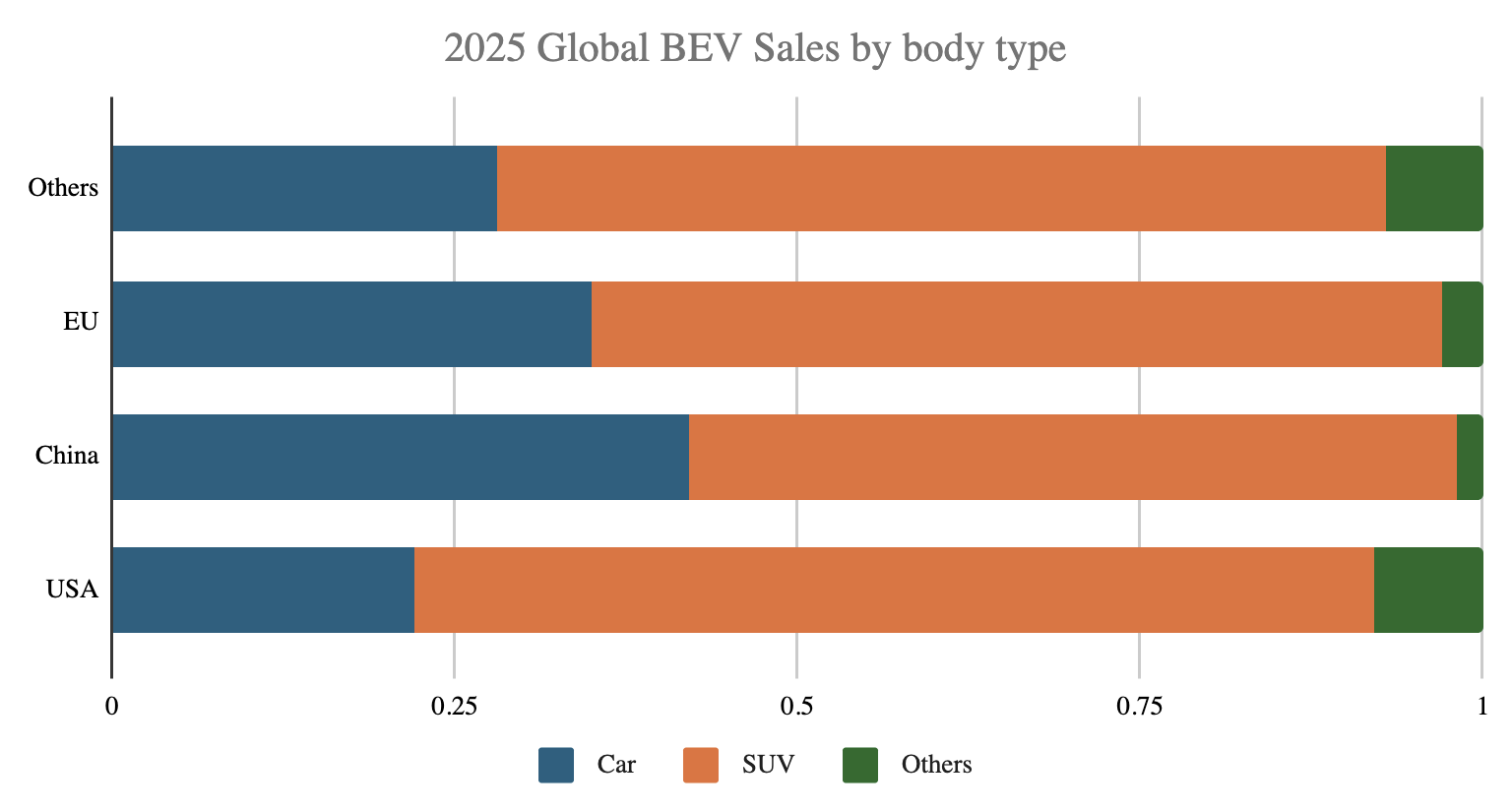
Looking at body types, there are some facts that are not surprising, like the US market being an SUV-heavy market (70% of all sales are SUVs), but it is surprising that sedans are still pretty popular in China, with cars representing 42% of total BEV sales, higher than everywhere else.
In the “Others” body category, the USA has a relatively high number due to pickup trucks, which represent 7% of total sales on their own. In the other markets, it is MPVs that up make the majority of sales under the “Others” moniker.
The fact that there is only one electric MPV sold in the USA, the VW ID.BUZZ, is pretty strange, and raises the same question I made regarding smaller cars — is it that buyers do not want them, or is it that OEMs do not want to sell them?
Still on MPVs, the percentage seems low in China, but this is partly because most MPVs there are PHEV/EREVs, so they are not counted here.

Comparing 2020 with 2025 BEV sales in Europe, by size category, we can see that the small A- and B-segment models have lost significant importance, compared to C- and D-segment vehicles, with city cars inclusively selling fewer units in 2025 (68,000 units) than in 2020 (77,000)!
And this in a BEV market that jumped 251% in the same period!
As such, with OEMs preferring to sell compact to midsize models, instead of small cars, it is no surprise that the average price of a BEV had surged during this period….
Having said that, it seems that 2026 is witnessing a changing trend, with the fastest growing category being the B-segment (+65% YoY). The A-segment also has growth potential (+10% YoY), and with new players landing this year (Renault Twingo, Dacia A-segment, Smart #2), expect city EVs to expand sales significantly.
Sign up for CleanTechnica’s Weekly Substack for Zach and Scott’s in-depth analyses and high level summaries, sign up for our daily newsletter, and follow us on Google News!
Have a tip for CleanTechnica? Want to advertise? Want to suggest a guest for our CleanTech Talk podcast? Contact us here.
Sign up for our daily newsletter for 15 new cleantech stories a day. Or sign up for our weekly one on top stories of the week if daily is too frequent.
CleanTechnica uses affiliate links. See our policy here.
CleanTechnica’s Comment Policy
cleantechnica.com
#Size #Matters #BEV #Sales #Breakdown #Category


