


In 1951, during a visit to the Topolski home in London, I chanced to see a copy of portrait of Bernard Shaw, a book containing reproductions of some exquisite sketches. Topolski had been to India twice before then. He had made a name by his remarkable drawings of men and events in India and in countries of the far east which had been published in the Hindustan Times. “You have sketch-ed my father quite often,” I said to him on seeing his Shaw collection, “Why not portrait of Gandhi’?” He spent the following day rummaging his papers and studio and collected every little Gandhi piece he had. They were not finished products in the sense of drawings or paintings which emerge from a series of conventional sittings. Gandhiji gave no sittings to Topolski. But the artist was equal to the challenge, more particularly as he found himself free to observe Gandhiji whenever and wherever he liked. The result was a number of quick, rough sketches which by a few vivid strokes of the pen captured the dynamic personality in a way that could not have been bettered had the artist received the conscious co-operation of his subject.
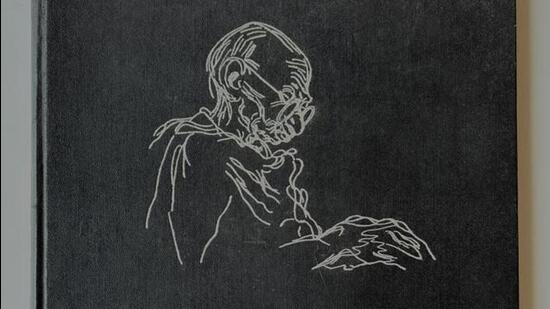
It gives me great pleasure to sponsor the publication of this volume. And I know how happy Topolski himself is that the work of production should have been entirely handled in India.
All the black-and-white sketches reproduced here were drawn in 1944. The frontispiece is a painting made by Topolski in 1946. Critics have described it as the artist’s premonition of the assassination that was to come, two years later, on January, 30, 1948. The artist himself has neither denied nor confirmed the theory of premonition, but the picture is there for everyone to judge. It represents a profoundly calm but limp figure of Gandhiji just prevented from falling by the support of his companions. Observe his right hand, half raised in doubt and pain. Beneath it is another hand, belonging to someone in the crowd, outstretched in readiness to help. Later, in 1948, after the assassination, Topolski painted one of his masterpieces “The East, 1948.” It is a composite picture in four vertical undemarcated sections representing Africa, the Near East, India and China. It is a remarkable painting in Topolski’s typical conglomerate style. In the section representing India he virtually repeats his 1946 painting with some minor additional features and the head bent considerably forward —colour plate number 26. The full painting is a large 12’x9’ canvas which fills a wall at Rashtrapati Bhavan, the residence of the President of India in New Delhi. It was acquired by the Prime Minister, Pandit Jawaharlal Nehru, for the Government of India when he visited London in April, 1949. The other 1946 painting is in the possession of Mr. Maurice Collis, one of London’s leading art critics.
The international reputation enjoyed by Topolski derives from the nonchalant audacity of his style. His sketches can at first glance appear frivolous. He revels in casual strokes which resemble those of a child playing with paper and pencil. Another of his mannerisms is to throw what look like coils of barbed wire over his work. But through it all peep unmistakably the serenity, vigour and rhythm of the gift that is Topolski’s.
The Hindustan Times
New Delhi
October 2, 1953
Devadas Gandhi
www.hindustantimes.com
#Remembering #Bapu #India #News


