


Support CleanTechnica’s work through a Substack subscription or on Stripe.
In the past week I had the opportunity to deliver the same presentation on the global acceleration to clean technologies and decarbonized solutions to two different audiences, one from a stage keynoting the 2026 Clean Energy Summit in the Vancouver Metropolitan area, and one virtually. Both were Canadian audiences. The first was entrepreneurial and business oriented, the second citizen activist oriented. What follows is the transcript of the second presentation, which you can also watch here.
Michael Barnard [MB]: This is a cross-Canada audience. What that means is we have people from all over the world in the audience. We’re a nation of immigrants. I’m second generation. My dad immigrated here.
Many of us have lived all over the world as well. I’ve lived on three or four continents, and I’ve visited 60 or so cities globally. Part of the way I look at solutions is that I look around the world for pockets of the future where solutions are scaling. Then I look at the conditions for success that allow those things to scale and see which ones can actually expand. It’s a diffusion question.
Part of my practice is accelerating the rate of diffusion of solutions where the test has already been run. A lot of this is based on the work of Vancouver author William Gibson. He’s a speculative science fiction author who wrote the Neuromancer series and the Pattern Recognition series.
His aphorism, “The future is already here, it’s just unevenly distributed,” speaks to me. It’s something I apply professionally. If the future is already here, I don’t have to reinvent it. I don’t have to test it here. I can look at where it’s being tested at scale and ask whether it can be applied here without more testing. If the answer is yes, then I bring those pockets of the future to assist my clients, using those proof points to break through the parochialism that so often afflicts us.
The not-invented-here syndrome is not my favorite syndrome, along with NIMBYism. And with that, the first pocket of the future.

About 10 km from where I’m sitting, there’s a brand-new student residence at BCIT. It’s 12 stories, 500 beds, and it’s mass timber. Mass timber, for those who don’t know, is basically plywood on steroids. You can make structural beams, floors, and walls with it, and it goes together like Lego.
Mass timber has a lot of advantages. You can cut out the windows in the factory. You can route the wiring and the water lines in the factory. It has five times the structural strength by mass as reinforced concrete, so a building weighs a fifth as much for the same volume enclosed. Among other things, that means the foundation only needs about 30% of the reinforced concrete.
You can also put mass timber buildings on top of existing buildings where you can’t build upward anymore. It’s a big thing globally to add density to downtown cores by adding mass timber floors on top of existing structures.
Canada happens to be a leader in mass timber. We have about 700 mass timber buildings of various types in the country. I’ve been to a few of them. Last year I did a report on mass timber as an industrial policy for Canada. It was about 100 or 130 pages and aligned with Mark Carney’s housing policy. That policy did not preserve the original $13 billion budget, but it did preserve $7 billion, which is expected to be extended by private investment and other forms of capital.
His program is going to support social housing for the bottom 20% of Canadians by putting in multi-unit residential buildings that are mass timber and prefabricated in factories. That provides a baseload income for mass timber factories. It enables the creation of regional hubs for mass timber, which in turn enables other builders to use mass timber less expensively.
Most of our mass timber buildings so far have been one-offs globally. That means we haven’t established and scaled the industry as much as we should have, even though there are hundreds of buildings around. If you have a baseline factory with solid annual revenue guaranteed for years, then everybody else can pile onto that and get the same products at the same price. That drives the price point down.
Up to now, mass timber has had about a 20% capital expense premium for constructing a building. With scaling and industrialization, that goes away.
Canada is also a close follower on embodied carbon limits for buildings. An embodied carbon limit says that per cubic meter of materials, you must be under a certain number of tons of CO2. For those who have paid attention to cement and steel, they’re carbon bombs. Reinforced concrete, which is full of cement and steel, is a carbon bomb. And remember, you need five times the mass.
Mass timber is the inverse. Every ton of mass timber, while having as much structural strength as reinforced concrete, embodies a ton of carbon dioxide from the atmosphere. As a tree grows, it breathes in carbon dioxide, releases oxygen, and keeps the carbon as structural material. It’s natural carbon fiber.
In Canada, we count the forests toward our carbon accounting, so we don’t double count the mass timber. As we electrify forestry, which is already happening with electric logging trucks in British Columbia, as we electrify sawmills, as we electrify distribution with electric trucks, and as we electrify construction equipment, the carbon debt of a building approaches zero with mass timber. We still need reinforced concrete for the foundation, but it’s a fraction of the embodied carbon of a conventional new building.
Embodied carbon is one of the most critical factors to consider. Then the operational energy needs to be electrified with heat pumps and the like.
This is a pocket of the future, and it’s in Canada. I’m not going to stop with Canada. The next thing, though, is to ask about the filters. In addition to where the pockets of the future are and whether they can spread, what are the filters?
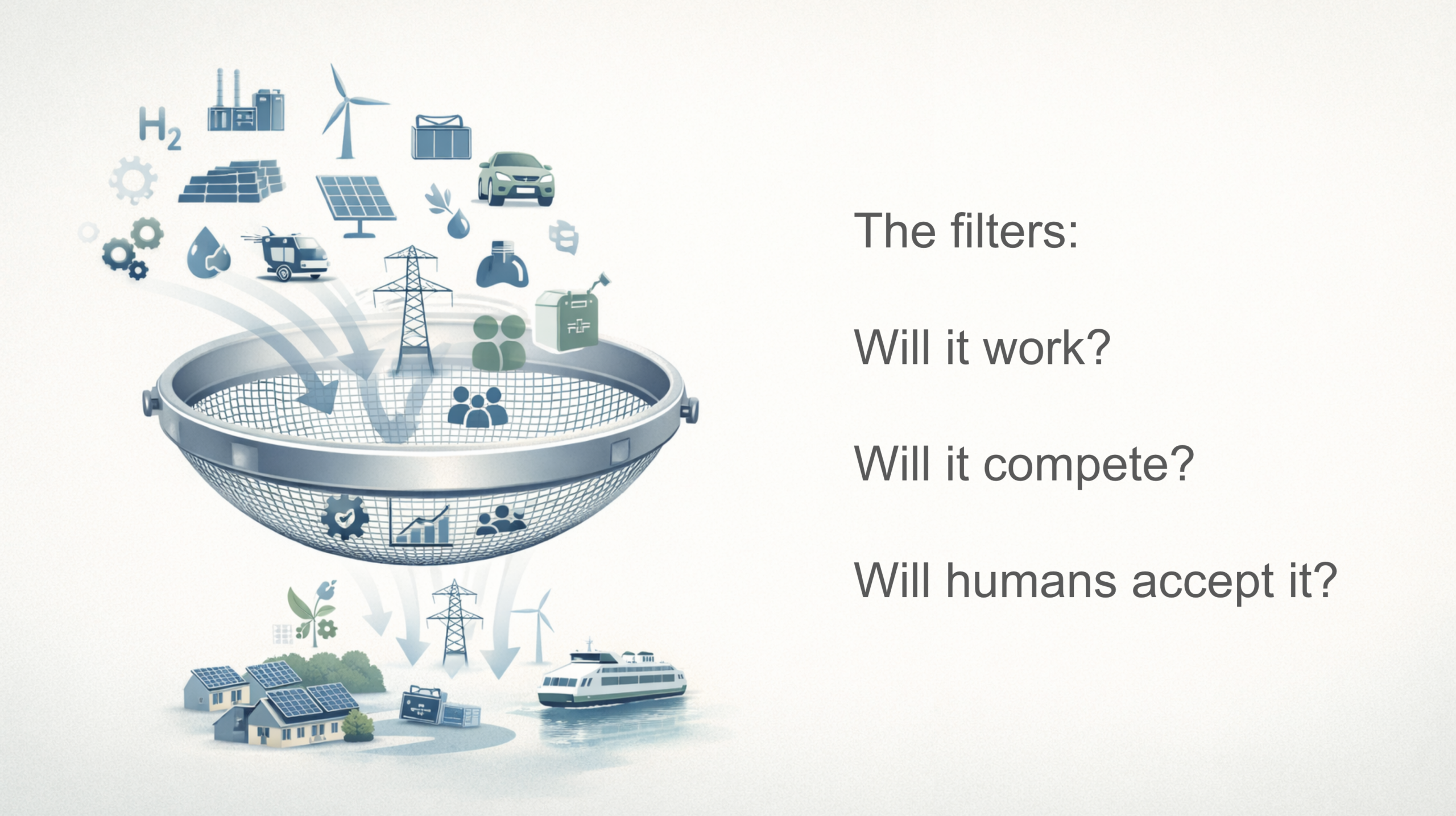
The filters I apply to any technology are straightforward. First, will it work? As Jim knows, I get nerdy about the STEM stuff. I get nerdy about the engineering and the chemistry. I’ve rebuilt my brain for chemical process engineering. One of my engagements last year was a techno-economic assessment of polymetallic nodule seabed mining. I partnered with an Edmonton-based mining engineer for part of that work.
I keep expanding my STEM competence beyond what is remotely reasonable. It’s not my only point of arrogance. I also do projections of major climate problem areas out to 2100. I don’t claim to be right. I just claim to be less wrong than most. I try to temper the arrogance, and I admit when someone points out that I’m wrong.
The second filter is economic. Will it compete? If I have seven solutions I can count on my fingers, and three are cheap while four are expensive, the three that are cheap are the ones that will scale globally. It’s basic. If something is cheaper, does the job, meets the conditions for success, and works, it’s going to scale. It’s a simple economic test.
The third filter is social acceptance. I don’t have kids, and I don’t watch major league sports, so I have time to fill my brain with things like cognitive science and the social acceptance of technology and transformation. Will humans accept it?
For this audience, I’ll give one example. Some people suggest cutting the global population to 2 billion. Humans are not going to accept that. Another suggestion is that everyone in the world has to become a vegetarian. That fights human nature. A more realistic path is to decarbonize beef, substitute chicken where possible, and shift to plant proteins where practical. But expecting everyone to become vegetarian is unlikely.
So the filters are: will it work, will it compete, and will humans accept it? Mass timber meets those tests. It works. It’s cost competitive. More than that, it’s time competitive. With reinforced concrete, you have to wait about a week for the higher-strength concrete to cure sufficiently before putting up the next floor. With mass timber, buildings can go up much faster. As soon as the structural beams are locked in place, they have the strength for the next floor.
You can accelerate delivery and reduce the impact on local roads, because the materials weigh a fifth as much rolling over them.
What else? Let’s go to the other side of the world, Pakistan, where I’ve spent time talking to people, thankfully virtually. I love talking to people in other parts of the world. I don’t love 36 hours of jet travel anymore.
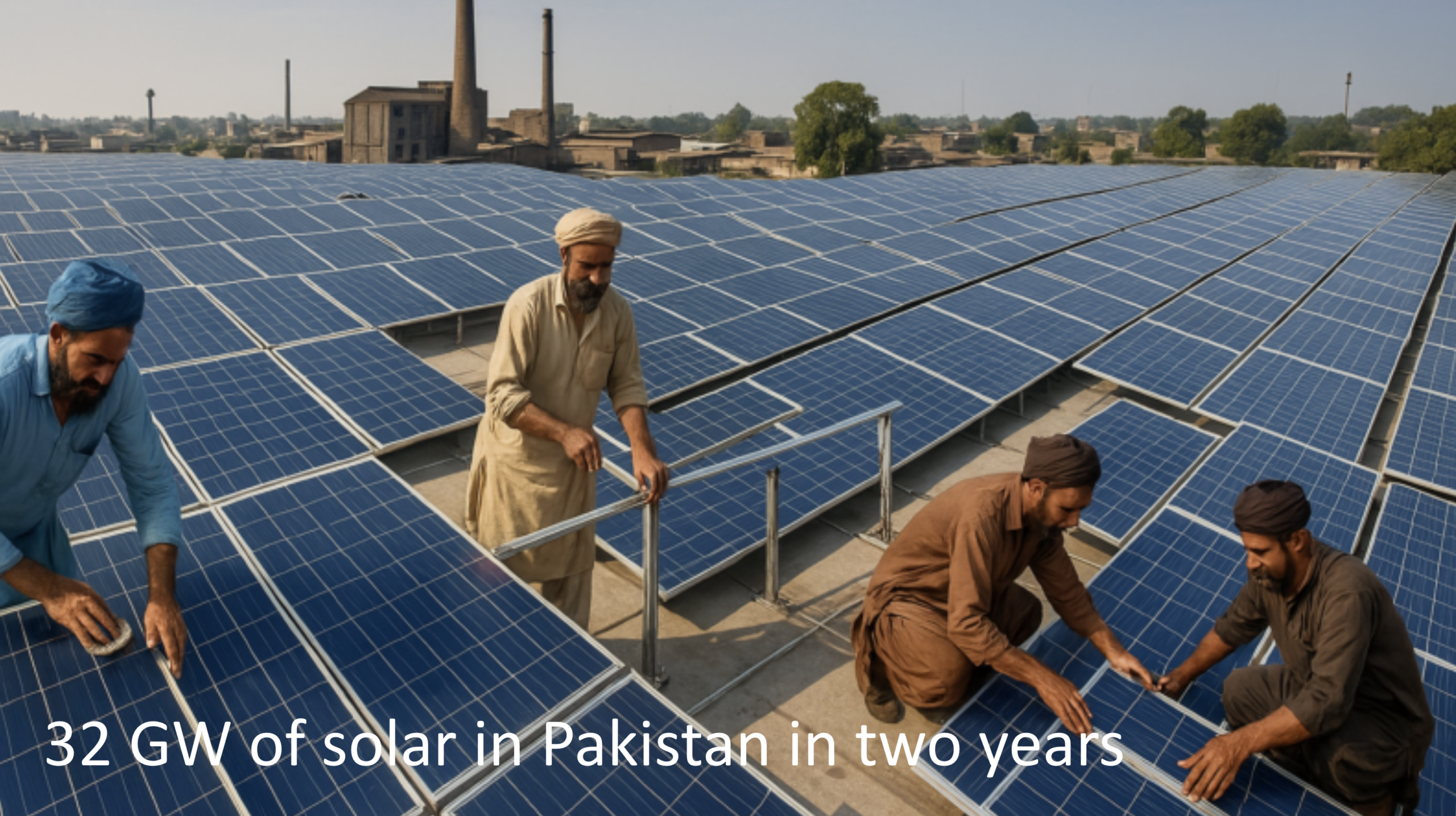
In 2024, people like me who were paying attention started noticing something unusual. We were hearing reports of massive gigawatts of solar panels landing in the country and being installed. By the beginning of 2025, it was counted up. Pakistan had brought in 17 gigawatts of solar panels.
There were YouTube channels showing people how to install them, and panels were going onto every flat surface. Pakistan is one of the global leaders in textile manufacturing. Most of the textile mills and factories in the country are now running largely on solar power.
There were two main reasons. First, the government got out of the way. There’s only a 10% tariff on Chinese solar panels. There were no heavy regulations on self-installation. No mandatory inspections. No pre-approval from city hall. The government also wasn’t anti-Chinese. The Belt and Road Initiative is strong there. China built the HVDC backbone running north to south in Pakistan and helped reconductor many of their transmission lines.
Then in 2025, they did it again with another 15 gigawatts of solar. For context, 32 gigawatts is six times all the solar in Canada. Canada has 11 times the land mass and a quarter of the population. We have absurd amounts of space for solar. We could be covering everything with panels and addressing our energy challenges. Pakistan is just moving ahead and making us look slow. That’s a pocket of the future.
I checked another proof point. That amount of solar could have been matched by massive battery storage behind the meter, because most of this solar is behind the meter. But Pakistan left a 40% tariff on Chinese batteries. As a result, only about a quarter as much battery capacity came in. There’s less time shifting of electricity, more pronounced solar peaks, and they’re accommodating around that.
Still, 32 gigawatts of solar is a massive amount of generation capacity, and it’s not the only thing happening. BYD is building a car manufacturing facility in Pakistan. They’re going to have electric cars from China manufactured in the country long before Canada does.
Two-wheelers are also significant there. Many entrepreneurs are importing electric two-wheel kits from China, branding them locally, and selling them domestically. The country’s two-wheelers are rapidly going electric because it’s cheaper. And they’re charging at home, at the office, at the workplace, because solar is everywhere.
The entire ecosystem is leapfrogging rapidly.

Let’s stay down south, which describes most of the world. Africa. I’ve spent a lot of time looking at different African countries and their solution spaces. I’ve looked at shipping green hydrogen from Namibia to Europe. I was engaged to examine the Maghreb countries—Morocco, Algeria, and Egypt—and European plans to manufacture green hydrogen there for export to Europe. I did that report two or three years ago.
I’ve spoken to energy entrepreneurs in Kenya about pumped hydro in the country, about grid weakness, and about the need for large-scale storage to buffer variability. I’ve spent time reading books like How China Escaped the Poverty Trap by Yuen Yuen Ang, which I strongly recommend. It’s from around 2016 and serves as a corrective to Why Nations Fail by the two Nobel Prize–winning economists, which largely dismissed China in a few pages of hand-waving without much insight.
After about 10 years of looking at different things across Africa, I felt I could say something about the continent as a whole. I coach people not to generalize about Africa if they’ve only looked at one country or one issue. I’ve looked at Belt and Road initiatives, transmission corridor initiatives, and a range of developments across the continent. I’ve read extensively. There’s something interesting happening.
Last year, African countries collectively installed about 2.5 gigawatts of solar. That’s roughly half of all the solar Canada has installed to date. My projection is that this year they’ll do 20 gigawatts, and next year more. The reasons are straightforward.
First, the 55 countries and 1.4 billion people are now part of a free trade zone under the African Continental Free Trade Area. It’s similar to the EU but without a common currency. It was established in 2019 and is still working through governance challenges. It’s imperfect, but border barriers to labor and goods movement are being reduced. It may end up with fewer internal trade barriers than we have between provinces in Canada.
Demographically, the continent has an average age of about 20, compared to Canada’s roughly 40 to 43. That matters. China has also been active through Belt and Road. They’ve built 13 ports. They’ve built 12,000 kilometers of highway for freight transportation. They’ve refurbished thousands of kilometers of railway originally built decades ago for mineral extraction. They assisted with building high-speed rail in Morocco. There is now more high-speed rail in Africa than in Canada.
Governance is also improving. One of the insights from Yuen Yuen Ang’s work was the story of Botswana. Much Western intervention tried to impose fully mature governance systems onto developing countries all at once. What Ang observed was a different pattern. First there were markets and “good enough” governance. Then markets expanded and made countries more affluent. Then governance improved. Then markets expanded further. It was iterative.
Botswana, facing many of the same challenges as other sub-Saharan nations, including poor soils and similar demographics, is now a stable, well-governed middle-income country. That provides a local example. There’s also a broader international practice of “good enough” governance and market creation that helps stabilize and improve countries.
Kishore Mahbubani, the former diplomat from Singapore, writes about this in Has the West Lost It? from around 2019. He documents the rise of better governance in parts of Asia and the developing world, alongside governance challenges emerging in the West. Many Asian countries look at Western political dysfunction and ask why we’re making those choices.
Then there’s the supply side. China may drop from around 300 gigawatts of solar deployment in 2025 to about 200 because of grid constraints. Even at 200 gigawatts, that’s roughly 40 times all of Canada’s solar capacity added in a single year. Those panels have to go somewhere. I think many will go to Africa.
There are about a million people in the Chinese diaspora across Africa. One book I read recently was China’s Second Continent, which documents the Belt and Road Initiative and Chinese diaspora networks. I live in Vancouver. I was recently walking through a mall in Burnaby where nearly every store was a Chinese outlet. That’s enrichment. It’s entrepreneurial energy and trade networks.
This clean energy flywheel is already turning. Solar imports are rising. Those Chinese entrepreneurs are bringing in container loads of inexpensive panels. They’re bringing in millions of electric two-wheelers. Kenya already has battery swapping for electric two-wheelers in Nairobi and other cities.
Africa leapfrogged directly to cellular communications without building extensive landline systems. It’s now leapfrogging in transportation and energy. This isn’t about a solar lantern in a shack. It’s about industrial-scale power and transportation systems being built rapidly, flowing across borders with fewer labor and goods mobility constraints.
It will be messy. But it will be fast.
Now to another country south of us. I’ll say again, there are some countries north of us, but coming up is India.
For those of you who’ve spent time dealing with rail or looking at rail corridors in North America, one of my previous clients was Canadian National Railway. You’ll note there are no overhead wires, no pantographs drawing electricity into locomotives. We are a serious global outlier.
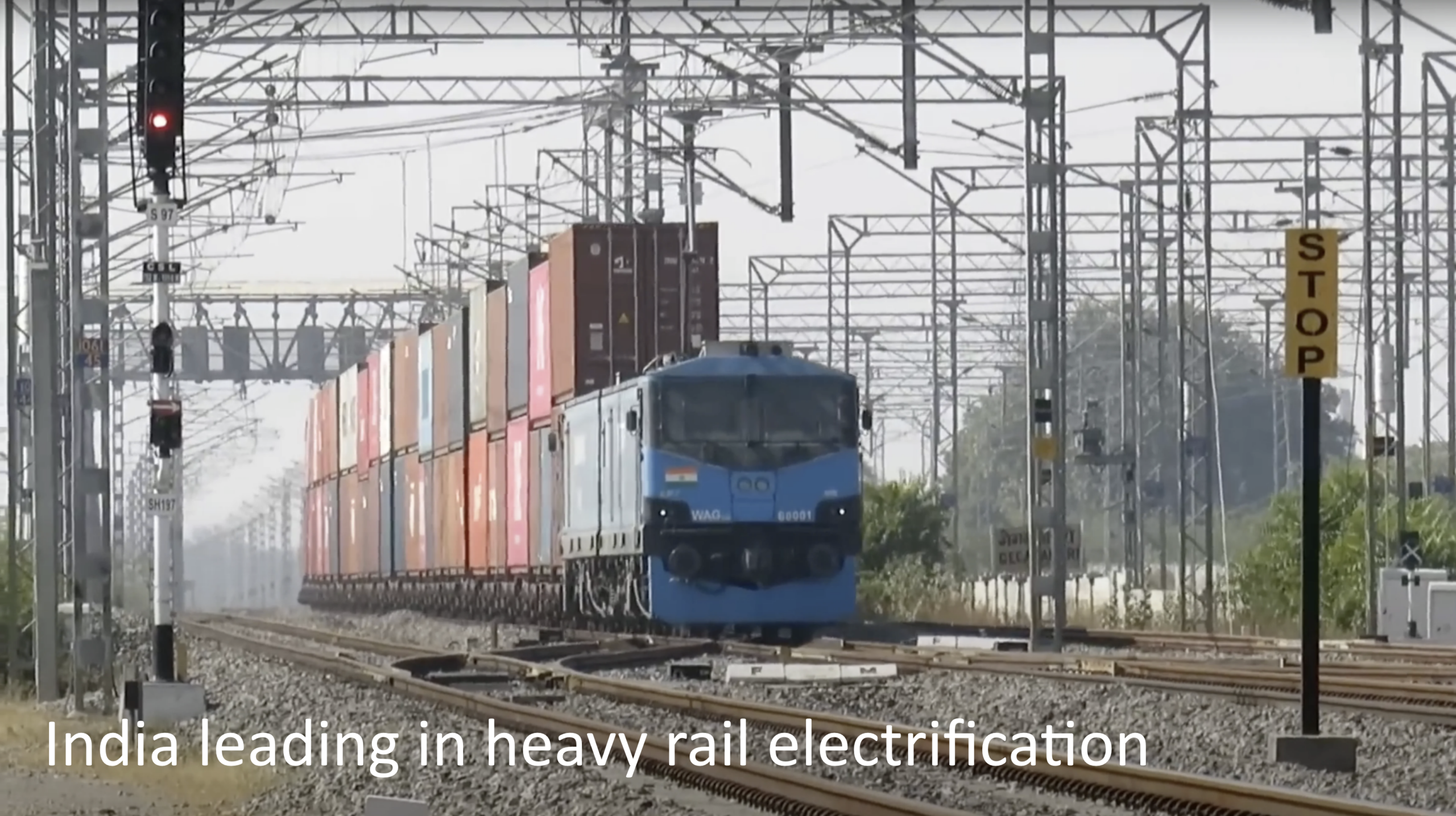
India, by contrast, moves virtually 100% of its domestic freight by rail. They started electrifying about 15 years ago, and they’re now at 99.7% rail electrification. The last bits are the hard, unusual segments. They’ve essentially finished. The momentum has slowed because they’re basically done.
That’s not the only thing happening globally. China is at about 80% rail electrification, and all of its 48,000 kilometers of high-speed rail is electrified. Indonesia’s high-speed rail is electrified. Indonesia has more high-speed rail than Canada. In fact, it has more than all of North America. Morocco’s high-speed rail is electrified. Japan’s high-speed rail is electrified. In Europe, about 60% or more of all rail is electrified.
The economic testing is clear. Wires for the easy segments and batteries for the difficult ones, such as tunnels and bridges that weren’t initially wired, is the lowest-cost way to move energy for rail. Electrifying rail isn’t expensive if you avoid electrifying the hardest parts and bridge them with batteries. That pattern is now emerging globally.
The UK, for example, has been spending up to three times more per kilometer than necessary because they insist on electrifying tunnels and rebuilding bridges to accommodate wires. If you remove those constraints and use batteries for the complex sections, costs can drop to a third. That’s the pattern coming out of the data.
In North America, we have structural problems. Rail lines are privately owned, not government owned. That’s unusual globally. These companies are governed by strict shareholder fiduciary rules. Their responsibility is shareholder returns, not broader stakeholder outcomes. That drives a quarterly earnings mentality. It discourages long-term strategic investments.
As a result, North American locomotive fleets are old. If companies buy new locomotives, they must meet higher efficiency standards, which makes them more expensive. So they keep locomotives from the 1970s running longer, even though they pollute more. Boards and shareholders resist the capital expenditure.
Meanwhile, about a third of rail revenue in North America comes from coal. That’s going away. Another significant portion is oil, also declining. That freight won’t be electrified.
At the same time, electric trucking is already lower carbon per kilometer than rail freight in North America. Major customers like Amazon are demanding lower CO2e per ton-kilometer. As electric trucks scale rapidly, rail will lose high-value container traffic. Revenue will fall.
We also have roughly twice the kilometers of rail per ton of freight compared to other major geographies. Our network is long relative to freight volumes. The economic pressure will build. My projection is that major North American railways will eventually face insolvency, be nationalized, and only then will we see serious rail electrification. That may take 20 years.
That’s where we are.
Now, down to Latin America.

Bogotá in Colombia, where I’ve been, I was there in 2012. I have to say, the air was bad. They had poor emissions controls on diesel vehicles and cars. Unlike São Paulo, where I was based, there was no corn ethanol or sugarcane ethanol blended into fuels. The air was polluted. They also experience temperature inversions, which made it worse. It was a combination of problems.
Now Bogotá has one of the largest electric bus fleets outside of China. There are about 1,500 electric buses operating on the roads. That’s far more than Canada has operating or on order. And these are not small buses. They include triple-articulated buses, the largest type of mass transit bus in operation. They are battery electric. The city made electrification a core requirement.
They’re not alone. Santiago in Chile has a similarly large fleet of electric buses. In Kenya, there are tens of thousands of electric buses on order. Across the developing world, as cities electrify and expand transit systems, they are leapfrogging directly to battery electric buses.
The reasons are straightforward. No tailpipe air pollution. Very low operating costs. And many of these countries face foreign exchange pressures from importing petroleum. Fuel imports are a major line item in national budgets. Every ton of petroleum they avoid importing preserves foreign reserves and helps stabilize their currency. That’s a powerful driver for electrification.
China, of course, is the global leader. They have roughly 700,000 electric buses. Shenzhen alone had about 16,000 five years ago. They electrified rapidly and at scale.
Consider Harbin in China. If you like winter cities and ice festivals, look up Harbin. It’s similar to Edmonton in climate, perhaps even colder. Every winter it builds a multi-hectare ice city with ice bars, ice restaurants, and international ice sculpture competitions. All of Harbin’s buses are electric.
They treated winter as an engineering problem. They insulated the buses. They used heat pumps. They installed radiant heaters similar to patio heaters to keep passengers warm. The buses perform just fine.
For those in Edmonton, where hydrogen bus trials are underway, complaints about winter performance often reflect design and procurement choices rather than fundamental limits of battery electric buses.
Electric buses are a global pocket of the future. They work. They compete economically. People accept them. In fact, people prefer them. They’re quiet, and they don’t pollute the air.
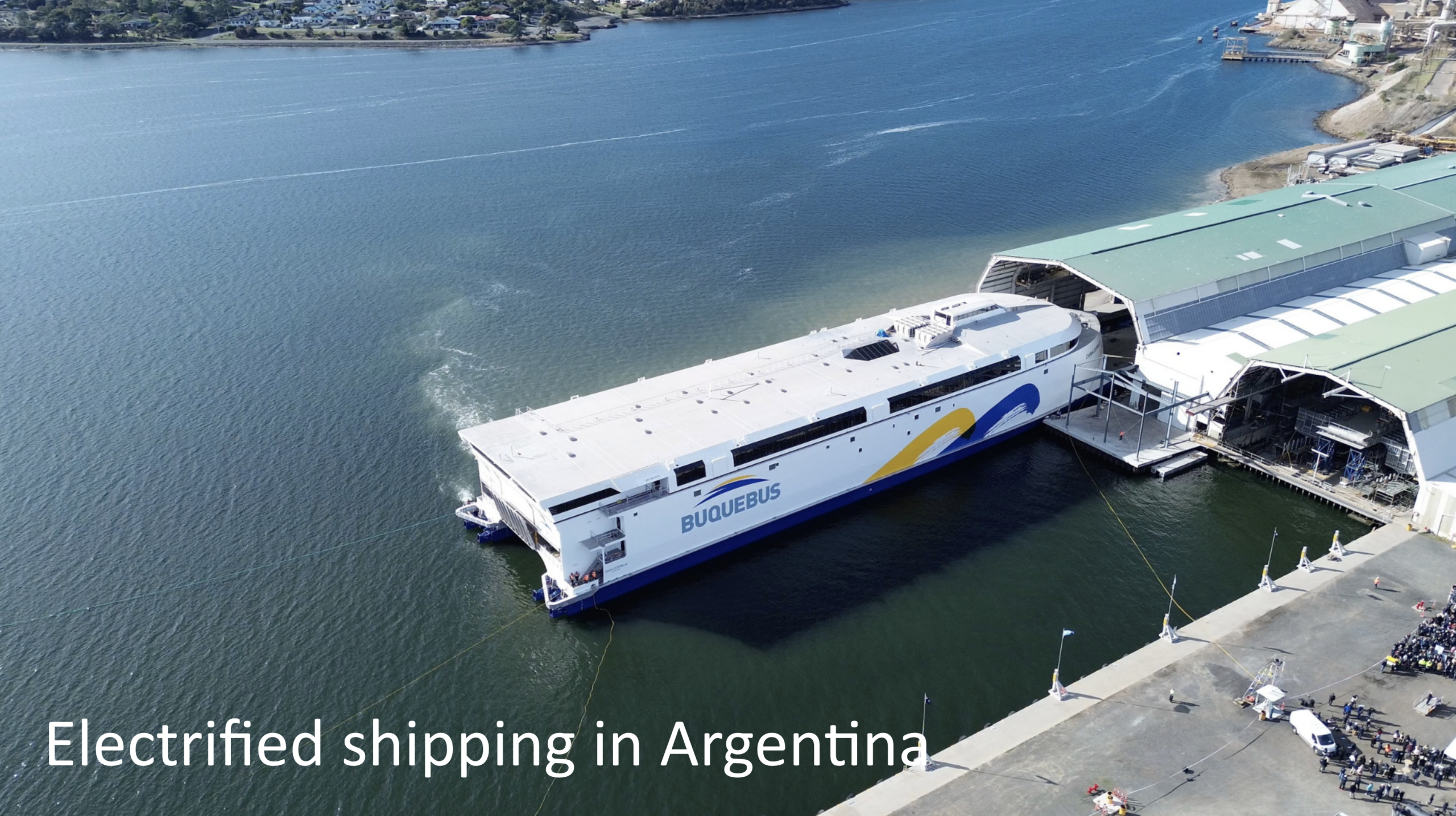
Further south, and another form of mass transit, there’s the Buquebus ferry China Zorrilla. China Zorrilla was a famous Uruguayan actress, maybe the Meryl Streep of Latin America. I haven’t watched any of her films. Despite trying, I failed to properly learn Spanish or Brazilian Portuguese. I was briefly conversational in Brazilian Portuguese, but I’ve lost it.
They named this ferry after her. It will run five times a day between Buenos Aires and Uruguay at 25 knots. It’s roughly the scale of the Spirit Class ferries in British Columbia, the largest ferries in Canada. It’s a medium-scale roll-on, roll-off passenger and freight vessel with capacity for about 2,100 passengers and roughly 300 cars or trucks.
It’s a catamaran built in Tasmania, now undergoing final sea trials before delivery to Uruguay. When it charges in Uruguay, it will be charging on virtually 100% renewable electricity. Uruguay has leapfrogged to nearly 100% renewable power, as much of Latin America has. Uruguay is far from the only country that has done this.
They’re buying it not primarily because it’s environmentally friendly or because it avoids the smell of marine diesel, but because it pays for itself in seven years on a 30-year vessel life. It has a seven-year payback because it runs on electricity. It’s the same size as our Spirit Class ferries and it’s faster.
There’s a larger one on order for northern Europe with roughly double the car capacity and several hundred more passenger spaces. About 70% of ferries currently on order globally have electric drivetrains. The Island Class ferries ordered in British Columbia are about a quarter of the capacity of this vessel. They’re hybrid for now, but once shore power is available at all docks, they will operate as fully electric vessels.
If it were just ferries, you might say it’s niche. But consider container ships. In China, there are now two 700-TEU container ships operating 1,000-kilometer routes on the Yangtze River. They are battery electric.
They use swappable battery containers. About 36 battery containers are distributed among the ports along the route. When a ship docks, depleted battery containers are winched off, plugged in to charge just like refrigerated containers, and fully charged containers are winched back on. Container ships already have crew members responsible for plugging in refrigerated containers. This is operationally similar.
From a software perspective, it’s just another container type and status code added to container management systems. There are five or six major vendors globally. It’s incremental integration.
Ports themselves are increasingly electrified. I worked with Sahar Ratchford Begi, who was responsible for decarbonization across APM Terminals, Maersk’s terminal division, which holds concessions in the majority of the world’s major container ports. Electrification of port equipment was central to that work. CATL, the large Chinese battery manufacturer, has joint ventures focused on port batteries and also partnerships with Maersk. CATL supplies batteries for vessels and is increasingly integrated into logistics networks.
The Center for Maritime Decarbonization recently released a report acknowledging that batteries will play a major role in larger ships. That recognition is spreading.
What we’re seeing is a clear pattern. Hundreds of container ships will electrify for inland and nearshore routes. Deep-sea shipping will increasingly hybridize. The trajectory is visible in current orders and deployments.

Here’s a large drone placing a strange silver ball on a transmission line in Norway, north of much of Canada. For anyone in Toronto, Norway is north of you. The device is a Heimdall Neuron. It’s part of a dynamic line rating system. A heavy-lift drone drops it into position, and it clamps onto the line automatically.
It’s powered by induction from the transmission line itself. It doesn’t need batteries. It simply draws energy from the current flowing through the conductor. It contains three core components: a mesh network communications link to transmit data back to the control center, an ambient temperature sensor, and a line temperature sensor.
When transmission and distribution systems were built decades ago, engineers relied on rules of thumb and tables. They knew the materials, the expected ambient temperatures, and used lookup charts to determine how much current a line could safely carry before sagging too much and risking faults or fires, as happened in California. The conductors are typically steel and copper. When those materials heat up, they expand and sag. That’s physics.
With real-time temperature sensing, AI-based inference, and modern high-resolution weather models that capture microclimates at the square-kilometer scale, operators now have much more accurate data. They can determine actual ambient and conductor temperatures and safely push more electricity through existing lines without exceeding sag limits. In some cases, operators have increased capacity by up to 30% on existing lines using dynamic line rating. In one example, a parallel transmission line was decommissioned because a single line, properly monitored, could carry sufficient load.
That’s only part of the story. Reconductoring is another major upgrade. Old steel-and-copper lines are replaced with advanced conductors made of carbon fiber cores and annealed aluminum. Aluminum naturally anneals when heated, so pre-annealing stabilizes its performance. Carbon fiber cores do not sag significantly when heated. The aluminum is lighter, allowing higher-capacity conductors to be installed on existing pylons. More power can flow through the same corridor.
For new transmission lines, these materials allow pylons to be spaced further apart, reducing overall infrastructure costs. In North America, companies like TS Conductor are prominent in this space. But Pakistan has already reconductored roughly 70% of its transmission lines.
Why? Climate. Pakistan is closer to the equator. It’s a hot country getting hotter. Rising temperatures were increasing sag and reliability problems. Reconductoring was the logical response.
One study indicates that with dynamic line rating and other grid-enhancing technologies, the United States could achieve about 85% of the additional grid capacity required for full electrification without building new transmission or distribution corridors. That’s transformative.
Will people accept replacing conductors on existing transmission lines? Yes. Will they accept a drone installing a sensor device on a line? Yes. Will they accept entirely new transmission corridors in North America or Europe? The evidence suggests no.
That makes grid-enhancing technologies a critical part of the solution stack.
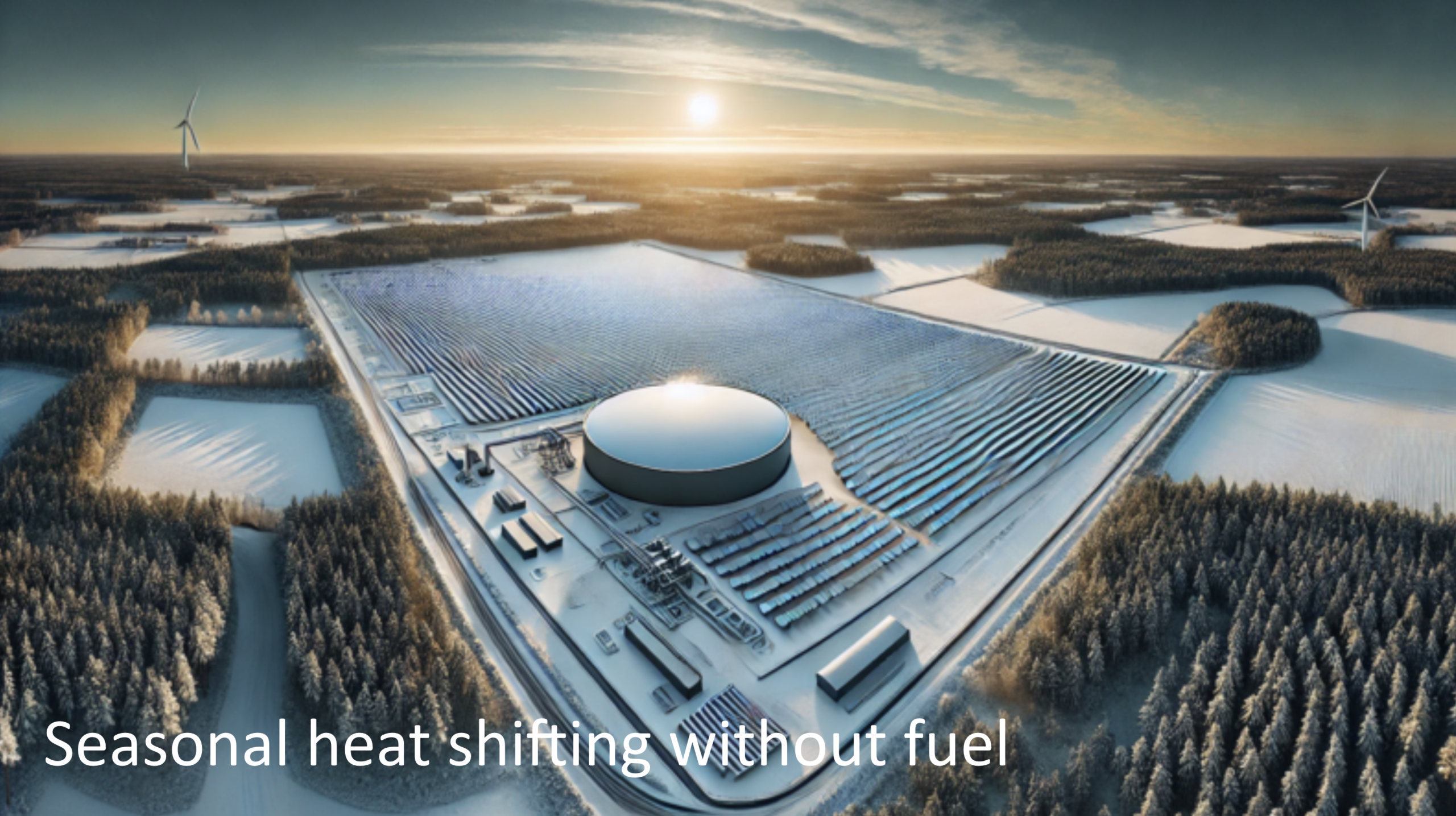
Back to the north. This is in Denmark. This is an AI rendition of a seasonal thermal energy storage solution. They capture solar heat in the summertime, store it underground, and extract it in the winter using heat pumps.
If you think this isn’t relevant to Canada, consider Okotoks, Alberta. Am I getting that right, Jim? Okotoks. Is that north or south of you?
James Byrne [JB]: A little north. Just south of Calgary.
MB: Okotoks, Alberta, about 19 years ago, installed one of these systems. For roughly 17 years, it delivered about 92% of the community’s winter heating through seasonal thermal energy storage. Then it wasn’t maintained properly. About two years ago, Alberta decommissioned it and went back to heating with natural gas. You can’t win them all. But we did have a working example in Canada.
This isn’t an isolated case. In the Netherlands, where I spent a week last year with the transmission system operator working on 2050 scenario planning, there are about 3,000 aquifer thermal energy storage systems. Three thousand.
They drill into existing aquifers and store heat in the summer and cold in the winter. The systems are thermally balanced, providing lower-cost heat in winter and lower-cost cooling in summer. This is a highly scaled technology.
When I first looked at this during a geothermal deep dive last year, I didn’t think seasonal thermal energy storage would prove viable. I was wrong. It’s significant. It’s global. It’s accessible.
With directional drilling techniques developed by the oil and gas industry, it’s even more practical. We can reach depths of 600 meters to access hotter thermal resources and brackish water, avoiding concerns about freshwater depletion or groundwater chemistry changes. And with directional drilling, those wells can be reached from kilometers away.
It’s another pocket of the future.
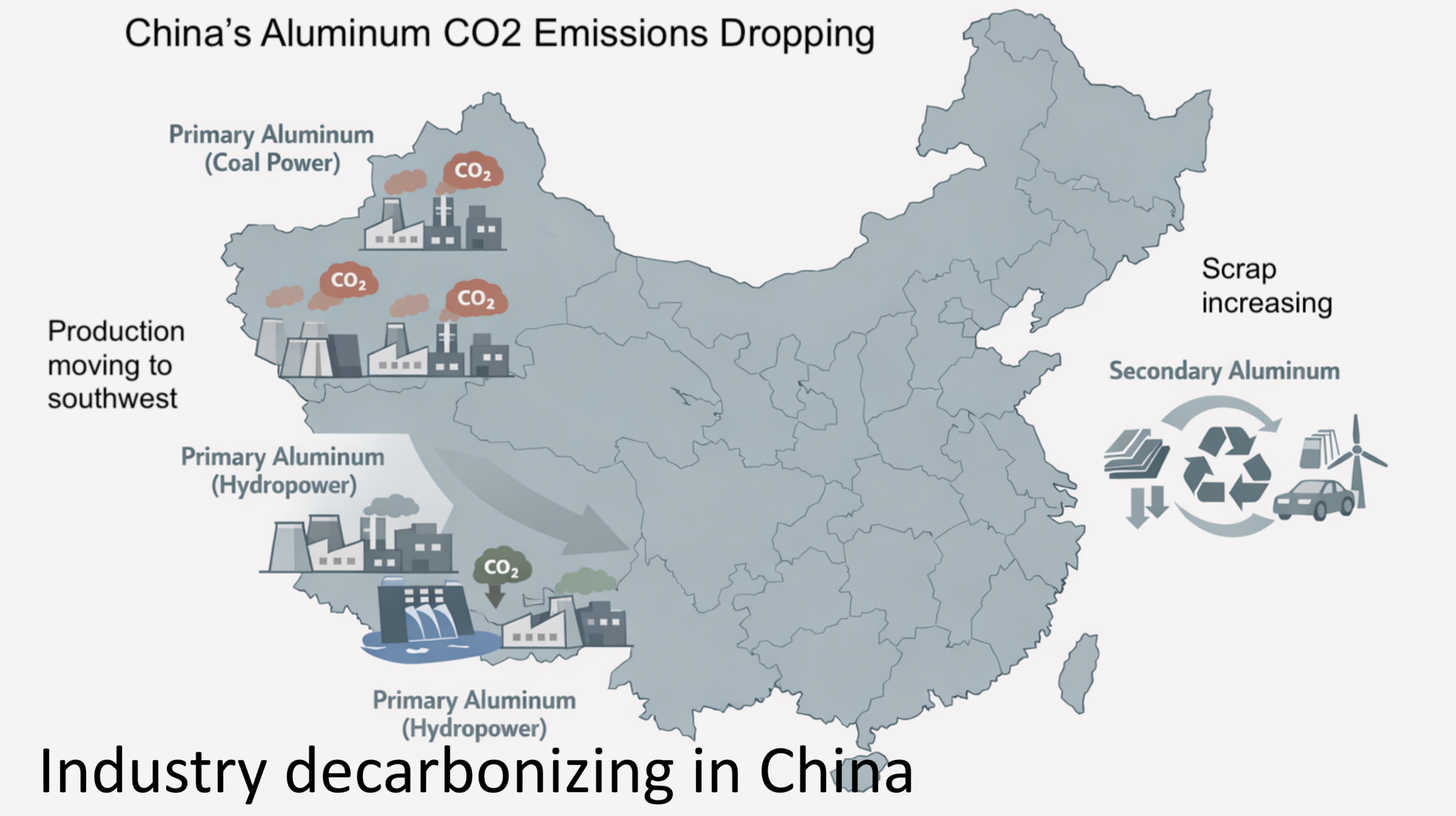
I’m a bit unusual. If a question occurs to me, or someone asks me something interesting, I have trouble resting until I’ve answered it. Some people wake up thinking about pickleball. I wake up wondering what aluminum is doing in China. Then I go find out.
About 60% of the world’s aluminum is manufactured in China. For almost any manufacturable product, you can ask whether China makes half of it or more. With aluminum, the answer is more than half. And aluminum is carbon intensive.
It takes about 13 megawatt-hours of electricity to produce one ton of aluminum. In Canada, we produce aluminum next to hydro dams, much of it in Quebec. In China, when aluminum production ramped up, they didn’t have enough hydro in the right places. They had bauxite and coal in the northwest, so they built coal plants to power aluminum smelters. That created hundreds of millions of tons of CO2 emissions. Aluminum became a significant part of China’s carbon profile.
Then in 2012, the Three Gorges Dam came fully online, followed by additional hydro capacity in the southeast. China began building aluminum plants in the southeast and shutting down the least efficient, highest-emitting plants in the northwest. They also began scaling wind, solar, and battery storage in the northwest, so remaining smelters there increasingly purchase cleaner electricity.
At the same time, China expanded aluminum recycling. Domestic scrap now supplies about 11 million tons annually, and projections suggest that could reach 25 million tons per year by around 2040. Roughly a third of China’s aluminum capacity is now located in the southeast, where electricity is much cleaner.
When I mapped carbon emissions for China’s aluminum sector, the data suggested emissions likely plateaued in 2023 or 2024, even as total aluminum production continued to rise. Production is increasing, but emissions have flattened and are likely to decline significantly through 2040. My projection is that emissions could fall to a third or even a fifth of current levels by then.
That’s a significant positive development. China produces 60% of global aluminum. If you have aluminum products at home, there’s a strong chance they were made in China. And the carbon intensity of that aluminum is declining.
It’s also a broader story about industry moving to where clean electrons are available. Germany’s industrial base relied heavily on inexpensive pipeline gas from Russia. With that disrupted, energy costs rose and manufacturing is struggling. At the same time, industrial investment is shifting toward Spain and Portugal, where there is abundant wind and solar capacity.
We’re seeing industry relocate to where clean electricity is plentiful and affordable.

More drones. I spoke to a guy named Arthur Erickson, not Canada’s Arthur Erickson, but a Texan aerospace engineer who founded Hylio.
Hylio makes 14-foot-diameter heavy-lift drones that carry about 200 pounds, roughly 90 kilos, of agricultural products and spray them autonomously using precision agriculture techniques. The routes are programmed into the drone’s guidance system the night before at the farm table or at the offices of the spraying service.
Two drones cost about $200,000 and can cover as much ground in a day as a $700,000 John Deere tractor. They sip electricity instead of guzzling diesel. They don’t compact soil. They can operate when the ground is wet to apply fungicides precisely where needed. The rotor wash pushes the spray down into the crop canopy, reducing overspray.
They follow field boundaries precisely. They can operate under power lines at the edge of fields. They can reach corners that are difficult for helicopters. They reduce agricultural chemical use by 30% to 50%. At the same time, drone spraying increases overall yields by about 3% to 5% globally, using less product to do it.
That product includes nitrogen-based fertilizers made from ammonia, which is produced from natural gas or coal. Reducing application reduces fossil fuel demand. DJI data suggests that roughly a third of Chinese agricultural fields are sprayed by drones. This is a major growth area.
If you live in an agricultural region without a drone spraying provider and know someone entrepreneurial, tell them about this. It’s a viable business model. I was speaking to someone from Vancouver Community College yesterday at a conference, and he immediately said he wanted to start such a company. I told him how I would approach it.
Then there’s agrigenetics. Pivot Bio, co-founded by PhD geneticist Karsten Temme, engineered soil microbes that naturally fix nitrogen around corn roots. Normally, those microbes have a nitrogen-sensing switch. When synthetic fertilizer is applied, they shut down nitrogen fixation and simply multiply. The corn roots emit glucose to feed the microbes, and in exchange, the microbes supply nitrogen.
By turning off that sensing switch, the microbes continue fixing nitrogen even when fertilizer is present. The result is roughly a 30% reduction in ammonia-based fertilizers across more than 30 million acres of U.S. corn.
That means less natural gas consumed to produce ammonia and lower emissions of nitrous oxide from fertilizer decomposition in fields. Nitrous oxide has a global warming potential roughly 265 times that of CO2 over 100 years.
Precision agriculture and biological nitrogen solutions are reducing fertilizer use, cutting emissions, improving yields, and lowering environmental impacts.
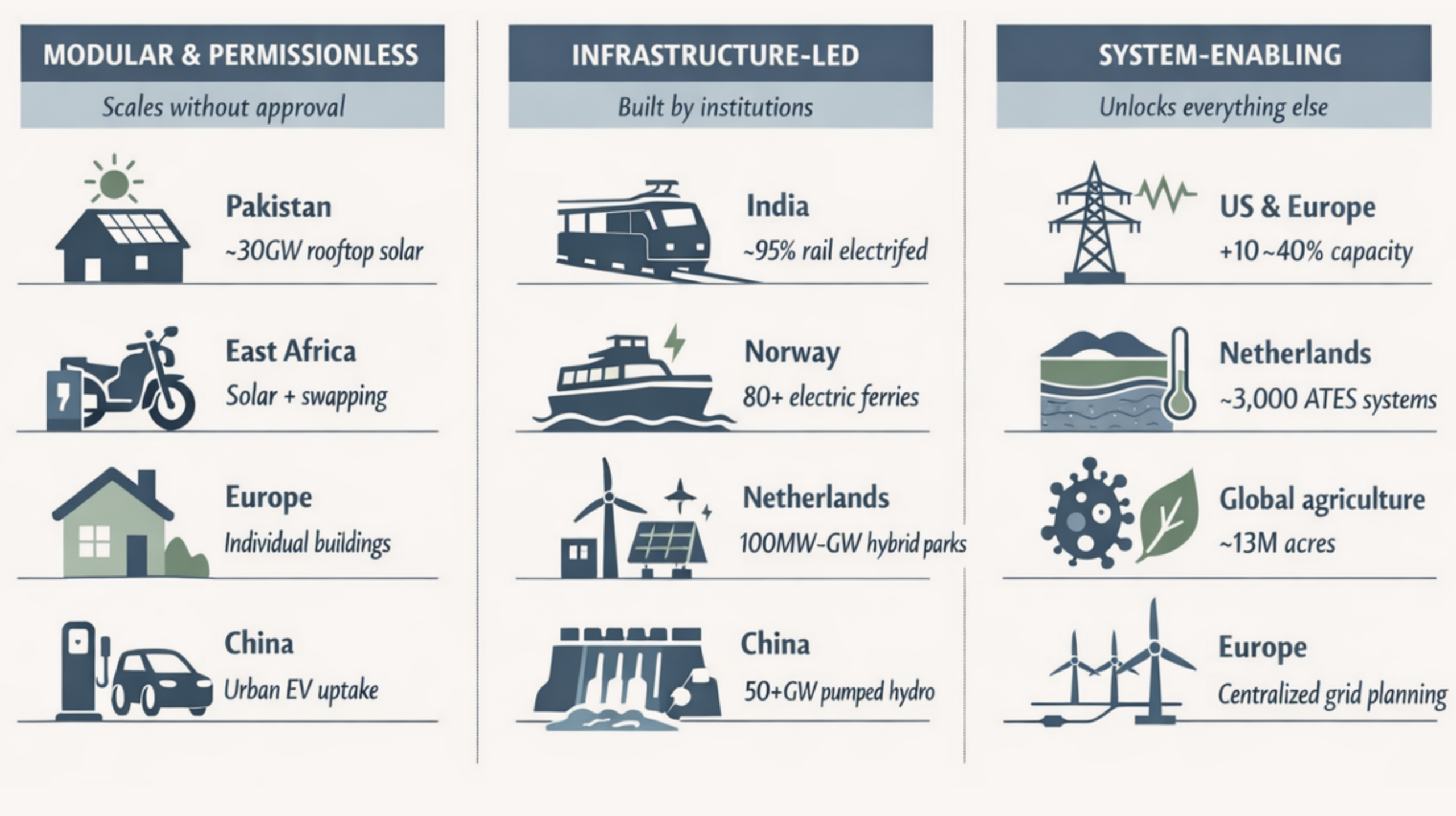
Three different patterns show up repeatedly.
The first is modular and permissionless. In Pakistan, the government largely got out of the way. It didn’t create barriers, and solar scaled rapidly. In East Africa, people are importing solar panels and electric motorcycles, putting up solar canopies, plugging in to charge, and building the system from the ground up. It’s distributed, incremental, and fast.
The second pattern is institutional infrastructure buildout. In Norway, companies like Norled and others are deploying electric ferries at scale. In China, there are about 365 gigawatts of pumped hydro either operating, under construction, or planned to begin construction by 2030. That’s coordinated, capital-intensive infrastructure.
The third pattern is unlockers. Transmission expansion is a major unlocker. Thermal energy storage is another. Centralized grid planning is a third. Europe is moving toward a more centralized grid architecture approach, planning transmission scenarios and energy flows across the continent rather than relying solely on bottom-up, country-by-country planning.
Those are three useful lenses: modular and permissionless deployment, institutional infrastructure scaling, and system unlockers. When you look around the world at what’s happening, these patterns help make sense of it.

Our Major Projects Office has a range of headline projects, some of which don’t make much sense and likely won’t come to fruition. My projection is that only about a third of the LNG plants proposed will actually be built, and even then, only a portion of their announced capacity. One of them, the facility in Squamish, is unlikely to remain viable past 2041.
But beyond LNG, there are significant opportunities. There are electrification initiatives for ports. There are billions available that can be accessed. The Major Projects Office includes substantial transmission projects. Crown corporations can now use clean electricity tax credits for transmission infrastructure. That unlocks projects for final investment decisions and supports the incremental backbone of a potential cross-Canada HVDC grid.
There are also mining projects in the portfolio. There’s a full critical minerals strategy. Significant funding is allocated for critical minerals extraction and processing to support the electrified economy. These commitments already exist in current budgets.
There are billions of dollars available that could help position Canada as an electrostate rather than a petrostate.

The future is already here. The question for each of you is what you will choose in your region. Which pockets of the future will you pull in and scale? We don’t need to invent much that’s new. The infrastructure funding is available. The examples exist.
Questions?
Martin Bush [MBush]: Thank you, Michael. What’s encouraging is that this is all good news. I’ve been criticized recently for focusing too much on the negative developments. But everything you’ve discussed is genuinely encouraging. It’s impressive.
We do have some questions. I see two people with their hands up, actually three. But I’ll start with the Q&A. Some of the questions may be more commentary.
Are you familiar with the Dryland Solutions Initiative? It focuses on turning desert and poor-soil areas into productive grassland and farmland.
MB: Sorry, I didn’t talk about this earlier, but China is reforesting enormous areas of land. Part of that stems from policies addressing massive deforestation that happened under Mao. They’ve reforested an area much larger than the size of France. In Africa, there’s a “green wall” ecosystem emerging to hold back the Sahara, just as China has large-scale efforts to keep the Gobi Desert at bay.
Rewilding — restoring grasslands, restoring forests, and making marginal land more productive — is happening around the world. I haven’t specifically studied the Dryland Solutions Initiative you mentioned, but I’ll look it up. One brain can only watch so much at once.
MBush: Obviously, for electrification to deliver climate benefits, the electricity needs to come from non-carbon sources. We’ve talked a lot about electrification on the end-use side, how efficient and effective it is. The question is whether, everywhere we see electrification, the generation is actually clean, or whether there’s a disconnect that isn’t being taken into account.
MB: Mostly that’s a red herring, for two reasons.
First, take electric cars. You would have to be on a grid powered almost entirely by coal for an electric car to be worse than an internal combustion vehicle on a lifecycle basis. That’s increasingly rare.
Second, as grids decarbonize over time, anything that runs on electricity gets cleaner automatically. If you’re running a heat pump or driving an electric car, the carbon intensity of that device declines every year as the grid improves. If you own an electric car for eight years, by year eight it will be emitting significantly less CO2 per kilometer than it did in year one.
So it’s not a chicken-and-egg problem. It’s not about which comes first. You do both.
Question: China is capitalist. We all understand that in its own form. At our core, we operate within capitalism as well. What I’m hearing here isn’t hidden knowledge. None of this is secret for anyone who wants to look for it.
So the question becomes: what’s wrong with Canada? Is it politicians? Is it the system? Is it the people? Is it all of the above? Where are we?
Based on all of this information, and having been to China a couple of times myself, are we at risk of becoming a developing country while celebrating our free market and our version of capitalism?
I keep coming back to that question: what’s wrong with us? Thank you.
MB: That’s a great question. I’m going to ask you something and ask all of you to hold a number in your head. What percentage of Canada’s GDP comes from oil, gas, and coal?
At one of the top business schools in Toronto, students were asked that question. The lowest answer was 30%. The highest was 60%. The actual answer is about 5%.
We’re being fed a narrative that the fossil fuel industry represents a much larger share of our economy than it does. That predisposes voters to overvalue it and to overestimate the economic harm of moving away from it. That narrative needs to change.
The second point is less discussed. Over the past decade, the Trudeau government significantly diversified Canada’s economy. The share of GDP from a broader mix of sectors increased. Montreal became a global center of AI excellence. Two of the three leading figures in modern AI are based there. In British Columbia, we developed strength in digital twins, building on the video game industry’s capabilities.
The government created industrial innovation clusters in five strategic areas. They weren’t perfect, but they were coherent. Montreal leaned into AI. British Columbia leaned into digital technologies. These policies strengthened and diversified the economy. Yet the Liberals received little credit for that work. Regardless of partisan views, it’s important to acknowledge that meaningful economic diversification occurred.
So part of the issue is narrative. The story about fossil fuels is distorted. The understanding of where Canada’s real economic strength lies is incomplete.
I’ll also say this as a progressive. Many of us assume that if we just present facts, people will understand and make what we consider the right decision. That’s not how people make decisions. Moral foundations matter.
There’s a body of research on moral foundations that identifies roughly six core value categories people use in decision-making. Progressives tend to emphasize fairness and equity. We communicate in those terms and speak largely to people who already share those priorities.
More conservative audiences distribute weight more evenly across all six foundations, including authority, loyalty, and sanctity. If we ignore those values in our messaging, we fail to connect.
The practical advice is to pair values. Combine fairness or equity arguments with appeals to stability, responsibility, or national strength. That broadens the coalition and reduces polarization.
Communication matters as much as economics.
Next question.
Question: I’m in Ottawa, which covers about 2,800 square kilometers. That’s a lot of land and a lot of opportunity to build a stronger nature-based, nature-positive economy. One of those opportunities could be mass timber.
Within Ottawa’s municipal boundaries, there probably isn’t sufficient forest stock to support large-scale mass timber production. There are also constraints around supporting industrial production at the regional plant scale I described earlier. But on a regional basis, Ottawa could potentially act as a consolidator or industrial hub, drawing on wood fiber from surrounding areas.
The question is how to get the analysis done. Ontario now has improved forest inventory data, partly due to fire protection requirements. That provides better information for urban and peri-urban areas, including Ottawa. Forest companies also maintain detailed inventories in managed forest regions.
If you wanted to generate preliminary numbers to start conversations with city council and economic development officials, how would you do that? Who should you talk to?
Those are the practical next steps.
MB: I have three answers for you.
First, regionalized mass timber hubs are exactly the right approach. There’s a strong opportunity for one in Ontario. I probably wouldn’t locate it in Ottawa itself, given the region’s industrial history, but there is a role for Ottawa.
Second, pick up my report on mass timber as industrial policy from last year. Search for “Michael Barnard Mass Timber CleanTechnica” and you’ll find it. It walks through the segments, fire performance, supply chains, and case studies. That will give you a structured starting point for discussions.
Third, Ottawa’s real opportunity may be digital. Mass timber is a highly automated, digitally integrated construction approach. It depends on BIM integration, digital twins, shared design platforms, and precision manufacturing. Kanata’s strength in the digital economy could position Ottawa as a national software and systems hub for mass timber infrastructure. That’s a meaningful role in the value chain.
Another angle is federal alignment. Ottawa has a concentration of federal agencies. I would identify the federal bodies that deal with forestry and timber innovation and begin conversations there. Explore optimal species, rotation timelines, and economic models. Harvesting for engineered wood products may involve different rotation strategies than traditional softwood lumber.
You also need to look at geography. Where is the boreal forest? Where are the nearest lumber mills? If there’s a nearby lumber town, Ottawa could support revitalizing that industrial base and then act as a demand anchor. City council could commit to using mass timber for new municipal buildings. That kind of procurement commitment creates predictable demand and de-risks private investment.
Ottawa may not be the manufacturing site, but it could be the digital hub, the policy hub, and the guaranteed customer. That combination can be powerful.
Question: Just once again, related to timber. I missed the very beginning of your presentation, but I’m curious, and it ties into the last question. What do you think the impact would be if we switch more to that type of technology?
I understand there’s less of a carbon debt compared to steel, but from what I’ve read, there has been less replanting than harvesting of timber crops. Even with replanting, you can end up creating monocultures, which are less beneficial for wildlife.
Would there be consideration of the broader environmental impacts in that regard?
MB: Part of the argument for mass timber is that it’s a high-tech, high-margin product that gives the forestry industry the revenue and capital it needs to reinvest in forest management. Right now, we’ve been drifting toward low-value outputs. Drax in Scotland has been wood-chipping lumber and sometimes even raw logs to pelletize and burn for thermal power. That’s a low-margin use. In some cases, raw logs from B.C. are exported to Japan to be turned into toothpicks. We send two-by-fours as low-value framing lumber to the United States.
If we move up the value chain, we increase skill, revenue, and profitability in Canada’s forestry sector. That gives the industry the financial capacity to invest in better silviculture and manage forests properly. Right now, we’ve been starving the industry while also demonizing it.
Mass timber is a vastly superior use of wood. Like wind turbines and solar panels compared to coal or natural gas, it is so much better that letting the perfect be the enemy of the better makes no sense. Mass timber construction is dramatically better from a carbon perspective. It creates the opportunity to invest meaningfully in forest stewardship and long-term sustainability. That’s my answer.
Question: Thank you, Michael. That was fascinating. I have a comment and a question tied together.
When you were talking about your filters — will it work, will it compete, will humans accept it — what immediately came to my mind was a fourth filter: who has the power to get in the way of it?
In Ontario, projections suggest that by 2040, about 70% of electricity generation could be based on nuclear reactors. My question is whether that represents a pocket of the future or a lock-in of the past.
MB: That would be a lock-in of the past. I like nuclear energy. It works well up to about 40% of a grid. Beyond that, its economic and technical inflexibility starts to create distortions. Ontario already has a high share of nuclear generation. Over time, it should allow some units to retire and replace incremental demand growth with wind and solar.
I will say this: 70% nuclear by 2040 is unlikely for practical reasons. Ontario hasn’t built a new nuclear plant in decades. Much of the workforce with hands-on experience has retired. The planned reactors are not CANDU units, so they involve different designs and supply chains. That introduces new learning curves.
Small modular reactors are first-of-a-kind projects using designs that are not yet fully commercialized at scale. First-of-a-kind projects historically face schedule delays and cost overruns. Large nuclear projects already rank among the highest-risk infrastructure projects for cost and timeline overruns. Combining nuclear with first-of-a-kind deployment multiplies risk factors.
As a result, the 70% projection is unlikely to materialize by 2040 simply because projects will take longer and cost more than planned.
More broadly, nuclear often functions politically as a way to signal climate seriousness without rapidly restructuring the rest of the energy system. It promises low-carbon power in the future while allowing continued reliance on gas in the present.
Ontario’s energy direction ultimately reflects political choices. If voters want a different energy mix, that requires political engagement and communication that resonates across different value systems. Energy policy follows governance, and governance follows public priorities.
Question: I have two questions. One relates to what was just discussed about nuclear. You said earlier in your presentation, which I found excellent, that if something is cheap and does the job, it will scale. We’re not seeing that with nuclear. It’s not cheap and it’s unlikely to do the job, yet billions are being invested in it. But that’s not the main issue I want to raise.
I’m sitting on an organic farm in central Ontario, my son’s farm. When I heard you describe drone applications of pesticides and nitrogen fertilizers as the wave of the future, it worried me deeply. I’m also a beekeeper. I’m very concerned about the impact of pesticides on pollinators, which are disappearing rapidly. Birds as well. I’m concerned about soil health.
It’s positive that drones don’t compact soils the way tractors do and that they can apply materials more precisely. But my question is this: how do you account for environmental factors beyond emissions? These technologies may reduce carbon impacts, but they are still applying substances that can be harmful to ecosystems. I would like you to speak to the broader environmental implications, not just the emissions reductions.
MB: As I said at the beginning, people have to accept solutions. No one is going to accept six billion people dying. Artificial fertilizers and crop protection products are part of the system that currently feeds eight billion people. You’re not going to unwind that globally overnight. We can disagree on the extent to which alternatives can scale, but I’ve looked at global agriculture and the production intensity required. Replacing that entirely with lower-yield systems would require labor and land inputs that simply aren’t available at global scale today.
That doesn’t mean we ignore ecological impacts. It means we work within the reality of feeding billions and reduce harm where we can. Precision application reduces overall chemical use. Biological nitrogen solutions reduce synthetic fertilizer demand. Those are steps toward lower impact, not endorsements of indiscriminate use.
On nuclear, it does work. It has worked. It has been reasonably priced under certain conditions. There are specific conditions for success: standardized designs, experienced supply chains, consistent regulatory frameworks, long-term political alignment, stable financing, and repeat builds. Very few jurisdictions maintain all of those conditions over time. Even China, which has strong state coordination, has not scaled nuclear nearly as fast as renewables. Nuclear is a small share of China’s total generation compared to the rapid expansion of wind and solar.
So nuclear can function within a system, and it does in places like Ontario, France, and South Korea. But expanding it rapidly requires sustained institutional alignment that most countries struggle to maintain. In practice, renewables have scaled faster and at lower marginal cost in most markets.
When I talk about climate action, I focus on what scales quickly, is cost-effective, and reduces emissions materially. Technologies that fail one of those tests tend to slow overall progress. That’s the lens I apply.
Question: Anyway, I want to know your thoughts on I don’t have kids, I don’t have, I don’t follow major league sports. So I have lots more time to think and well, thank you. Thank you for that because you’re doing a great service to all of us who want to learn.
What’s your thoughts on wind turbines and Where will all the batteries be recycled or repurposed?
MB: Wind turbines, along with solar, will be the primary sources of energy globally. Roughly 80% to 90% of electricity generation over time will come from those two sources. Wind turbines are one of the most benign forms of energy generation ever deployed.
They kill a vanishingly small number of birds and almost no endangered species. They do not create meaningful human health impacts. By contrast, a megawatt-hour of coal power emits 4,000 to 8,000 times more mass into the environment than a megawatt-hour of wind energy. That mass includes greenhouse gases, sulfur dioxide, mercury, radioactive materials, and fly ash. It’s toxic pollution.
Opposition to wind turbines often stems from visibility. People can see them, so they attribute unrelated problems to them. In Ontario especially, there has been a great deal of misinformation. The health and environmental data are clear. Wind power is dramatically cleaner than fossil alternatives.
On battery recycling, there’s an interesting challenge. Recycling startups expected a large volume of end-of-life electric vehicle batteries by now. Instead, batteries are lasting roughly twice as long as early projections suggested.
On top of that, many batteries removed from vehicles are being repurposed for stationary storage. Companies are refurbishing and packaging them for behind-the-meter or grid storage applications, extending their life another 10 to 15 years.
As a result, the volume of batteries available for recycling today is lower than anticipated. Eventually there will be a surge of recycling as those batteries reach true end-of-life, but for now they continue to provide value.
I spoke with several battery reuse and repackaging firms at a conference this week. The systems are being built. It’s just a matter of timing.
Question: Nature recently published a review titled, “Can the Clean Energy Revolution Save Us from Climate Catastrophe?” You’ve highlighted many examples of clean energy progress.
My question is this: can it truly save us from catastrophe if, at the same time, fossil fuel production is increasing, as we’re seeing in Canada?
MB: Production does not equal demand. Canada is operating under the illusion that global markets will continue growing and that demand for fossil fuels will keep increasing. In 2025, both India and China reduced their LNG imports by double digits. In India, natural gas–fired electricity generation fell by 35%. That is not a story of growth.
Coal generation in China plateaued two years ago. Pakistan, which had signed long-term LNG contracts with Qatar, was trying to find buyers for 24 shiploads of LNG last year because it didn’t need them. The rapid deployment of solar and batteries globally is undermining LNG markets just as Canada is building export facilities.
As we move forward in time, we are already at peak oil demand. North America and Europe reached peak diesel demand several years ago. China reached peak diesel demand last year and peak gasoline demand two years ago. These are the major consumption regions, and demand there is now in structural decline.
Emerging economies are leapfrogging directly to electrified transport. They do not have entrenched expectations of 2,000-kilometer road trips in large vehicles. Their transportation systems are evolving differently.
As global oil demand declines, the most expensive sources to extract, process, and refine will be pushed off the market first. That includes heavy sour crude from Alberta, Mexico, and Venezuela. Alberta’s product is likely to be among the first displaced.
My projection is that the Trans Mountain pipeline will never reach full capacity. It may operate at about half capacity by 2035 and face insolvency by 2040. The Squamish LNG facility, with roughly 2 million tons per year under a 15-year contract, may struggle to find buyers once that contract expires. The larger projects that have not yet reached final investment decision, representing roughly 30 million tons per year, may never proceed.
There is a speculative bubble around fossil fuel growth that is dissolving in real time.
Question: I had solar panels installed on my home two years ago, and I’m very happy with the result. It feels like a win-win. But I’m surprised and frustrated that hardly anyone else is installing solar panels on their rooftops.
Do you have any advice on how we can change that situation?
MB: First, you’ve put solar panels on your roof. They’re now visible and normal. Your neighbors see that nothing bad happens when someone installs them. You can also share your reduced electricity bills at a time when energy costs are a concern. That kind of practical example matters.
Second, think about how to frame the story using different value lenses. If you want broader adoption, communicate in ways that resonate beyond environmental arguments. Energy independence, resilience, cost stability, and local self-reliance can connect with more conservative audiences.
Third, look at regulatory barriers. Often the issue isn’t interest, it’s friction. Australia is a classic example. They made rooftop solar simple and permission-light, and adoption surged.
In the UK, heat pump adoption accelerated after two regulations were removed. Originally, installations had to be one meter from a property line and limited to a single unit, based on outdated noise concerns. The rules were replaced with a simple performance-based standard: a 43-decibel limit at the neighbor’s window. Modern heat pumps easily meet that threshold, so homeowners can install units where needed. Removing those barriers increased deployment.
Examine the regulations in your city. Identify any zoning, permitting, setback, or inspection requirements that create unnecessary obstacles. Propose shifting from prescriptive rules to performance-based standards where appropriate.
You can even use tools like ChatGPT to help analyze local bylaws and prepare recommendations. Then bring practical, constructive proposals to council. Small regulatory changes can unlock large-scale adoption.
Sign up for CleanTechnica’s Weekly Substack for Zach and Scott’s in-depth analyses and high level summaries, sign up for our daily newsletter, and follow us on Google News!
Have a tip for CleanTechnica? Want to advertise? Want to suggest a guest for our CleanTech Talk podcast? Contact us here.
Sign up for our daily newsletter for 15 new cleantech stories a day. Or sign up for our weekly one on top stories of the week if daily is too frequent.
CleanTechnica uses affiliate links. See our policy here.
CleanTechnica’s Comment Policy
cleantechnica.com
#Pockets #Future #Clean #Tech #Outrunning #Fossil #Fuels


