


The Union government had “not added anything substantially new” to the University Grants Commission’s (UGC) recently notified regulations on equity and inclusion, amid ongoing controversy over the revised rules, said political activist Yogendra Yadav, while addressing students and faculty during a guest lecture organised at Panjab University (PU) on Thursday. Yadav said that the changes were largely the outcome of judicial directions rather than a fresh policy push.
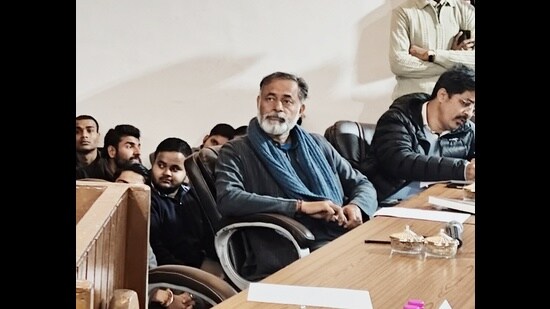
The panel discussion held at PU’s English Auditorium also featured Saroj Giri, associate professor at Delhi University, and Kuldeep Puri, a retired professor of education at PU.
During his lecture, Yadav outlined what he described as “five interlinked crises facing higher education in India”. The first crisis, Yadav said, was access to adequately funded public institutions. “While student intake from across the country has expanded over the years, public infrastructure and staffing has steadily declined, he said.
PU only has 50% of its 1,378 sanctioned teaching posts currently occupied by regular faculty, with contractual and guest teachers continuing to shoulder a significant portion of the academic workload.
Highlighting the second crisis, Yadav described it as a social one, arising from shifting gender and caste compositions within universities. While calling this diversification a positive and long overdue development, he said, institutions had failed to build safeguards to address discrimination.
Speaking about the ongoing controversy over the UGC’s newly notified anti-discrimination guidelines, Yadav said the regulations did not introduce any fundamentally new provisions. Recalling the UGC’s 2012 anti-discrimination rules, he said he was part of the committee that had drafted them. “These regulations were revisited following a 2019 Supreme Court case filed by the mothers of two students who allegedly died by suicide due to caste discrimination. In late 2024, the apex court directed the UGC to revise the framework,” he said.
The revised guidelines, he noted, explicitly include OBCs alongside Scheduled Castes and Scheduled Tribes and spell out the spaces and forms in which discrimination can occur on university campuses.
As for PU, although a 27% OBC quota was implemented nationally over three decades ago, the university did not adopt it for years due to uncertainty over whether to follow the Punjab government’s 12% OBC policy or the Centre’s 27% norm. A committee appointed by the PU vice-chancellor Renu Vig recommended in May 2024 that 27% of seats be reserved, with 12% earmarked for OBC candidates from Punjab. However, in the absence of a functioning senate, the proposal was forwarded to the Centre and is yet to be implemented.
The third crisis, according to Yadav and Delhi University’s professor Giri, lay in the current idea of education itself. Both criticised the National Education Policy, arguing that it borrows heavily from foreign models and dilutes education’s emancipatory role. “We achieved political independence, but cultural and intellectual dependence has only grown,” Yadav said.
Kuldeep Puri flagged employability as another structural fault line, saying higher education was increasingly failing to equip students with meaningful employment prospects. Yadav also pointed to a technology-driven crisis, warning that unchecked reliance on AI risks eroding human labour and academic agency. Identifying democracy as the fifth crisis, Yadav said universities must function as spaces that allow students and faculty to raise questions without fear.
www.hindustantimes.com
#Panjab #University #revised #UGC #rules #Yogendra #Yadav


