Support CleanTechnica’s work through a Substack subscription or on Stripe.
When I published my recent piece on Germany’s bid to double hydrogen-based fuel targets to try to justify already built and already stranded hydrogen infrastructure, readers raised important questions about compliance mechanics. One pointed out that the 1% RFNBO subtarget can be met by replacing grey hydrogen in refineries rather than putting hydrogen directly into vehicles. Another noted that renewable electricity supplied to electric vehicles can generate credits that help meet transport renewable energy obligations. Both comments go to the heart of the issue. The question is not only whether hydrogen makes economic sense in transport, but how the regulation actually allows EU member states to comply.
RED III—the EU’s binding 2030 renewable energy directive setting sector-specific targets for clean energy deployment across power, heat, and transport—Article 25 requires that by 2030 at least 5.5% of energy supplied to transport comes from advanced biofuels and RFNBOs combined, with at least 1% specifically from RFNBOs. RFNBOs are renewable fuels of non-biological origin. In practice this means renewable hydrogen and hydrogen-derived synthetic fuels that meet lifecycle greenhouse gas reduction thresholds of at least 70% relative to fossil comparators. The target is framed as an energy share, not a technology mandate, and it is embedded within national fuel supplier obligation systems.
The first compliance pathway is direct use of RFNBOs in transport. This includes hydrogen supplied to fuel cell vehicles and synthetic fuels such as e-methanol or e-kerosene used in internal combustion engines or aviation. On paper this is the cleanest interpretation of the rule. A kilogram of renewable hydrogen contains roughly 120 MJ of lower heating value energy, or 0.12 GJ. If delivered at €12 per kilogram—hydrogen is retailing at refueling stations at prices between €10 and €20 in early 2026, with the median under €15, so this is a generous price point—, that is €100 per GJ. By comparison, diesel at roughly €1.50 per litre equates to about €42 per GJ of fuel energy. Retail electricity for depot charging at €0.20 per kWh equates to about €56 per GJ before drivetrain efficiency. A battery electric truck converting 88% of input energy to motion delivers useful energy at roughly €64 per GJ. A modern diesel truck converting about 43% of fuel energy to motion delivers useful energy at roughly €97 per GJ. A fuel cell truck converting about 55% of hydrogen energy to motion would deliver useful energy at roughly €182 per GJ if hydrogen costs €100 per GJ. Hydrogen has to be far cheaper than any retail pump available hydrogen available today or electricity has to be much more expensive in order for hydrogen to only be twice the cost per kilometer of battery electric. The arithmetic explains operator reluctance.
The second pathway, and one highlighted by readers, is the refinery route. Renewable hydrogen can replace grey hydrogen used in hydrocracking and desulfurization in oil refineries or biofuel upgrading. Grey hydrogen produced from steam methane reforming emits roughly 9 to 10 kg of CO2 per kilogram of hydrogen. Replacing that with renewable hydrogen reduces refinery emissions. Under national transposition of RED rules, the renewable hydrogen input can generate compliance credits toward the transport RFNBO subtarget, even though the final fuel sold at the pump is conventional petrol or diesel. The hydrogen becomes an upstream decarbonization input, and its cost is blended into the refinery’s output fuels.
Under RED, advanced biofuels are defined primarily by feedstock rather than processing method. They are fuels produced from the waste and residue streams listed in Annex IX Part A, including agricultural residues such as straw and corn stover, forestry residues, sawdust, manure, sewage sludge, non-recyclable biological municipal waste, algae, lignocellulosic material, and other non-food cellulosic inputs. These fuels must meet lifecycle greenhouse gas reduction thresholds, generally at least 65% to 70% relative to fossil fuel comparators depending on plant commissioning date. I started on a global assessment of harvestable waste biomass and the volumes of biofuels that could be delivered from them a couple of months ago, but have been distracted by more pressing research.
Crop-based biofuels such as ethanol from corn or biodiesel from rapeseed do not qualify as advanced biofuels and are subject to separate caps, typically limited to 7% of transport energy for EU bunkering. Not for the rest of the world, which has a rather different perspective on allowing the agricultural industry to sell its products more freely. Annex IX Part B includes used cooking oil and certain animal fats, which can count toward renewable transport targets but are often treated differently and capped due to supply constraints, something the market and emerging verification standards are dealing with outside of the EU. The core principle is that advanced biofuels under RED are derived from waste, residue, and non-food feedstocks with lower indirect land use change risk and demonstrable greenhouse gas savings.
This route changes the economics and the optics. Instead of asking motorists to buy €200 per GJ synthetic fuels, the system spreads the additional cost of renewable hydrogen across a large fuel volume. If a refinery processes 10 million tons of crude per year and consumes 100,000 tons of hydrogen, replacing that hydrogen at a premium of €5 per kilogram would imply €500 million in additional annual cost. Spread over roughly 400 million GJ of fuel output, that is about €1.25 per GJ, or around €0.04 per liter of petrol equivalent. That is politically manageable. It is also very different from building a national hydrogen refueling network.
It’s also a potential additional carbon tax on road fuels, increasing the economic pressure to electrify instead. However, strategically it would be only reasonable to apply it to refineries likely to survive the massive coming cull due to being suitable for petrochemical manufacturing or biofuel refining. It’s unlikely that a refinery that isn’t going to survive would bother.
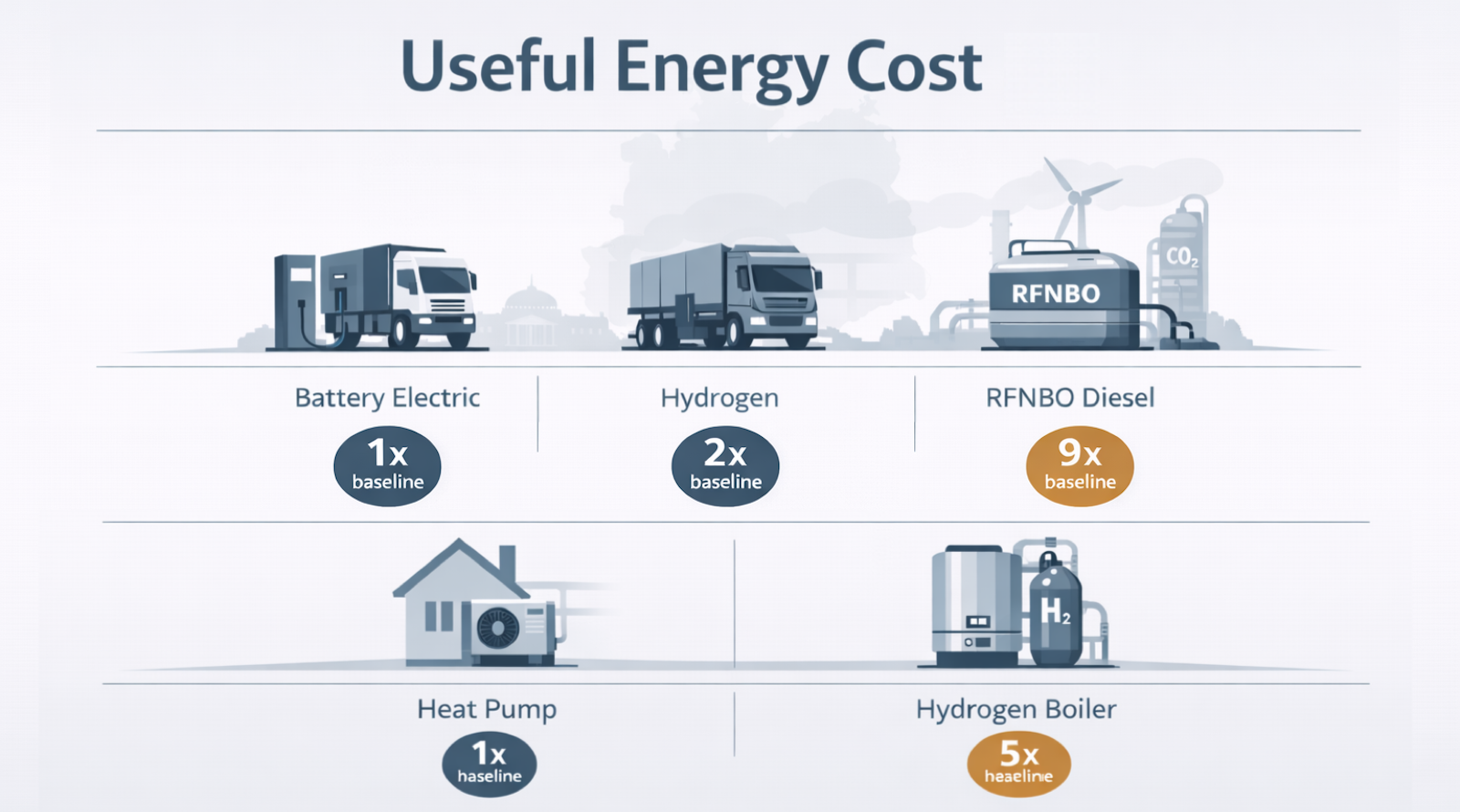
The third pathway is production and use of synthetic fuels derived from renewable hydrogen and captured CO2. E-methanol contains about 20 MJ per kilogram. At realistic plant gate costs above €3 per kilogram, an order of magnitude higher than fossil methanol, that equates to €150 per GJ before distribution and taxes. Synthetic fuels won’t make sense even in aviation and shipping where alternatives are limited because they will be significantly more expensive than biofuels and batteries. In road transport, they will be multiples of the cost of battery electric options on both efficiency and cost.
The fourth pathway involves renewable electricity supplied to electric vehicles. RED allows renewable electricity used in transport to count toward transport renewable energy targets, and member states implement crediting systems for electricity supplied to charging infrastructure. If a charging operator supplies 100 GWh of renewable electricity annually, that is 360,000 GJ of renewable transport energy. In credit-based systems, those GJ can offset obligations that would otherwise require advanced biofuels or RFNBOs. If renewable electricity credits are cheaper to generate than renewable hydrogen credits, fuel suppliers will prefer them. In practical terms, doubling the RFNBO subtarget could increase the value of renewable electricity credits and drive more investment into charging infrastructure rather than hydrogen fueling, something that commenters pointed out as a potential upside.
There are also flexibilities such as multipliers and statistical transfers between member states. In earlier iterations of RED, certain fuels counted more than once toward targets. While the 1% RFNBO subtarget is defined in physical energy terms, member state accounting practices and credit trading systems can lower the effective physical volume of RFNBO molecules required domestically. Compliance becomes a matter of credit optimization rather than molecule flows.
When these pathways are viewed together, the physical amount of hydrogen that must be delivered into vehicle tanks to meet the 1% subtarget—which the EU is far from on track to meet—may be far smaller than headline interpretations suggest. A member state could likely meet all of its RFNBO obligation through biofuel treatment with green hydrogen, refinery displacement of gray hydrogen and renewable electricity vehicle charging credits, with no deployment of hydrogen vehicles. That outcome aligns with operator demand signals. Fleet managers buy trucks based on total cost of ownership. Surveys by German research institutes show battery electric trucks are preferred when charging access is available. Hydrogen rail projects in several Länder have been scaled back in favor of battery multiple units. The market is voting with capital.
This brings the discussion back to Germany’s push to double RFNBO targets. Doubling the subtarget from 1% to 2% would increase the nominal requirement for renewable hydrogen or hydrogen-derived fuels. It would not change the underlying cost differential between hydrogen and electricity. Member States facing higher obligations would look for the lowest-cost compliance routes available within the rules.
Policy design matters. If targets are raised without tightening rules around credit substitution—something to be hoped for—, the likely outcome is more refinery hydrogen substitution and more renewable electricity credit generation. That reduces refinery emissions and accelerates EV deployment, both of which are positive developments. It does not validate a broad buildout of hydrogen fueling infrastructure for road transport. The arithmetic continues to favor direct electrification for most light and medium duty vehicles and an increasing share of heavy duty applications. Personally, my discovery of the loopholes allowing sensible transportation repowering alternatives to count for RFNBO requirements makes me think that very smart policy makers were working around Germany’s Gruppendenken around hydrogen to pay lip service to it while allowing real decarbonization that made economic sense to proceed more rapidly.
If Germany succeeds in persuading the EU to double RFNBO targets, the most probable response from member states will be pragmatic. National policies will focus on biofuel processing with renewable hydrogen, incremental refinery upgrades at sites expected to endure as petrochemical manufacturers, and expanded renewable electricity crediting for EV charging. These approaches allow compliance without committing to large scale hydrogen for energy in transport. The risk is not that Europe will be flooded with hydrogen trucks with the attendant major costs. The risk is a softer one that keeps policy debates anchored in a vision of hydrogen as a broad energy carrier, while compliance practice moves quietly toward electrification and selective industrial use. Europe needs to face reality rather than finding ways to creatively comply with fantasy.
Sign up for CleanTechnica’s Weekly Substack for Zach and Scott’s in-depth analyses and high level summaries, sign up for our daily newsletter, and follow us on Google News!
Have a tip for CleanTechnica? Want to advertise? Want to suggest a guest for our CleanTech Talk podcast? Contact us here.
Sign up for our daily newsletter for 15 new cleantech stories a day. Or sign up for our weekly one on top stories of the week if daily is too frequent.
CleanTechnica uses affiliate links. See our policy here.
CleanTechnica’s Comment Policy
cleantechnica.com
#Europe #Meet #Hydrogen #Fuel #Mandates #Hydrogen #Fuels