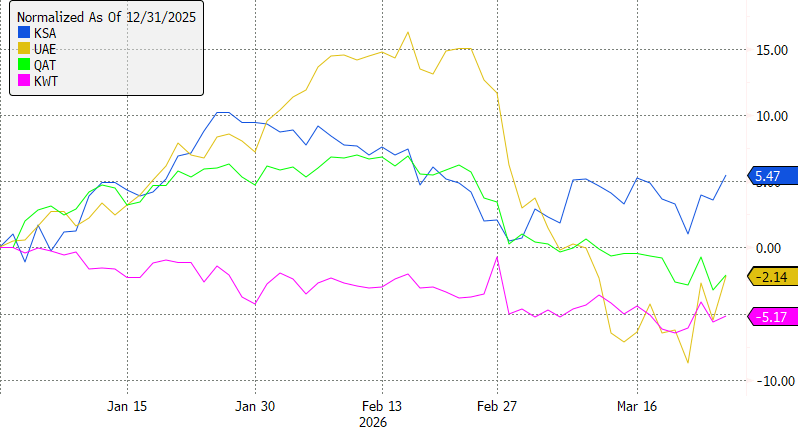
If you assumed Gulf-country ETFs got crushed during the Iran war, that would be a reasonable guess. Iran has launched missiles and drones at Gulf energy infrastructure, shipping through the Strait of Hormuz has been severely disrupted, and the region’s long-running pitch as a stable oasis in a dangerous neighborhood has taken a hit.
But the ETFs have held up much better than you might expect.
What makes these ETFs interesting is they aren’t just a way to bet on the various Gulf countries. They’re also a rough real-time indicator of how investors think this war will play out.
If the funds are stabilizing or rebounding (as they have been in recent days), that may suggest markets see the worst-case scenarios as less likely. But if they head the other way, it may reflect a deeper reassessment of the region’s economic model and geopolitical risk.
In the case of Saudi Arabia, higher oil prices are likely helping offset at least some of the damage. The country has reportedly been able to reroute around 4 million barrels per day of exports through the Red Sea, avoiding the Strait of Hormuz, which has effectively been shut down.
Normally, Saudi Arabia exports around 6 million to 7 million barrels per day, with most of that flowing through the strait, so the alternate route has allowed it to preserve a meaningful share of its exports while also benefiting from the surge in oil prices.
What’s interesting is that KSA isn’t nearly as oil-heavy as many investors might assume. Energy accounts for only about 13% of the portfolio, almost all of that tied to Saudi Aramco, the $1.7 trillion oil giant. Aramco’s weighting is limited because the index is free-float adjusted and most of the company is still owned by the government.
Instead, the bulk of the ETF is made up of financials, which account for roughly 42% of the portfolio. Materials are next at about 15%.
Even so, oil remains the backbone of the Saudi economy, and those other sectors are still deeply tied to it. Banks, industrial firms and materials companies may not drill for oil themselves, but they all benefit from the broader economic support that oil revenue provides.
The UAE ETF has a somewhat different makeup. Financials are still the largest sector at 37%, but real estate comes in second at 20%.
The UAE, and Dubai in particular, has spent years building a reputation as a safe and attractive destination for foreign capital, businesses and wealthy expatriates. That image is part of the investment case.
With the war now spilling more directly into the Gulf, some investors are starting to question whether that safe-haven narrative still holds up as well as it once did.
The UAE is also a major energy producer, with around 2.5 million barrels per day of oil exports in the pre-war period.
According to the IEA, the Abu Dhabi Crude Oil Pipeline has the capacity to export 1.5 million barrels per day, giving the country at least some ability to divert flows away from Hormuz. That does not eliminate the problem, but it does provide more flexibility than some of its neighbors have.
Qatar appears more exposed than its neighbors. It does not seem to have meaningful alternative export options, either for oil, which normally flows through Hormuz at around 1.4 million barrels per day, or for LNG, where the country is the world’s second-largest exporter after the U.S.
As the IEA put it, “There are no alternative routes to supply natural gas from Qatar to the global LNG market.” QAT, however, is not really an energy ETF either. Financials make up 57% of the fund.
The same is true in Kuwait. The country normally ships around 2.4 million barrels per day through the strait and, according to the IEA, also lacks alternate routes. Yet, KWT is about 69% financials.
That point is worth emphasizing. Energy is a massive industry in all of these countries, but in many cases the sector is largely controlled by the state and only partially represented in public equity markets.
Saudi Aramco is one of the few major examples where investors get exposure through the country ETF, but even there the exposure is limited.
So these ETFs are not really straightforward oil bets. They are mostly baskets of banks and other domestic companies that are indirectly tied to the fortunes of the energy sector.
Longer term, the bigger question may be what this war means for how investors view the Gulf as a whole. For years, countries like the UAE and, increasingly, Saudi Arabia have tried to present themselves as stable, business-friendly hubs in a turbulent region.
They have also worked to diversify their economies away from energy, building up sectors like finance, real estate, and tourism. This conflict does not erase that progress, but it does call parts of that story into question.
Even if the immediate damage proves manageable, the fact that Iran has been willing to target Gulf states directly may force investors to think differently about the region’s political risk going forward.
PXGEO, a United Arab Emirates-based marine geophysical service provider, has secured a contract to provide offshore seismic data acquisition services,…