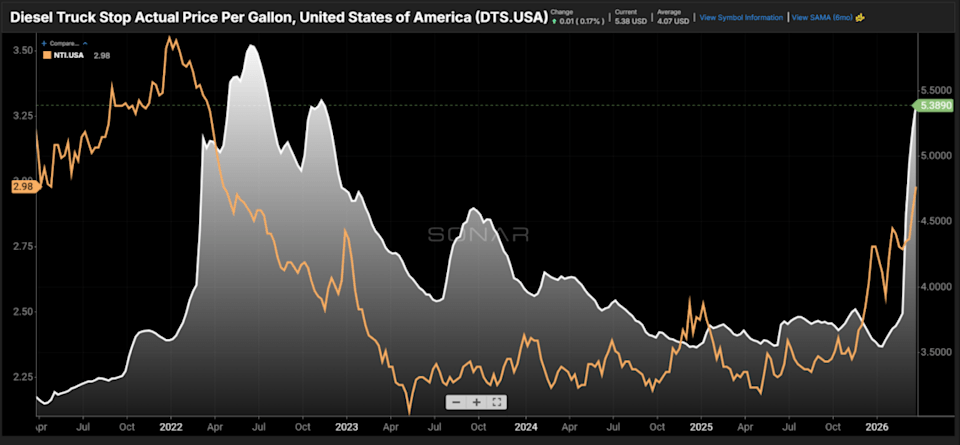
Chart of the Week: Diesel Truck Stop Actual Price Per Gallon, National Truckload Index – USA SONAR: DTS.USA, NTI.USA
The average retail price of diesel (DTS) — the primary fuel source for Class 8 trucks — has risen over 41% since March 2. The average spot rate for dry van truckloads (NTI in orange) has increased 7.5% over the same stretch, forming a fairly strong positive correlation of 0.7, meaning they moved together fairly well. This is not always the case, however. In March 2022, the correlation was inverted at -0.8, meaning the two moved in opposite directions at nearly the same rate. This illustrates that fuel prices do not always drive truckload pricing movements. So what is the relationship between the two?
Correlation is one of the most misused statistics. The famous adage is that correlation does not imply causation, and the world is full of spurious or coincidental correlations. This is not entirely true in the case of fuel and truckload rates, but like most things, it’s complicated. The underlying market value is what determines a carrier’s ability to pass along their costs.
Fuel costs account for roughly 25% of the total operating cost of a truck, though this figure fluctuates as costs shift. According to the American Transportation Research Institute (ATRI), fuel costs fell from 28% to 21% of total operating costs between 2022 and 2024. The key takeaway is that fuel represents a significant portion of operating costs, even if its exact share varies.
When fuel prices rise sharply, so does their influence on trucking costs. The majority of truckload moves operate under long-term pricing agreements between shippers and service providers. A portion of fuel costs is separated out as a variable surcharge tied to the average price of diesel — typically the weekly DOE figure — so short-term fuel price changes do not affect contract rates, as those costs are passed along separately.
In the spot market, which the NTI measures, rates are typically quoted as all-inclusive totals with no component breakouts. Since all information about the load and its costs reflects current conditions, there is no need to separate costs into components. The price is simply what the market will bear at that point in time.
In 2022, the truckload market was at the beginning of a collapse. The market value for trucking services was near all-time highs, driven by a severe imbalance between supply and demand — freight demand far exceeded available capacity.
Demand (STVI in yellow) fell rapidly in March 2022 as many shippers realized that months of over-ordering had finally caught up with them. Pandemic-era quarantines were largely being lifted, and goods consumption declined. Meanwhile, truckload capacity had expanded dramatically over the prior two years.
From June 2020 to October 2022, more than 131,000 new motor carrier operating authorities (CDTTA in white) were created — compared to roughly 104,000 created in the entire decade from January 2010 to June 2020. While these figures don’t represent individual drivers, they reflect a flood of new carriers competing for what had become far less freight, collapsing the market value of their services and leaving them unable to pass along additional costs.
The pie chart above is based on ATRI’s 2024 report and excludes back-office and overhead functions at larger fleets. Fuel costs averaged $0.48 per mile (21%) that year — a figure that has since ballooned to over $0.77 per mile, assuming fuel efficiency of around 7 miles per gallon. Holding all other costs constant, fuel would account for roughly 30% of total operating costs today.
Also missing from the chart is a measure of profit or loss. During a severe down cycle, carriers are often unable to generate enough revenue to cover their costs on many loads, pushing them to find efficiencies in their networks. A carrier whose costs totaled $2.26 per mile might have only been able to command $2.25. During the pandemic era, the opposite was true — operating costs were around $1.85 per mile in 2021, while spot market revenues averaged closer to $3.21 per mile.
So when fuel prices rose during that period, market value was simultaneously deflating and profit margins were compressing rapidly.
The current market is different. Truckload service values are rising — before the recent jump in oil prices, spot rates were already averaging 13% higher year-over-year compared to January and February 2025, reflecting shippers’ need to offer higher prices to secure capacity. Carriers are now better positioned to pass along higher costs in the spot market.
But this is not always the case. The cost of operating a truck has increased more than 30% since 2019, yet spot rates over the same period were up only about 10% leading into the holidays last year. A cost increase does not automatically translate into a price increase — a reality that holds true across many industries, not just trucking.
The FreightWaves Chart of the Week is a chart selection from SONAR that provides an interesting data point to describe the state of the freight markets. A chart is chosen from thousands of potential charts on SONAR to help participants visualize the freight market in real time. Each week a Market Expert will post a chart, along with commentary, live on the front page. After that, the Chart of the Week will be archived on FreightWaves.com for future reference.
SONAR aggregates data from hundreds of sources, presenting the data in charts and maps and providing commentary on what freight market experts want to know about the industry in real time.