


Delhi’s air quality remained in the “very poor” category for a fourth straight day on Tuesday, even as wind speed was expected to drop due to a western disturbance, and worsen the situation. The 24-hour rolling average air quality index (AQI) of 311 (very poor) at 9am was marginally higher than the Monday 4pm reading of 309 (very poor) when the Central Pollution Control Board (CPCB) releases its daily national bulletin.
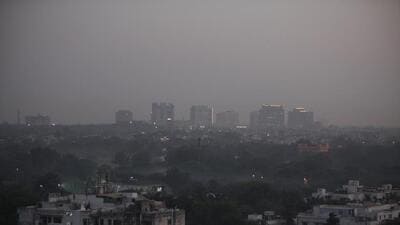
Meteorological experts said wind speed will drop sharply on Tuesday and remain almost calm on Wednesday due to a western disturbance. The Early Warning System (EWS) for Delhi has forecast the AQI will remain “very poor” on both days. EWS, which comes under the Ministry of Earth Sciences and is managed by the Indian Institute of Tropical Meteorology (IITM), on Sunday said that the AQI is likely to touch “severe” on Tuesday.
The IITM did not issue a forecast on Monday. An updated one issued on Tuesday showed the AQI is expected to stay “very poor”. The Decision Support System (DSS), which gives the estimated contribution of sources to Delhi’s PM 2.5, has not been updated since Monday. IITM did not comment on why this was the case.
“Delhi’s air quality is very likely to be in the ‘very poor’ category on Tuesday until Thursday. The outlook for the subsequent six days shows AQI is likely to be ‘very poor’.” the EWS said on Tuesday.
The CPCB classifies an AQI between 0-50 as “good”, 51 and 100 as “satisfactory”, 101 and 200 as “moderate”, 201 and 300 as “poor”, 301 and 400 as “very poor”, and over 400 as “severe”. Delhi is yet to record a “severe” air day since December 23, 2024, when the AQI was 406.
Data from CPCB’s Sameer app at 9am showed at least four out of the 38 active stations in the “severe” zone, including Alipur (421), Anand Vihar (412), Bawana (402) and Wazirpur (407). At least three stations were in the “moderate” zone. They included IGI airport (193), Lodhi Road (153) and Aurobindo Marg (146).
HT on Monday flagged stations showing some unusual data. This included ITO, a busy traffic intersection, where the AQI was just 188 at 9pm on Monday. A closer look revealed the station had several hours of data missing before noon. The average AQI at 8am, largely due to data gaps, was as low as 80 (satisfactory), the app showed.
Private forecaster Skymet Weather vice president Mahesh Palawat said winds began to pick up during the day on Sunday, touching 10 km per hour. On Monday, it touched 15 km per hour, he said. “The western disturbance will again lead to a drop in wind speed. It will be almost calm on Tuesday and Wednesday. This, combined with some moisture in the air, will lead to a haze and increase pollution again,” he said.
Meteorologist Navdeep Dahiya said the western disturbance will negatively impact AQI, leading to a fresh layer of smog on November 4 and 5. “The western disturbance is expected to bring one spell of moderate rains and thundershowers in parts of Punjab and Haryana on Tuesday night into Wednesday,” he said on X. He added chances of rain in Haryana, Delhi, Uttar Pradesh, and Uttar Pradesh were low. Strong northwesterly winds are expected to return from November 6 onwards, leading to a possible improvement in AQI as night-time temperature dips by 3-4°C.
Delhi recorded a maximum temperature of 31.5°C on Monday, a degree above normal, and a minimum of 16.5°C, a degree below normal. The mercury was expected to go up to 28-30°C on Tuesday and Wednesday due to overcast skies. A dip of another degree was likely from Thursday as cold northwesterly winds return. The minimum temperature is likely to dip below 15°C from Thursday.
Northwesterly winds typically aid long-range transport of stubble smoke to Delhi-NCR from Punjab and Haryana. DSS data from Sunday showed the estimated contribution of stubble burning was fairly low at 3.5%. It was at a season-high of 9% on Saturday. In previous years, peak contribution from stubble burning, typically in the first week of November, has reached up to 35%.
www.hindustantimes.com
#Delhis #air #quality #remains #poor #4th #day #situation #worsen


