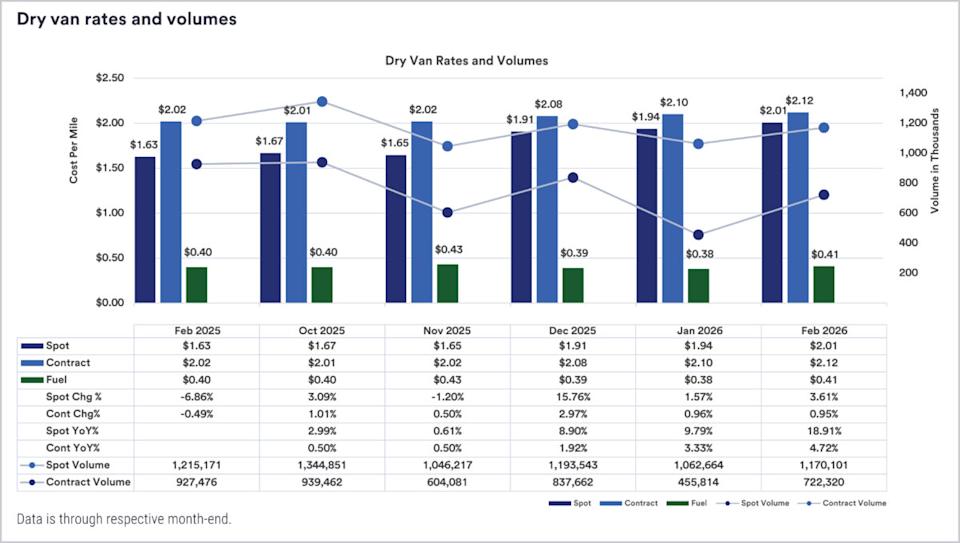
Shippers watching their routing guides and budgets face a new reality in 2026: costs are climbing even as volumes lag. That’s according to the latest quarterly U.S. Bank Freight Payment Index – Rates Edition. The report, produced in collaboration with DAT Freight & Analytics, showed a freight market where pricing power is shifting toward carriers through capacity discipline rather than surging demand.
Spot rates reached $2.01 per mile in February, rebounding from $1.65 in November 2025. Contract rates ticked up to $2.12 per mile from $1.99 over the same period — marking a fourth consecutive month of increases across both pricing mechanisms.
“What we’re seeing in early 2026 is a freight market beginning to rebalance, with spot rates improving modestly while contract pricing has remained relatively steady,” said Ken Adamo, chief of analytics at DAT Freight & Analytics.
The spot market registered the sharpest recovery. After bottoming at $1.57 per mile in May 2025, spot linehaul climbed roughly 28 percent through February 2026 — a $0.44 increase from the low. Contract pricing followed but moved far less dramatically, rising from $1.99 to $2.12 per mile over the same period, about a 6.5 percent gain.
The inflection point arrived in December 2025. Spot linehaul jumped from $1.65 to $1.91 per mile — a 15.76 percent month-over-month increase that coincided with a 14 percent rise in spot activity. Contract linehaul also moved higher, climbing just under 3 percent, signaling that the repricing impulse in transactional markets was filtering into contract outcomes.
“The Rates Edition is a timely warning for shippers and carriers: pricing power is shifting with tighter capacity, not stronger volume,” said Darlene Laferriere, accounts payable analyst at Charles River Labs. “We’re partnering with core carriers and stress-testing budgets as the contract premium compresses.”

The year-over-year data highlighted just how unusual this setup is. From March 2025 through February 2026, spot linehaul increased about 23.3 percent while contract linehaul rose roughly 5 percent. Yet volumes moved the opposite direction: spot volume fell approximately 3.7 percent and contract volume dropped about 22.1 percent.
That divergence is the core story. Pricing strengthened even as activity — particularly on the contracted side — remained under pressure. The market behaved as though capacity was being managed more tightly than demand was growing. This appears consistent with a supply-led shift where carriers protect yield and become more selective about the freight they accept.
finance.yahoo.com
#Contract #premium #shrinks #truckload #market #reprices #higher