With 30 years of Wall Street experience, Co-Editor-in-Chief Todd Campbell explains why ConocoPhillips stance on Venezuela’s oil ramp is a reality check for the energy sector.
Energy companies have felt significant pressure over the past year as OPEC production has ramped up, driving West Texas Crude prices down to $62 per barrel, below Permian Basin production costs. As a result, many think the next big play will be resource-rich Venezuela, which holds world-leading oil reserves of 303 billion barrels.
The allure of unlocking that much black gold should have big oil chomping at the bit, yet decades of failed promises mean CEOs are anything but eager to commit the billions of dollars necessary to refurbish Venezuela’s aging infrastructure, including ConocoPhillips CEO Ryan Lance.
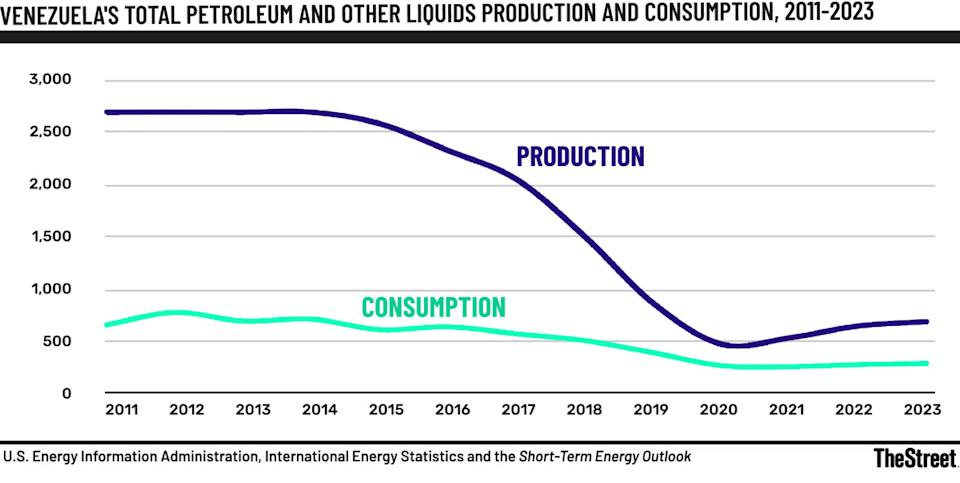
Quick fact: Venezuela’s peak production totaled 3.75 millionbarrels per day. In 2025, it totals about 800,000, up from a low of about 350,000 in 2020.
On ConocoPhillips’ (COP) recent earnings call, Lance addressed the matter directly, resetting expectations for a rapid ramp-up by his company.
“We’re pretty focused on what we’ve talked about in the past, and that’s the focus on the pathway to get some recovery on Citgo in Venezuela,” said Lance. “That’s our first priority right now.”
Like many oil majors, ConocoPhillips was burned by Venezuela nationalizing its oil reserves, and seizures have left the company owed at least $10 billion, including interest, following a 2019 International Arbitration Tribunal ruling.
U.S. Energy Information Administration, International Energy Statistics and the Short-Term Energy Outlook ·U.S. Energy Information Administration, International Energy Statistics and the Short-Term Energy Outlook
Venezuela owes ConocoPhillips more than anyone else for its past operations there, because it declined to accept a minority stake in its assets when former President Hugo Chavez seized them in 2007.
More Oil and Gas:
ExxonMobil similarly refused the deal, while Chevron (CVX) accepted those terms and is considered to benefit most from the capture and removal of Maduro and the forthcoming Venezuelan oil ramp.
Petrozuata: Extra-heavy crude oil project in the Orinoco Belt. More than $2.4 billion was spent building it, with an estimated daily production of 120,000 barrels, according to Offshore Technology.
Hamaca: 160,000-acre, extra-heavy crude oil project in the Orinoco Belt. The project costs totaled $3.8 billion, with an estimated production of 190,000 barrels per day. ConocoPhillips had a 40% interest, according to Offshore Technology.
Corocoro: A large offshore light oil development project in the Gulf of Paria was discovered in early 1999 and is estimated to contain 500 million barrels of oil reserves. ConocoPhillips had a 32.5% interest, according to World Ports Directory.
Given the size of the projects and the money owed, ConocoPhillips’ hesitancy to throw good money after bad is understandable.
On the company’s earnings call, Ryan outlined three major changes that need to happen to clear the way for participation in Venezuela:
Security needs to improve.
Constructive relationships must be strengthened with local governments and “local people that actually want U.S. companies there.”
Durable policies: “You need durability both in Venezuela and clearly here on the U.S. side.”
So far, assurances from the White House addressing those asks have been tepid, despite calling for up to $100 billion of investments to address years of underinvestment in Venezuela.
President Donald Trump has suggested that the U.S. military will provide security, but signed Executive Order 14373 in January, effectively halting oil companies from recovering funds from oil revenue held in U.S. accounts, including some money held in Qatar.
One way ConocoPhillips has been trying to recover the billions it’s owed by Venezuela is through the auction of petroleum giant CITGO, a U.S. subsidiary of Venezuela’s national oil company, PDVSA.
Quick fact: Seizures in 2007 resulted in ConocoPhillips’ loss of 16 million BOE of 2007 Venezuelan production and 1.089 billion BOE of reserves.
Last November, a court-appointed officer recommended that CITGO be sold for $5.9 billion to Amber Energy (an affiliate of Elliott Investment Management). ConocoPhillips is a priority claim holder; however, total claims exceed $21 billion, according to EnergyNow, so any money received from the sale will fall far shy of what they’re owed.
As I wrote previously, unlike ConocoPhillips, Chevron continued operating in Venezuela as a minority owner and is best positioned to capitalize on tapping into the country’s vast reserves.
It currently participates in a slate of valuable assets, and removing restrictions should allow it to quickly ramp back to production levels in place prior to them.
Petroboscán: A 39.2% interest in the Boscan Field
Petroindependiente, S.A.: 25.2% interest in the LL-652 Field at Lake Maracaibo
Petropiar, S.A.: 30% interest in Huyapari Field within heavy-crude dominant Orinoco Belt
Petroindependencia, S.A.: 34% interest in Carabobo 3 Project in Carabobo area of the Orinoco Belt (extra-heavy crude)
Ioran: 60% interest offshore in the Loran Field Source: Chevron
Chevron was producing more than 200,000 barrels per day in Venezuela, but that figure fell below 100,000 as the U.S. imposed export restrictions.
“Chevron has been in Venezuela for over a century,” said Chevron CEO Michael Wirth in January. “We see the potential to further grow production volumes by up to 50% over the next 18 to 24 months.”