


In electric motor engineering, copper is king. The more copper you can pack into the stator, the lower the electrical resistance, and the more current, torque and power the machine can deliver. Traditional motors rely on bundles of round wires, but those circular cross-sections leave large pockets of unused space.
“If you would take such a motor and cut through and count the surface of the copper compared to the area where the wires are, you will get something of the order of 40% of the volume is copper,” Dr. Florian Kassel, co-founder of Germany-based electric motor developer SciMo, told Charged in an interview. “This is very cheap to manufacture, but only allows very small currents, and results in poor performance.”
The copper density in the stator is a key property of an electric motor determining the performance for a given motor size. An increased copper density leads to reduced stator diameter, less motor weight and a reduced rotor diameter, enabling increased rotational speeds. Adding material makes the rotor heavier, which slows down the rotor. “If you go to a higher diameter to put in the copper that you need, you’re also missing all the possibilities to spin the rotor to high speeds, which in turn reduces your maximum power output,” Kassel said.
One solution is the auto industry’s hairpin technology: thick copper bars, roughly 2.5-3 mm across, bent like oversized staples and inserted into the stator slots. On the far side, every protruding end must be precisely aligned and welded to form closed loops.
This technique delivers high copper density, but only works economically at large scale because it demands complex, highly specialized machinery. And it has drawbacks at high rotational speeds, as larger conductors suffer significant high-frequency losses, which can sap efficiency during sustained, high-power driving.
“If you buy, for example, a Porsche Taycan, you can reach high efficiencies at typical inner-city speeds. But if you go on the highway and just floor it, you will have very high losses. And you will lose a lot of energy, resulting in a significantly reduced range.”
To overcome these limitations, Germany-based SciMo uses a different approach. The company has developed a novel motor winding architecture that maximizes copper utilization without increasing size or weight. The technology keeps the rectangular shape, but uses thin, fragile and flat wires, roughly 1×4 mm, to fill the slots in the motors. This allows for a smaller motor that contains the same amount of copper, increasing the density and supporting higher speeds.
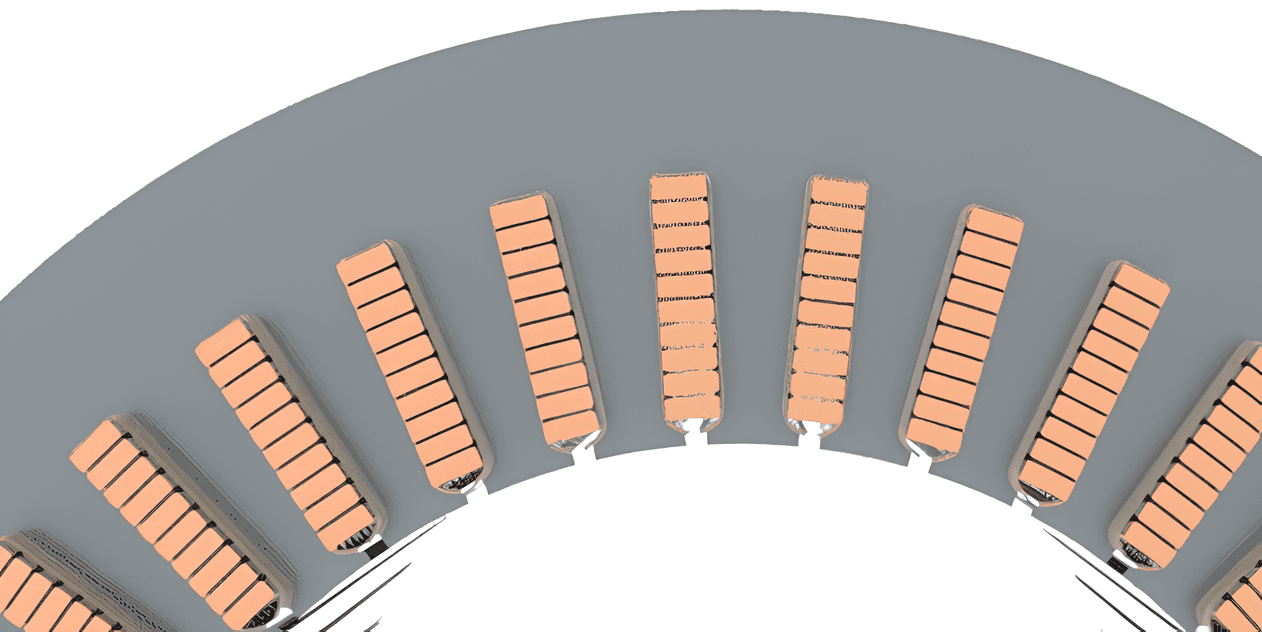
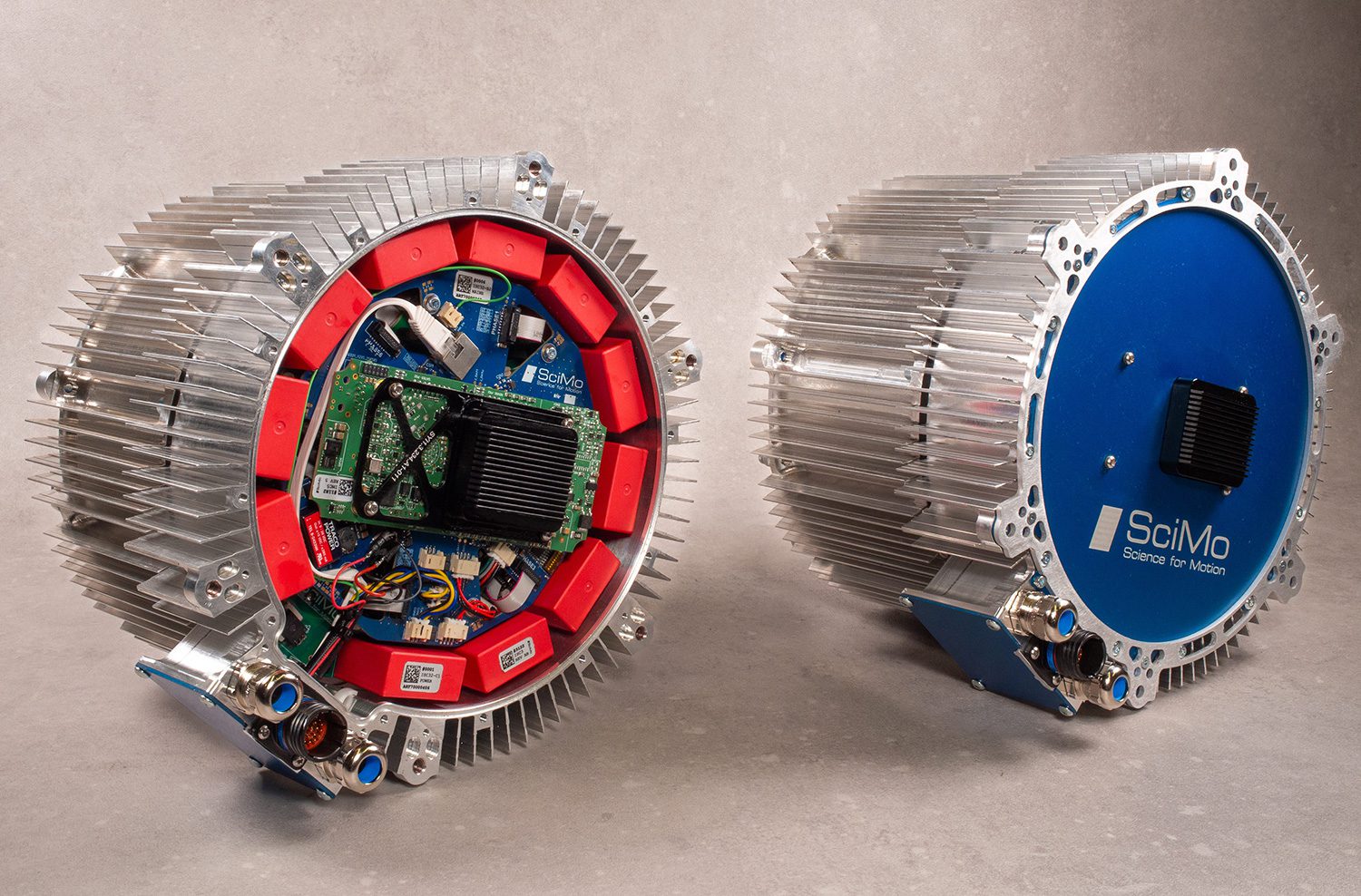
“We’re reaching something in the order of 70% copper filling factor. So we can double the copper density in the motor, and therefore we can put much more current through the system and have much higher power densities,” Kassel said.
The smaller cross-section avoids the high-frequency losses that plague hairpins. The method pairs high copper density with better efficiency at top-end RPMs. “We don’t have these negative effects, so we’re somewhere in between these two worlds and have a really nice tradeoff,” Kassel added.
This winding technique brings an unexpected second advantage: thermal performance. Because each conductor is individually and precisely positioned geometrically, every wire lies only about 1.5 mm from the water-cooled motor housing, creating a highly efficient cooling effect.
In traditional round-wire bundles, hundreds of strands may sit buried in the middle of a coil, far from any cooling path. Hairpin motors, meanwhile, must contend with chunky weld points that can only efficiently be cooled by oil. The precisely arranged flat wires in SciMo’s motors create a clean thermal path, letting engineers push more current without overheating.
The result is an unusually high power-to-weight ratio—in the order of 20 kW/kg, several times that of typical production motors. In motorsport applications, the company builds lightweight units of 20–30 kg that are capable of peak outputs comparable to 2,000 horsepower when used in multi-motor setups.
Slashing winding costs through full automation
SciMo was founded in 2017 by three PhD students working with the Karlsruhe Institute of Technology (KIT) and supported the students on the university’s formula racing team with electric motors. Every year, about 60 students develop, build and drive a vehicle in the Formula Student Electric international competitions.
“During that time, we realized that these motors were exceptionally good; they had significantly higher power density compared to all the competitors,” Kassel said. “In the following years this team won the World Title of the series and made first places several times—at that point we knew: this technology is really something.”
The SciMo team has grown to 25 people working on the technology full-time, building the business by working with customers directly without backing from outside investors to fund its development.
But producing such stators hasn’t been simple. In the early years, each unit required weeks of painstaking manual work. “We started in the beginning doing it by hand. It was highly expensive. It took three weeks for just one stator.”
Production was limited to small batches, often just three to 30 motors per customer, depending on the project. That limited the business to niche applications willing to absorb high labor costs, such as motorsport or early-stage aerospace customers.
The company’s turning point arrived in 2022, when it secured roughly €2 million in support from the EU’s Horizon 2020 accelerator program to automate the production process.
Semi-automation followed. Machines supported the technicians in winding the stators, which reduced the production time to one week.
Now the company has achieved fully automated production—an essential step toward scaling the technology beyond today’s niche markets.
“Since founding SciMo, we have always had this target of having fully automated manufacturing of this winding technology,” Kassel said. “This winding takes up 30-35% of the total manufacturing costs of the motor, and now we can drop that to half. And the more volume we produce, the better the margin gets.”
Because the cost per unit improves with volume, the company can now consider markets that were previously out of reach.
Scaling motor innovation with robotic precision
The new winding line relies on robotic systems guided by a sophisticated software stack, rather than the conventional CNC-style machines that dominate the motor industry. These robots execute fine, force-controlled movements to place each fragile rectangular wire into the stator slots with more accuracy than skilled human technicians. “There’s no reduction in precision or performance,” Kassel noted. “With automation, it actually gets better.”
But precision comes at a cost: time. Unlike the automotive industry’s hairpin-wound motors, which can be produced in around 60 seconds per stator, even with full optimization, a single SciMo stator is expected to take roughly six hours to wind. That makes it challenging to scale the technology for mass-market production.
“It’s still very time-consuming to produce motors with our winding technology,” Kassel said. “We will never be a competitor to hairpin technology or anything like that.”
Instead, the robotics-based process offers something equally valuable for certain sectors: flexibility. Because the system relies on software-defined motion paths for precision rather than fixed tooling, engineers can reconfigure the winding setup quickly to accommodate different stator geometries or custom layouts. Producing five units for a research program, 50 for a specialty vehicle maker, or 500 for an electric bus fleet all fall within the company’s sweet spot.
The approach has practical limits. Scaling to 10,000 units a year would require upwards of 20 to 25 winding machines—an investment that would make other technologies more cost-effective. But in the niche markets where high performance matters more than ultra-low manufacturing cost, the company’s robotic system gives it an edge. It can deliver custom, high-performance motors without the rigid tooling and requalification burdens that constrain hairpin or other conventional winding manufacturing technologies.
“Now that we have the fully automated winding technology ready we can look at other markets with increased economic pressure,” Kassel said. ”There’s no drawback, there’s no reduction in precision or in performance…if we scale up now.”
Powering motor sports, aviation and the next frontier
Automation enables SciMo to dominate the high-performance, low-volume applications in which precision, adaptability and unconventional engineering pay off.
That includes the high-end automotive sector, where manufacturers of high-performance car brands are willing to pay a premium for increased power density.
“In the motorsport business, where we have batch sizes of 100 to 200 motors per year, we’re a big competitor,” Kassel said, “because you can either have a cheap, non-custom, mass-produced motor or you go to manually produced custom motors that rely heavily on expensive materials and come with astronomical prices. SciMo is exactly in between these two worlds.”
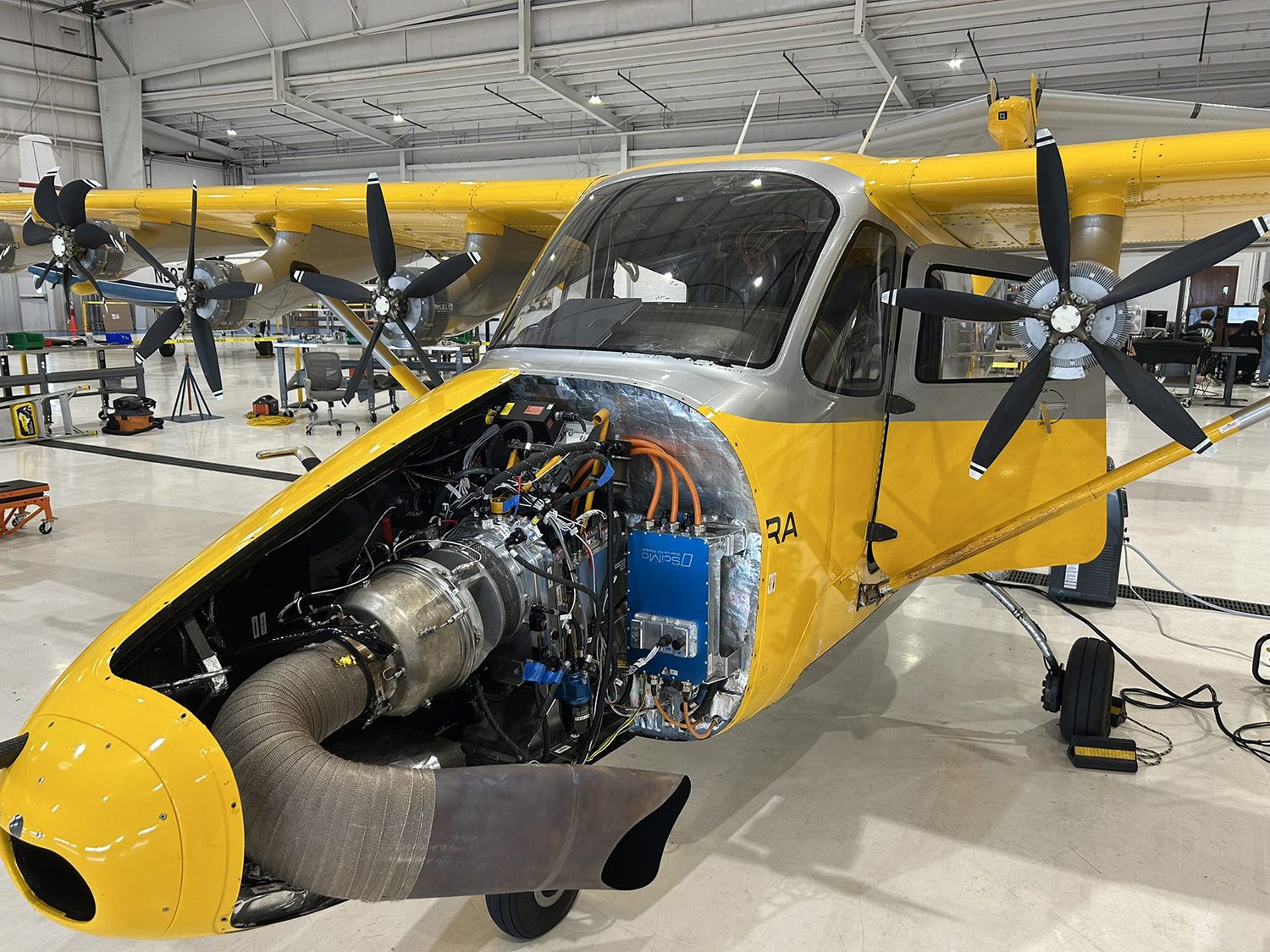
One of the most promising applications is electric aviation, where weight is crucial. One of SciMo’s first customers was a company developing electric people-carrying drones. “You want to have as little weight as possible, and therefore we could sell these motors at high prices.” The sector’s needs align perfectly with the company’s lightweight, high-output motors.
“We are in many different industries at the moment. The main customers come from the motor sports and aviation industries, but we also provide electric motors for rocket engines or as dyno motors in test bench applications,” Kassel said.
Setting the stage for the next leap in electric motor engineering
If SciMo succeeds in scaling, the economic implications could be as transformative as the performance gains. Conventional motors derive around 70% of their cost from materials, especially copper and steel.
By packing copper more efficiently, engineers can shrink the entire motor, reducing overall material use by roughly 30% while enabling smaller, faster rotors that further boost power and efficiency. And because SciMo winding architecture inherently runs cooler, it opens the door to future upgrades.
“Now if we would say, we need an even higher performance output, we could do this either with advanced magnetic materials for much higher temperature tolerance, or with ultra-thin premium electrical steel to cut stator losses even further,” Kassel said.
Electric motors are fundamentally constrained by heat, because as the temperature rises, the magnets weaken and can be permanently destroyed. But motors built with premium, heat-resistant materials can tolerate much higher operating temperatures.
“For us, there’s still lots of room for improvement; but at the moment, we don’t need it. We are just happy that we have now managed to get this winding technology fully automated and can pass on these savings to our customers,” Kassel said.
“We’re now at a really interesting point in time for the company where we’ll now try to scale up and find new markets, and we’ll see how it goes. But this is the point we’re standing at. So, exciting times ahead.”

chargedevs.com
#Charged #EVs #SciMo #bets #automated #flatwire #windings #beat #handbuilt #specialty #motors #highperformance #niches


