


Support CleanTechnica’s work through a Substack subscription or on Stripe.
Morgan Stanley decided to do some research on battery degradation in China. It got data from ride-hailing firms on 12 different EV models — 100 cars in total — and measured how much their battery capacity declined. The cars showed considerable differences in battery degradation. The company also studied degradation of batteries at a long-term, large-scale energy storage.
It’s not clear what EV models were tested, but one thing was clear from the research: CATL batteries rock. The two models with CATL batteries showed the slowest degradation rates. They are Model 11 and Model 12 in the graph below.
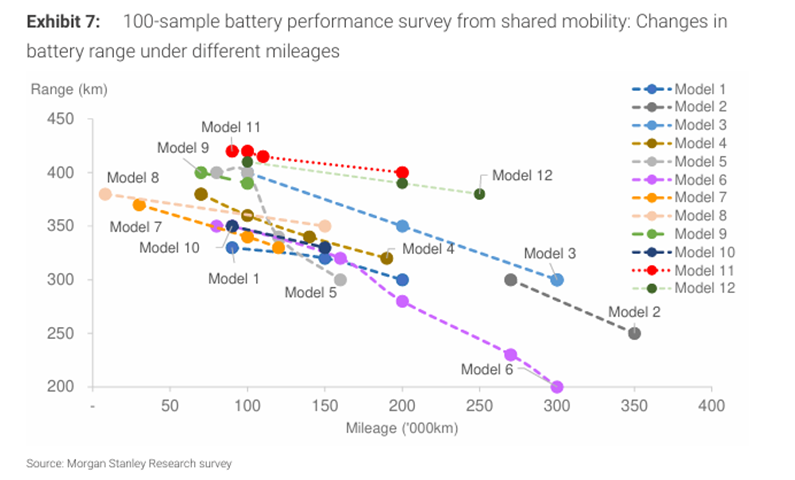
In the long-term energy storage evaluation, Morgan Stanley examined batteries at the Zhangbei National Wind–Solar–Storage Demonstration Project (one of the first large-scale energy storage systems in China). ESPLAZA LDES Network summarizes CATL’s leadership as follows: “Among four LFP battery suppliers involved:
- Only CATL batteries have never been replaced
- After 14 years of operation, capacity remains at approximately 90%
- Other suppliers experienced large-scale replacements or early retirement”
That looks like a huge difference. Perhaps this is one key reason CATL has become the largest battery maker in the world — a reputation for high-quality, long-lasting batteries.
Sign up for CleanTechnica’s Weekly Substack for Zach and Scott’s in-depth analyses and high level summaries, sign up for our daily newsletter, and follow us on Google News!
Have a tip for CleanTechnica? Want to advertise? Want to suggest a guest for our CleanTech Talk podcast? Contact us here.
Sign up for our daily newsletter for 15 new cleantech stories a day. Or sign up for our weekly one on top stories of the week if daily is too frequent.
CleanTechnica uses affiliate links. See our policy here.
CleanTechnica’s Comment Policy
cleantechnica.com
#CATL #Batteries #Stand #Minimal #Degradation #EVs #LongTerm #Energy #Storage #Systems


