


Support CleanTechnica’s work through a Substack subscription or on Stripe.
Ballard Power and New Flyer announced what sounds at first like a market-making agreement, a commercial arrangement for 500 fuel cell engines, or about 50 MW of modules, for hydrogen transit buses starting in 2026. On the surface, that reads like the kind of order that only appears when a technology has crossed from pilots into sustained adoption. Ballard described it as the largest single commitment from New Flyer. It did not describe it as backlog, a firm purchase order, or a take-or-pay agreement.
That distinction matters, because the North American hydrogen transit bus market is nowhere near large enough for 500 new buses to be a reasonable commitment. It is a framework that only makes sense if a much larger future market emerges than current evidence supports. This is an aspirational arrangement more than a commercial one.
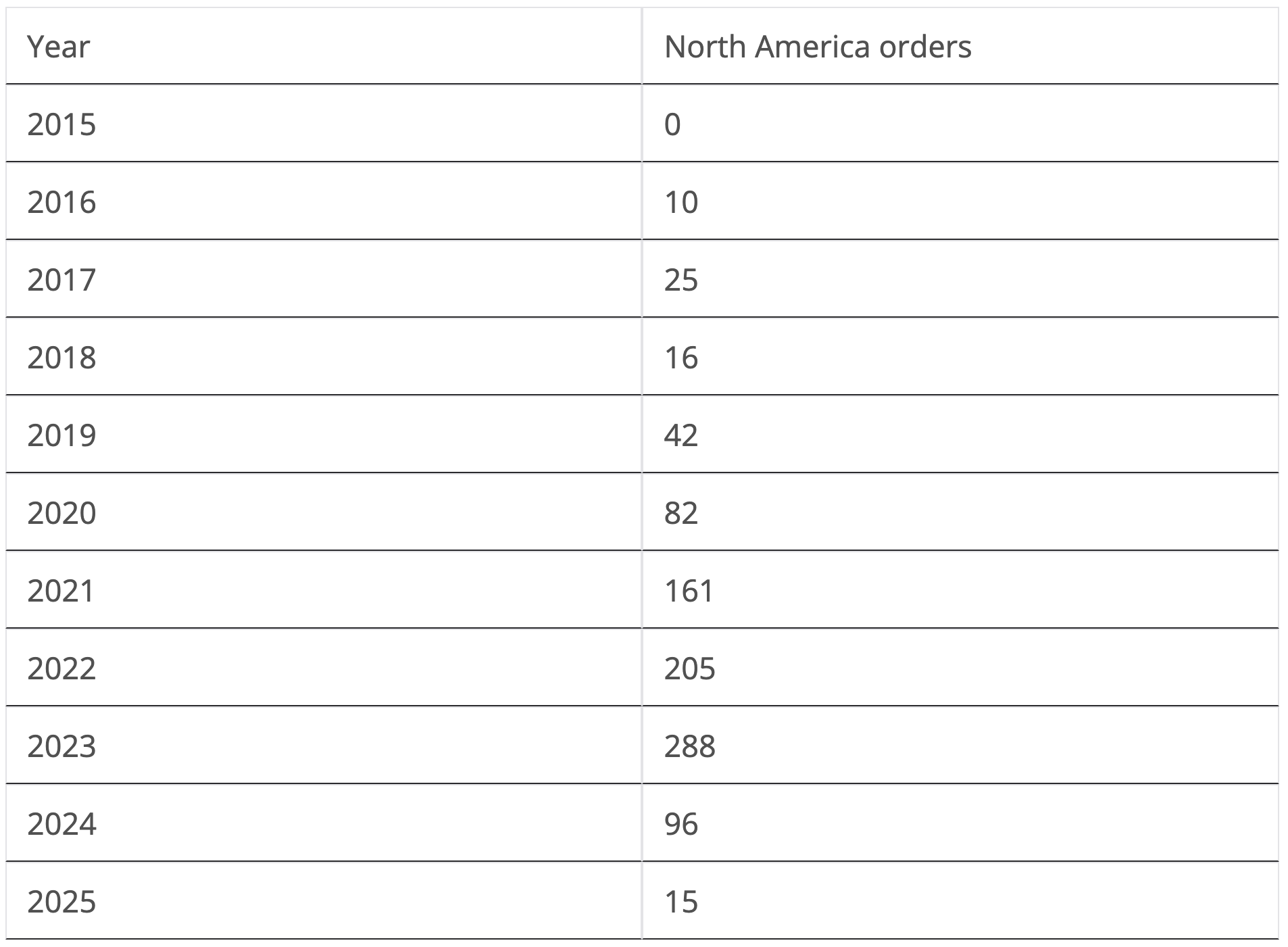
The first thing to clear away is the fog around hydrogen bus counts. Different public sources count buses in service, buses delivered, buses ordered, buses funded, and buses in some combination of funded, ordered, delivered, or deployed. That makes the market look bigger and more stable than it is. CALSTART’s adoption counts are useful for understanding the size of the pipeline, but they are not a clean annual order book. When one strips away rolling stock figures and focuses on public awards, board approvals, and identifiable procurements, the North American full-size transit fuel cell bus market is small and lumpy. In the strict public order reconstruction for the United States and Canada from 2015 through 2025, the visible annual market reached 288 buses in 2023, fell to 96 in 2024, and dropped to 45 gross in 2025 before accounting for known reversals. That is the shape of a niche market, not a scaling one. As a side note, Mexico has so far avoided the hydrogen bus cul de sac entirely.
It’s also a market that seemingly peaked three years ago at a small number, per the numbers. For clarity, this may be an artifact of the law of small numbers, where the sample size is small so the degree of variance from statistical norms tends to be higher. However, it aligns with global evidence that the enthusiasm for hydrogen buses has distinctly cooled. Recently I analysed European hydrogen bus deliveries, found that they had plateaued in 2024 and 2025 and with a plummeting order book from 2023 onward were going to be in steep decline in coming years. For hydrogen buses, 1-2 year lags from ordering to delivery are common. Announcements of deliveries are taken as market strength, but it’s masking the collapse of the market. One last point on the 2024 numbers. Those orders were in a year when the US IRA and hydrogen subsidies were still in full swing, but orders fell off a cliff. Once again, small numbers, but it certainly has the appearance of a rapid cooling of enthusiasm for the technology.
New Flyer would have contracted with Ballard for fuel cells for all of the buses listed above, with the possible exception of the 15 remaining buses ordered in 2025, before the 500 fuel cell announcement, so while some fuel cells in operating buses will undoubtedly fail and need replacement, the 500 should be thought of as supporting close to 500 future buses.
That small market is also concentrated to an unusual degree. California is not merely the leading hydrogen transit bus state. It is the center of gravity for the entire North American market. CALSTART’s latest full-size transit bus data show California with 690 fuel cell buses in the funded, ordered, delivered, or deployed pipeline as of 2025, compared with about 920 for the entire United States. That means about 80% of the U.S. hydrogen transit bus market sits in a single state. Outside California, only 165 full-size hydrogen transit buses were spread across 15 states, with Nevada at 52, New York at 15, Illinois and Ohio at 14 each, Maryland at 13, Arizona at 12, and several states in the single digits. This is not a diversified continental market. It is a California market with a small outer ring.
That concentration matters because California is also the place where the economics of hydrogen buses have been given the most policy support. If hydrogen buses were going to find durable commercial footing anywhere in North America, California was always going to be the proving ground. Yet even there, the economics remain fragile. The California Transit Association’s 2025 legislative program said agencies face financial and operational pressure from zero-emission deployment and specifically called for action to reduce the prohibitive cost of hydrogen as a fuel.
NREL’s review of California’s Innovative Clean Transit transition found that a 25-bus fuel cell fleet replacing CNG buses still had a negative net present value even with Low-No funding, and a more negative result without it. The same work found battery electric buses in a comparable scenario producing a positive net present value and a discounted payback of just over six years compared to the baseline of a diesel transit bus due to the much lower operating and maintenance costs. The issue is not that hydrogen buses cannot operate. It is that they struggle to compete financially even in the most supportive jurisdiction on the continent.
Foothill Transit’s 2025 board papers provide the clearest real-world example of this structural weakness. Foothill was not a skeptical bystander. It was one of California’s early hydrogen adopters, with hydrogen refueling and operating experience already in place. When DOE support tied to ARCHES, California’s hydrogen hub, was terminated, Foothill reported that it was losing $300,000 per bus, $4 million for a new hydrogen station, and $1 million for upgrades to an existing station.
At the same time, the Hybrid and Zero-Emission Truck and Bus Voucher Incentive Project (HVIP) was oversubscribed and uncertain. It is a California state program that provides point-of-sale subsidies to reduce the upfront cost of zero-emission and low-emission commercial vehicles, including transit buses, with funding released in limited, often oversubscribed rounds. Staff told the board that changing a 30-bus hydrogen procurement and associated fueling work to CNG would save about $27.6 million upfront and about $1.8 million per year in fuel cost. Those are not rounding errors. They are the difference between a project proceeding and a project unraveling. The lesson is that hydrogen bus deployments do not merely benefit from policy support. They require stacked support across buses, fueling, and fuel supply to remain viable.
That is where the comparison with battery electric buses becomes important. BEBs also receive policy support, but they do not depend on it in the same brittle way. Charging infrastructure is cheaper than hydrogen fueling infrastructure, easier to add in stages, and tied to an electricity system that is already everywhere. Agencies can phase in chargers, adjust depot layouts, and sequence fleet replacement over time. Electric bus fleets are much more modular and incremental. They are not forced into the same all-or-nothing infrastructure decisions that hydrogen fleets often face. California’s own transit pipeline reflects this. As of July 2025, CALSTART counted 1,933 battery electric transit buses in California versus 690 fuel cell buses. Even in the strongest hydrogen bus market in North America, battery electric buses outnumber fuel cell buses by about 3 to 1.
The larger road transport market in California tells the same story with more force. In medium- and heavy-duty trucking, CALSTART reported about 10,659 zero-emission truck deployments in California by mid-2025, while national hydrogen truck deployments were only 197. Even if every fuel cell truck in the United States had somehow been in California, which they were not, hydrogen would still have been under 2% of California’s zero-emission truck base. Passenger vehicles are even more revealing. California recorded 378,216 new zero-emission vehicle registrations in 2025. BEVs alone represented 20.9% of the new light-duty vehicle market. Fuel cell vehicles rounded to 0.0% of the market in that reporting. CARB also reported 14,128 active fuel cell car registrations in April 2025, a year-over-year decline and the first recorded drop in the active fleet. Battery electric is not merely ahead in California. It is the default and growing pathway in cars, dominant in trucks, and leading by a wide margin in buses in the most hydrogen focused jurisdiction in North America. Hydrogen, by contrast, is fading in every segment.
Infrastructure follows demand, and here the divergence becomes hard to ignore. California had over 200,000 public and shared EV charging ports by September 2025, alongside an estimated 800,000 Level 2 chargers at single-family homes. Hydrogen refueling was on a very different scale. CARB said California had 61 hydrogen stations as of late August 2025, of which only 50 were open retail and 11 were temporarily non-operational. The Hydrogen Fuel Cell Partnership later reported broader gaseous hydrogen supply disruptions affecting station availability.
In early March in 2026, 70% of the stations were unavailable due to a combination of a fuel truck explosion, compressor failures, seal failures and undisclosed other reasons. What was remarkable was that there were no headlines about this. The stations exist without users and are out of service or lacking hydrogen regularly, so no one cares. It’s not news.
That is not simply a matter of fewer stations. It is a reflection of a fuel supply and retail network that has never found a stable commercial footing. Battery charging networks have problems and delays, but they are scaling along the grain of the electricity system. Hydrogen retail remains a specialized overlay that struggles with uptime, economics, and supply. In my assessments of hydrogen refueling station economics, I haven’t found one in any jurisdiction that was a viable commercial proposition, with operations and maintenance costs that exceeded revenue from hydrogen, never mind revenue paying for amortized capex.
Supply-side structure reinforces the same conclusion. New Flyer is not the only company that has ever supplied a fuel cell transit bus in North America, but it is now the only active one. Earlier in the market, ElDorado National-California (ENC) supplied fuel cell buses, including units for SARTA. NREL’s more recent fuel cell bus materials identified New Flyer as the current bus OEM in the market, and Rochester’s transit agency said in 2024 that ENC was winding down bus manufacturing, forcing a hydrogen procurement change toward New Flyer. In Canada, CUTRIC reported that New Flyer was the sole provider of fuel cell transit buses reported by transit agencies, and Mississauga said New Flyer was the only manufacturer in Canada producing transit fuel cell transit buses. When one reconstructs the North American full-size transit fuel cell bus market on a strict public order basis for 2015 through 2025, New Flyer accounts for all but a handful of orders.
That is not what a healthy competitive growth market looks like. It is what a narrow surviving niche looks like. The absence of any alternative in the space should give transit agencies serious pause. If no one cares about the market, what does that mean for the price of buses, maintenance and warranties, and what does it mean should New Flyer fail, as so many providers of hydrogen vehicles have in the past five years?
Canada adds little volume to change the picture. Using the same strict public-order approach, the Canadian full-size transit fuel cell bus market from 2015 through 2025 amounts to only about 20 confirmed public orders, with 10 confirmed physical receipts or deliveries in that time span. This is mostly due to the conflict of interest laden guidance of a transit think tank, CUTRIC, that was captured by Ballard Power, a major gas utility and New Flyer.
The visible programs are few. Edmonton and Strathcona County each received one bus in the Alberta pilot, and further hydrogen bus orders were canceled due to high costs. They aren’t running scheduled routes. The refueling station 40 km south of the city that they depended on closed, so now they are being fueled with very high emissions hydrogen from a small and temporary methanol reformer. How high are the emissions? I did the math when Winnipeg was considering this pathway, and it turns out to be 3.2 times as high as diesel emissions. These two buses thankfully aren’t running full routes, because it would be like having over six buses worth of emissions for the same passenger volumes.
Winnipeg ordered eight fuel cell buses in its initial fleet and had received them by 2025. This was after originally cancelling the purchases entirely after rising program costs, especially with their aging trolley depot that they wanted to refurbish for the buses and with the hydrogen refueling infrastructure. They are receiving gray hydrogen in tube trailers with temporary refueling, so like Edmonton are experiencing high emissions, 60% to 70% of diesel, and vastly higher than battery electric buses running on Manitoba’s ultra-low carbon intensity electricity.
Mississauga ordered 10 fuel cell buses from New Flyer, but those were expected to arrive in 2026. With luck the city will undertake the hydrogen bus derisking workshop I outlined and avoid the long term costs to their taxpayers and challenges for their ridership.
Even with a broader commitment count that adds Brampton’s planned buses—planned based on seriously flawed modeling by CUTRIC that forced hydrogen buses into a blended fleet—Canada remains only about 5% to 6% of the North American market on the strict order-book basis. That means any serious claim about 500 fuel cell engines for New Flyer has to rest overwhelmingly on a larger U.S. market, and especially a larger California market, emerging from conditions that currently point the other way.
The demand picture looks different, but not more encouraging, when the reconstructed North American order curve is used instead of the strict public ledger. The market appears to ramp from about 82 buses in 2020 to 161 in 2021, then to about 205 in 2022 and a peak near 288 in 2023, before dropping sharply back to 96 in 2024 and about 15 in 2025 on currently visible data. It does not suggest steady growth. Quite the opposite it, suggests a policy-driven surge that did not sustain even when policy was still favorable. The same structural weakness remains visible. A handful of large procurements drive the entire curve. The 108-bus SamTrans order alone accounts for more than a third of the 2023 peak. In a broad market, a single order of that size would not dominate the annual total. Here it does, which reinforces that this is still a small and fragile market rather than a scaling one.
This is where the Ballard announcement has to be read carefully. A 500-engine framework can make sense from the supply side. Ballard wants to secure its position in a segment where it remains relevant. New Flyer wants to make sure modules are available if projects materialize. Both companies benefit from signaling confidence to customers, investors, and policymakers. But that does not mean 500 buses are effectively sold. If North American transit agencies had visible, funded, near-term plans for anything like 500 new hydrogen buses, the public procurement trail would look very different from the one in front of us. It would show a widening set of state markets, a stable subsidy regime, multiple active OEMs, and annual order volumes already approaching that level. None of those conditions exists.
Projecting forward under the current conditions leads to an uncomfortable conclusion for hydrogen advocates. If ARCHES does not return in a comparable form, if HVIP remains intermittent and modest, if hydrogen fuel remains expensive, if fuel cell bus prices rise with inflation while BEB prices stay flat or drift down, and if California’s zero-emission bus requirements remain in place, then battery electric becomes the default compliance pathway. To be clear, I think all those ifs are certainties.
Hydrogen survives at agencies with sunk refueling infrastructure, political commitment, or route profiles that make them reluctant to go all-in on batteries, although there are solutions for all routes today. But survival is not scale and it’s not guaranteed. Aberdeen, Scotland, had all of that and just abandoned its fleet, hoping, likely in vain, to find some other agency to buy them. The likely curve is one where BEB orders rise and then level off at strong replacement numbers as the dominant technology, while fuel cell orders remain a small and declining minority niche, volatile from year to year, and highly sensitive to policy shocks. It’s quite probable that as orders dry up New Flyer exits the market except for servicing existing orders and clients, just as European train manufacturer Alstom did recently. I’ve argued that they should do that sooner rather than later, as like Solaris in Europe, they are winning a dead end segment and losing the battery electric segment as a result.
The Ballard and New Flyer announcement sounds like the opening of a large market. The actual market signals point somewhere else. Demand is small and lumpy. Supply has narrowed to one dominant bus OEM. The economics still need stacked subsidy support, especially in California, which remains the market’s center of gravity, and that stack is missing it’s key pillar. Battery electric alternatives are doing much better in buses, much better in trucks, and overwhelmingly better in passenger vehicles. Supposed shortcomings of battery electric buses have been solved globally under every climate and route condition. Charging networks are scaling. Hydrogen retail is small, shrinking and unreliable. Under those conditions, the right way to read the 500-engine deal is not as proof that North America is about to buy 500 new hydrogen buses. It is as a framework for hoped-for demand in a market that still has not demonstrated the ability to absorb anything close to that volume.
Sign up for CleanTechnica’s Weekly Substack for Zach and Scott’s in-depth analyses and high level summaries, sign up for our daily newsletter, and follow us on Google News!
Have a tip for CleanTechnica? Want to advertise? Want to suggest a guest for our CleanTech Talk podcast? Contact us here.
Sign up for our daily newsletter for 15 new cleantech stories a day. Or sign up for our weekly one on top stories of the week if daily is too frequent.
CleanTechnica uses affiliate links. See our policy here.
CleanTechnica’s Comment Policy
cleantechnica.com
#Ballards #Fuel #Cell #Deal #Meets #Hydrogen #Bus #Market #Arrived


