


Support CleanTechnica’s work through a Substack subscription or on Stripe.
Or support our Kickstarter campaign!

Earlier this week, Toyota introduced its next generation Highland three-row SUV, and to the surprise of many, it is a battery-electric vehicle — not a mild hybrid or plug-in hybrid. That surprised a lot of people because Toyota has been a laggard in the electric car space for years.
Toyota’s timing is curious. GM, Ford, and Stellantis are running away from electric cars as fast as they can, racking up stunning financial losses, although as Larry Evans explains, there may be more to that story. You can read his analysis here.
Motor Trend had some thoughts on Toyota’s decision to introduce a battery only version of the Highlander. It said, “Electric cars are, unfortunately, a politically charged subject at this moment, but with any luck, the fact both the Highlander and its battery will be made in America will…..smooth some of the rhetoric. If you need more space or don’t want to be tethered to a cord, there’s always the Grand Highlander, still available with a conventional or hybrid powertrain.”
Room For Six — Or Seven
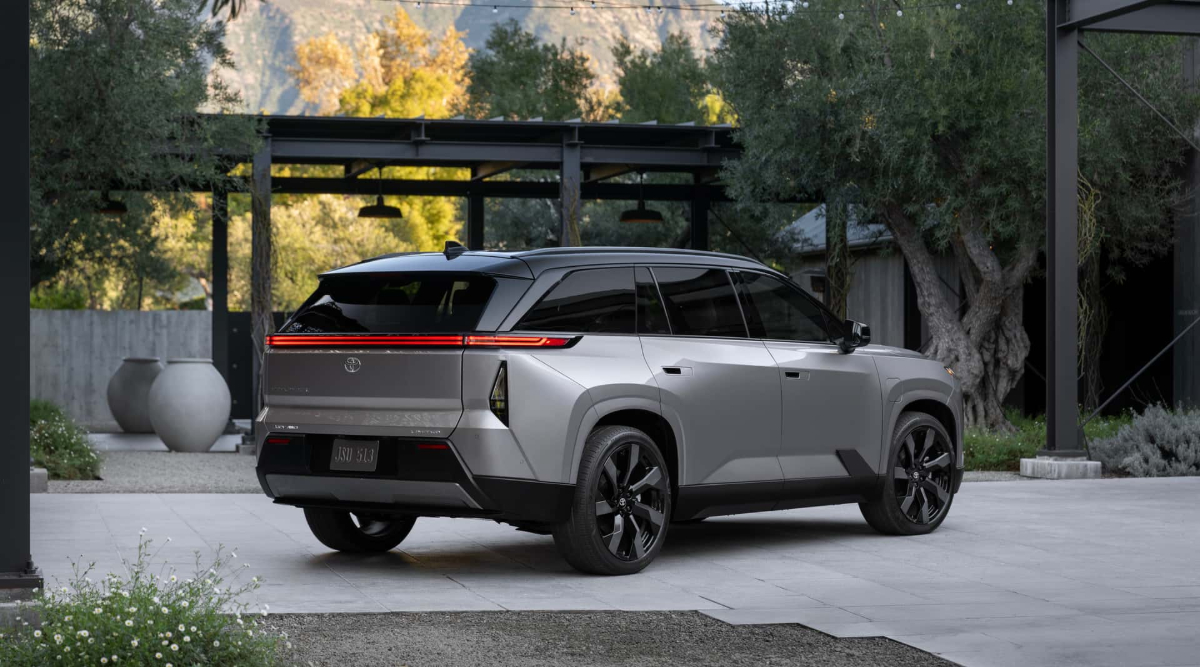
The new Highlander is billed as a seven-passenger vehicle, but in fact that requires the optional middle bench seat in place of the standard captain’s chairs and is only available with the XLE AWD trim.
The entry level Highlander XLE comes with a single motor powering the front wheels, rated at 221 horsepower and 198 pound-feet of torque. It is fitted with a 77 kWh battery and has an EPA rating of 287 miles.
The AWD version adds a rear motor that gives a combined output of 338 horsepower and 323 pound-feet of torque. The 77 kWh battery is standard, but buyers can opt for a larger 96 kWh battery that increase EPA range to 320 miles. The Limited version comes standard with AWD and the larger battery.
Car and Driver points out that if those specs sound familiar, it’s because the drivetrain of the Highlander is identical to that of the smaller bZ electric SUV, both of which are built on a version of the Toyota TNGA-K platform.
XLE AWD and Limited models also offer terrain-specific drive modes and Crawl Control, in which the vehicle handles acceleration and braking at low speeds to allow the driver to focus on steering around obstacles. Handy if you find yourself on the Rubicon Trail on your way to Buc-ees for some fast charging.
NACS & V2L
All new Highlanders come with NACS charging ports and Toyota says both batteries can be charged from 10 to 80% in 30 minutes. Preconditioning can be activated manually or automatically using the onboard navigation system. Plug and Charge technology is also standard. An 11 kW onboard charger is included, which the company claims allows the smaller battery to be charged at Level 2 speeds in about 6 hours, with the larger battery taking two hours longer.
Vehicle to load capability is supported on all versions of the new Highlander, and in the avocado toast lounge at CleanTechnica global headquarters, we believe this will be a feature that will be much in demand in the future.
Once people learn they can use the battery in their car to store electricity they produce themselves for free, there will be no turning back. And no longer needing to worry about being caught in a cold, dark house during a grid outage? That’s when all the whining about having to spend ten extra minutes during highway stops will end and people will start clamoring for cars like this.
Gasmobiles can’t do either of those things — never have, never will. Let the ignoramuses make love to their filthy coal-fired generating stations. There’s a reason why railroads don’t use coal anymore, and there is no longer any justification for people to get their electricity that way either. Cars like the Highlander EV will move that transition along more quickly.
Driver-Focused Interior
The Highland EV is a few inches longer and wider than its predecessor, but has added over 8 inches to the wheelbase to make room for the battery. Standard on all versions of the new Highlander is Toyota Safety Sense 4.0, the latest iteration of Toyota’s safety hardware and software, promising noticeable upgrades in the pre-collision system’s functionality, as well as improved dynamic cruise control across all speed ranges, lane departure assist, and automatic high beams.
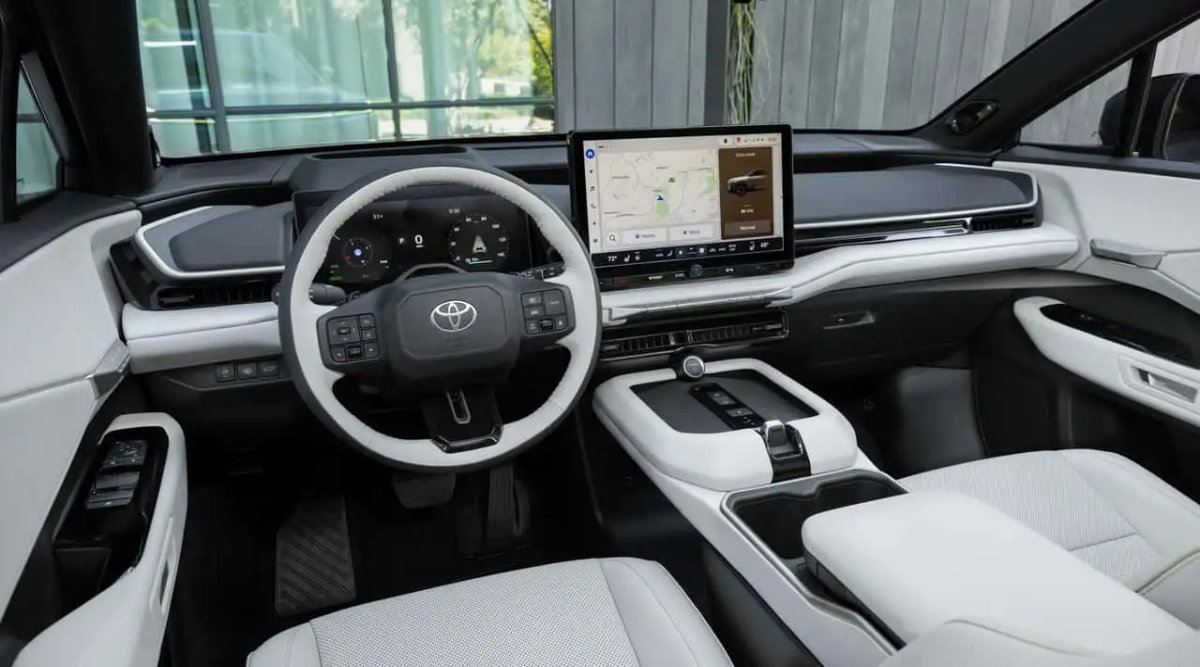
According to Inside EVs, “The Highlander gets a driver-focused cockpit with a 12.3 inch digital instrument cluster and a 14 inch central touchscreen running Toyota’s latest generation infotainment system. Dubbed Toyota Audio Multimedia, the new user interface features 5G connectivity from AT&T, an embedded voice assistant with wireless Apple CarPlay and Android Auto connectivity. There’s also a built-in dashcam feature called Drive Recorder.”
The XLE features front acoustic glass, 19-inch wheels, heated front seats and steering wheel, a 64-color ambient lighting setup, and a six-speaker audio system to go with that pair of screens. The Limited trim package includes a head-up display, ventilated front seats, heated second row seats, rear sunshades, a 360-degree camera system, and lane change assistance.
On the option list are such things as a fixed panoramic glass roof, a JBL premium sound system with 11 speakers, two-tone paint which makes the car look even longer, and 22-inch wheels. It should be noted that larger wheels and tires tend to lead to lower range, so please, let’s not hear any bellyaching about range from those who specify the larger kicks!
Highlander EV Is A Big Deal For Toyota
The new Highlander is a big deal for Toyota and its American manufacturing portfolio. It’s the company’s first three-row EV for the US market and the first electric car built at one of its American factories.
Production of the 2027 Highlander will kick off later this year at Toyota’s factory in Kentucky, with sales expected to begin in late 2026. That means you may not be able to put one in your driveway until a year from now. The Hyundai Ioniq 9 and Kia EV9 are the only battery-electric three-row SUVs available in the US today. Will the Toyota be worth the wait?
For some, the answer is yes. Although prices have not yet been announced, it is a safe assumption that Toyota will price its new car competitively with the Hyundai and Kia offerings, which sell for between $55,000 and $80,000.
Toyota has more than 60 years of brand equity built up in the US and there are some who would not drive a car from any other company, due to its reputation for durability, reliability, and value.
Support CleanTechnica via Kickstarter

Sign up for CleanTechnica’s Weekly Substack for Zach and Scott’s in-depth analyses and high level summaries, sign up for our daily newsletter, and follow us on Google News!
Have a tip for CleanTechnica? Want to advertise? Want to suggest a guest for our CleanTech Talk podcast? Contact us here.
Sign up for our daily newsletter for 15 new cleantech stories a day. Or sign up for our weekly one on top stories of the week if daily is too frequent.
CleanTechnica uses affiliate links. See our policy here.
CleanTechnica’s Comment Policy
cleantechnica.com
#Automotive #Press #Heaps #Praise #Toyota #Highlander


