


After years of neglect left it cracked and crumbling, a 19th-century royal kitchen inside Lucknow’s Chhota Imambara is being brought back to life, with the Archaeological Survey of India (ASI) using traditional methods to restore it to its original form. The aim is to restore it exactly as it existed during the time of the nawabs of Awadh.
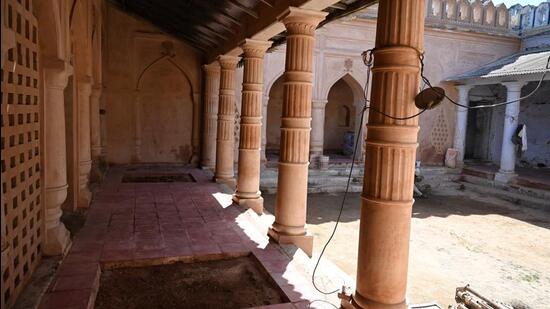
The intricate exercise in conservation is nearing completion. The project, which began around six months ago, is now in its final stages and is expected to be completed within 1-2 weeks.
“This is not a routine repair work. Our goal is to restore the structure to its original form, using traditional materials and techniques,” Aftab Hussain, superintending archaeologist, ASI, Lucknow region, told HT.
As per the ASI, modern construction methods are not being used here. Instead, the restoration relies on a traditional lime mortar, which takes time and care to prepare.
“Slaked lime is soaked for about a month and then mixed with natural ingredients like wood apple pulp, black gram, jaggery, gond (gum) and brick dust. This old method, once widely used in Mughal-era buildings, makes the structure strong and long-lasting in a way modern cement cannot,” Aftab explained.
“Workers on site have been trained to prepare and apply this mortar, ensuring that every layer adheres to historical accuracy. Equally critical is the use of lakhauri, thin and hand-moulded bricks that define Awadhi architecture. These are being sourced and laid carefully to match the original structure, preserving both strength and aesthetic authenticity,” he added.
The kitchen kept running during restoration
The royal kitchen, built in 1837 by Nawab Muhammad Ali Shah and designed as twin units on either side of the Imambara, remained operational during Ramzan even while the restoration work was underway. Distributing food during Ramzan and Muharram is a system that still sustains under the Hussainabad and Allied Trust (HAT).
According to experts taking up the restoration work, the twin design helped keep the kitchen active during the Ramzan month which ended recently, as while one kitchen underwent conservation, the other continued to function.
“Every crack has been studied, every layer of plaster was carefully removed and reapplied using traditional methods. Intricate wall details are being preserved rather than replaced, and no modern shortcuts are being allowed to alter the structure’s original character,” the superintending archaeologist said.
Meals that carry a 200-year-old legacy
“Every Ramzan and Muharram, the kitchen feeds the poor, widows and others unable to provide for themselves,” said HAT superintendent Habibul Hasan.
“Around 700 coupons are distributed daily, and cooked food is sent to 16 nearby mosques to serve both to the needy and the faithful. The simple yet filling meals include meat curries, flatbreads, kebabs, fruits and sweets, reflecting Lucknow’s rich culinary tradition,” he added.
According to kitchen in‑charge Murtaza Hussain Raju, the menu and even the portion sizes are recorded in the former ruler’s will.
“During Muharram, the menu changes. For the first nine days, it is simple and largely vegetarian — sweet flatbread, lentils and potato curry among the staples. For the remainder of the 40-day mourning period, richer meat curries and kebabs are added,” said Ejaz, another HAT official.
“I have been coming to the Chhota Imambara since childhood to receive tabarruk (the royal offering) during Muharram, and sehri (early meal before dawn) and iftar (evening meal to break their fast) during Ramadan,” said Syed Abbas, a local.
HISTORICAL SIGNIFICANCE
According to Lucknow-based historian PC Sarkar, Muhammad Ali Shah, during his brief reign from 1837 to 1842, created the Chhota Imambara on what was formerly Jamunia Bagh. “Due to his foresight, he established the Hussainabad Endowment Trust in 1839 to maintain the area’s heritage and religious structures and to fund the Shahi Bawarchi Khana (royal kitchen) on the Imambara premises, which continues to provide food to the poor and needy, irrespective of religion,” he added.
www.hindustantimes.com
#ASI #restores #Nawabiera #royal #kitchen #Chhota #Imambara #pristine #glory


