Support CleanTechnica’s work through a Substack subscription or on Stripe.
Trump voters all over the country are running to the media with their tales of woeful buyers’ remorse. Well, sure, if it makes them feel better, let them whine. Meanwhile, the real action is taking place in court, where state attorneys general are trying to undo some of the damage wrought by Trump voters. In the latest news, 18 states are suing the Trump administration to release the funds from two different federal EV charging programs.
Wait, Didn’t They Already Release the EV Charging Funds?
If you’re thinking of the NEVI program, close but no cigar. The National Electric Vehicle Infrastructure program is a $5 billion Biden-era funding pot aimed at establishing a seamless fast-charging network along US Interstate highways and other major arteries.
Under the NEVI program, states were tasked with choosing their own EV charging station locations within certain guidelines, and that’s where things got a little sticky. Some states, like Pennsylvania, were well-prepared to get the ball rolling when the program launched. Others were a little slow on the draw, but all 50 states had their NEVI planning documents lined up as of July 2024.
On the down side, only eight of those states actually had NEVI stations in operation as of July 2024, for a total of just 61 charging ports. Still, plans for another 2,500 ports were well underway, and the program was hitting its stride by the time Trump won the 2024 election.
Trump declared the NEVI program all but dead upon taking office in January, but the barn door was already open. His new Transportation Commissioner followed through in February, officially suspending the distribution of NEVI funds. The matter then went to court, where a judge issued a preliminary injunction against the Trump administration in June, blocking the suspension.
California Attorney General Rob Bonta was among the group of state attorneys general suing the Trump administration to release the remaining NEVI funds. “The administration cannot dismiss programs illegally, like the bipartisan Electric Vehicle Infrastructure formula program, just so that the President’s Big Oil friends can continue basking in record-breaking profits,” Bonta said on June 24, in a press statement marking the injunction.
Release The EV Charging Funds!
By August, the Trump administration finally knuckled under and began releasing the NEVI funds, but that was just one stop along the quest to release all of the federal funds for new EV charging stations. Bonta is also among a group of 17 state attorneys general who are suing the Trump administration over two other charging station programs. The State of Pennsylvania is also a party to the lawsuit, which includes Arizona, Delaware, District of Columbia, Illinois, Maryland, Massachusetts, Michigan, New Jersey, New York, Oregon, Rhode Island, Vermont, and Wisconsin as well as California.
“Without any explanation or notice, the U.S. Department of Transportation (USDOT) has quietly refused to approve any new funding under two electric vehicle charging infrastructure programs created in the Infrastructure Investment & Jobs Act (IIJA): Charging and Fueling Infrastructure Program (CFI) and the Electric Vehicle Charger Reliability and Accessibility Accelerator (Accelerator) Program (together, the EV Charging Infrastructure Programs),” Bonta’s office explained in a press release dated December 16.
“In the lawsuit, California and the coalition allege that these unexplained and secretive actions violate the constitutional separation of powers, as the funding was approved by bipartisan majorities in Congress,” Bonta’s office added.
Congress, Schmongress. The Republican Party holds the majority vote in both the House and Senate. They can choose to exercise the authority of Congress as a co-equal branch of the US government, or not. So far they have not, leaving Trump free to act as he chooses.
There’s No Win Without A Battle
The two EV charging programs are no small potatoes. The Accelerator program is a part of the NEVI funding pot, aimed at providing state and local governments with funds for repair and maintenance. The CFI program is a separate pool, covering $2.5 billion in state and local funding for new EV charging stations and hydrogen fuel stations, too.
California estimates that its share of the two programs adds up to $179.8 million. The funds are supposed to be earmarked for cleaning up the state’s freight transportation system, including seaports as well as key freight corridors.
Regardless of the long odds in Congress, state attorneys general and other defenders of the Constitution have won a series of key legal battles against the Trump administration this year. Chances are they will prevail in the fight over the two EV charging programs, though the victory will be bittersweet considering the awful state of the EV market in the US.
Still, EV stakeholders have continued to lay plans for a comeback in the US, the IONNA charging station consortium being one example. Composed of BMW, General Motors, Honda, Hyundai, Mercedes-Benz, Kia, Stellantis, and Toyota, in November the consortium announced a new $250 million plan to build out its retro chic “Rechargery” network in California. The plan includes adopting Ford and Rivian into its hassle-free charging system.
On his part, California Governor Gavin Newsom is itching for a fight. “The Trump Administration is unlawfully withholding funds from the Bipartisan Infrastructure Law — investments Congress approved to build America’s EV charging network, reduce pollution, and create thousands of good-paying jobs,” Newsom stated in support of the lawsuit.
“We won’t stand for it. California will defend the Constitution, our communities, and the future we’re building. With 2.4 million zero-emission vehicles on our roads and critical projects ready to move forward, we’re taking this to court,” the Governor emphasized.
Coincidentally or not, the IONNA consortium staged a media day on December 17 complete with a full sized gong prop (available on YouTube), in which they explained how they expect to cover 30,000 charging bays by 2030.
As for who’s going to use all those charging bays, that’s a good question. Ford is banking that individual drivers will continue to favor gas for tricked-out pickup trucks, SUVs, and other large and pricey vehicles, leaving the EV market to more budget-conscious households for support.
Against that backdrop, Slate Auto still has high hopes for its original concept of a stripped-down, customizable electric pickup truck, despite the loss of the $7,500 federal tax credit. “The Slate is still affordable, so it doesn’t matter,” is the company’s attitude as reflected in a Q&A posted on slateforums.com earlier this week.
If you have any thoughts about that, drop a note in the comment thread. Better yet, find your representatives in Congress and let them know what you think.
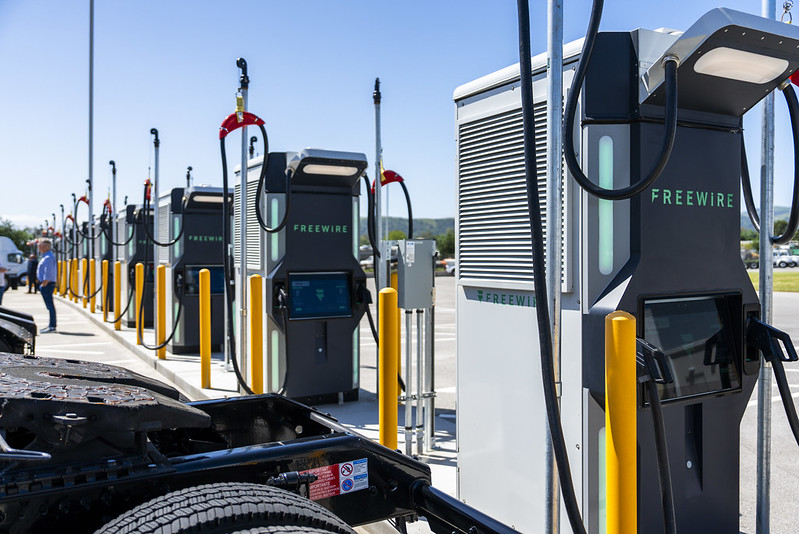
Photo: States fight back — again — as the Trump administration continues to withhold federal funds for EV charging station buildout, repair, and maintenance (cropped, courtesy of California Energy Commission).
Sign up for CleanTechnica’s Weekly Substack for Zach and Scott’s in-depth analyses and high level summaries, sign up for our daily newsletter, and follow us on Google News!
Have a tip for CleanTechnica? Want to advertise? Want to suggest a guest for our CleanTech Talk podcast? Contact us here.
Sign up for our daily newsletter for 15 new cleantech stories a day. Or sign up for our weekly one on top stories of the week if daily is too frequent.
CleanTechnica uses affiliate links. See our policy here.
CleanTechnica’s Comment Policy
cleantechnica.com
#Day #Charging #Lawsuit #Trump