


China will release a standard for solid-state EV batteries later this year as several automakers begin testing the new battery tech in vehicles.
What is a solid-state EV battery standard?
Automakers and battery manufacturers have been promising to launch solid-state electric vehicle batteries for over a decade.
With several companies now testing the promising new battery tech in real-world conditions, solid-state batteries are becoming a reality.
After several recent breakthroughs, China is preparing to introduce its first solid-state EV battery standard in July 2026 to help clarify some of the new terminology.
In December, China’s National Automotive Standardization Technical Committee released the first draft of its standard, “Solid-State Battery for electric vehicle – Part 1: Terms and Classification,” opening it up for public discussion.
The comment period is set to conclude on February 26, 2026, followed by a review period and a final decision in April. If approved, the final solid-state EV battery standard will be released in July 2026.
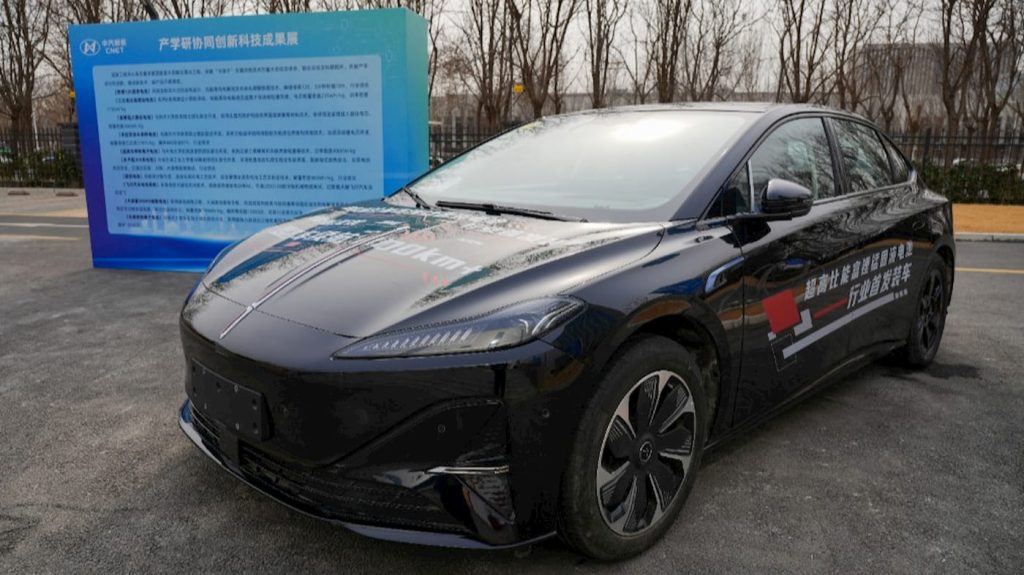
According to local reports, Wang Fang, chief scientist of the China Automotive Technology and Research Center (CATARC), confirmed the news during an industry conference.
The standard is designed to categorize and clearly define solid-state batteries, including terms such as liquid, hybrid, semi, solid-liquid, and all-solid-state EV batteries.
It then breaks it down further by electrolyte type (sulfide, oxide, composite, polymer, or halide), conducting ion (lithium or sodium), and whether it’s high-energy or high-power.
The draft set the allowable weight-loss rate for qualifying as a solid-state battery at no more than 0.5%, but we’ll see whether that remains in the final copy.
Several Chinese automakers, including Dongfeng, GAC, BYD, and Geely, recently announced they have already started installing solid-state batteries in vehicles for testing. On February 10, FAW Group said it installed the “industry first” lithium-rich manganese semi-solid-state EV battery in a vehicle.
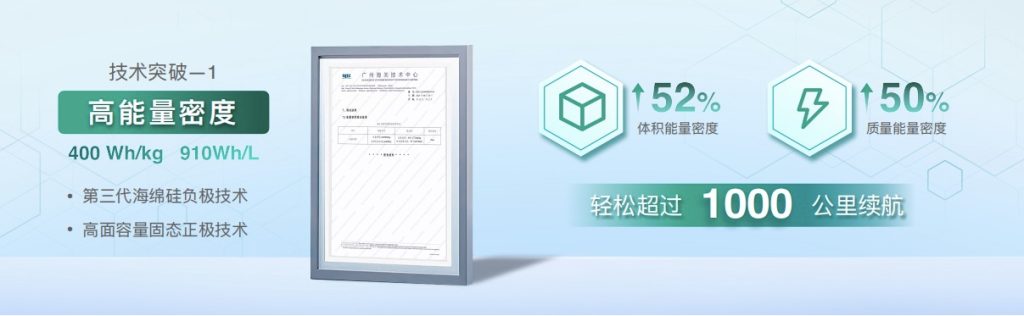
According to FAW, the cell energy density exceeds 500 Wh/kg, and the total battery pack capacity is 142 kWh, enabling over 1,000 km (620 miles) of CLTC driving range.
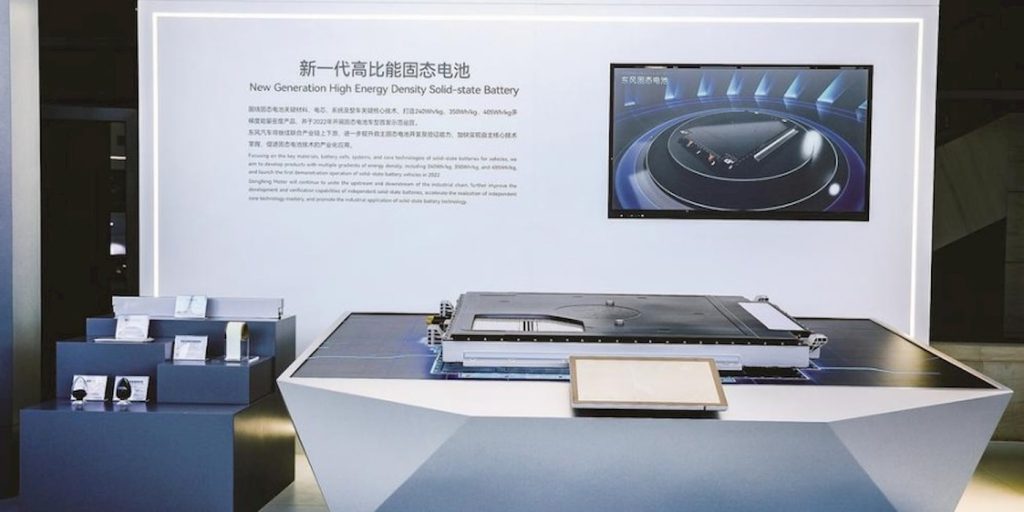
Last month, Dongfeng Motors began testing a solid-state battery-powered prototype in cold weather conditions. Dongfeng also claims that its solid-state batteries, with an energy density of 350 Wh/kg, can deliver more than 1,000 km (620 miles) of CLTC driving range.
Electrek’s Take
BYD, FAW, Dongfeng, and several others are preparing to begin producing solid-state batteries in 2027. The first few years will be limited, likely reserved for higher-end models, until mass production begins around 2030.
Outside China, other automakers are moving forward with plans to launch solid-state batteries around the same time, including Toyota, Mercedes-Benz, BMW, Nissan, and Volkswagen.
Mercedes announced last year it had driven a modified EQS, equipped with solid-state EV batteries, for 1,205 km (750 miles) on a single charge.
The battery cells, which Mercedes called “a gamechanger,” were supplied by US-based Factorial Energy. Factorial also has partnerships with Hyundai, Kia, and Stellantis to develop and test solid-state batteries based on its FEST (Factorial Electrolyte System Technology) platform.
Just last week, Factorial launched the first solid-state battery program for passenger vehicles in the US through a partnership with Karma Automotive.
While solid-state batteries have shown promise in delivering significantly higher energy density than traditional lithium-ion batteries, they’re only one of the new battery chemistries that will help reduce costs, improve safety, and offer longer driving range and faster charging.
Source: CarNewsChina, Mydrivers


FTC: We use income earning auto affiliate links. More.
electrek.co
#solidstate #battery #standard #released #China


