


Delhi’s decision to develop 25 signal-free corridors has renewed attention on Lucknow’s U-turn-based traffic management model, which has expanded from a pilot project in 2024 to 28 intersections across the city.
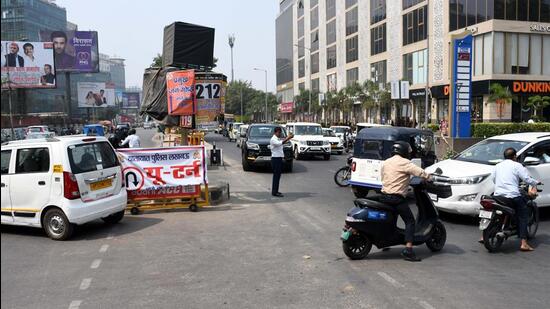
Lucknow police introduced the city’s first U-turn-based traffic management plan at Wireless Chauraha in Mahanagar in April 2024, replacing conventional signal movements with channelised left turns and designated U-turns to improve traffic flow.
The pilot marked a shift from traditional traffic regulation to traffic engineering. Instead of allowing vehicles to cross intersections directly after waiting at traffic signals, motorists were diverted through free-left movements and strategically planned U-turns, enabling continuous traffic flow while reducing conflict points and congestion.
The experiment was launched after police identified Wireless Chauraha as a major bottleneck due to long signal cycles and heavy traffic volume. Under the redesigned traffic plan, vehicles from PAC Gate No. 1 were diverted towards Classic Chauraha before taking a U-turn to reach Channi Lal Chauraha, while traffic from the opposite direction followed a similar route via Rahimnagar, eliminating the need for direct crossing at the junction.
Since then, the city has expanded the model to several busy intersections as part of its broader effort to decongest arterial roads. “There are already 28 such crossings in Lucknow which have U-turns,” said DCP (Traffic) Raveena Tyagi. She said the objective is to keep vehicles moving with minimal stoppages by redesigning intersections rather than relying solely on traffic signals.
Officials said the U-turn model has helped reduce waiting time at intersections, improve average travel speed and lower fuel consumption caused by prolonged idling at traffic lights. Besides easing congestion, the redesigned junctions have also reduced the number of traffic conflict points, improving overall road safety.
“Lucknow police complemented the initiative with route maps, public advisories and on-ground personnel during the initial phase to familiarise commuters with the changed traffic pattern. The model was gradually replicated at more intersections after receiving a positive response from road users, Tyagi added.
With Delhi preparing to roll out 25 signal-free corridors after drawing inspiration from Ahmedabad’s traffic management model, urban traffic experts say the focus is increasingly shifting from installing more traffic signals to redesigning road geometry for uninterrupted vehicular movement.
According to the traffic department, by scaling up its U-turn-based traffic management system from a single pilot to 28 intersections, Lucknow has demonstrated how traffic engineering can complement conventional enforcement in tackling urban congestion.
www.hindustantimes.com
#Delhis #signalfree #push #puts #Lucknows #Uturn #model #spotlight


