


A sudden spell of unseasonal rain, thunderstorm and dense cloud cover plunged Lucknow and adjoining areas into darkness on Monday morning, catching residents off guard and sharply reducing visibility across the city.
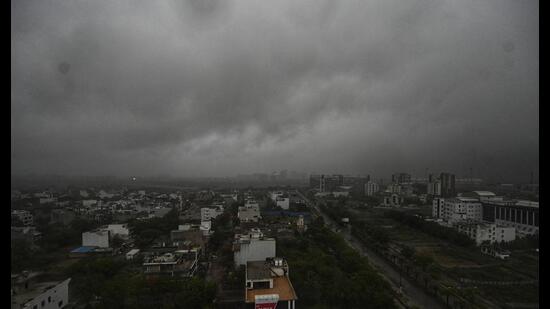
Lucknow recorded 14.8 mm rainfall within an hour, while the maximum temperature dropped to 29 degrees Celsius, 10.4 notches below normal. The city also logged its lowest day temperature for May in the last four years. The minimum temperature, however, rose to 24 degrees Celsius.
The weather office has forecast partly cloudy skies with thundery development and one or two spells of rain or thundershowers for Tuesday. The maximum and minimum temperatures are likely to hover around 31 degrees Celsius and 21 degrees Celsius, respectively.
Across Uttar Pradesh, 6.8 mm rainfall was recorded in the last 24 hours against the normal 0.5 mm. Among districts, Gunnaur in Sambhal received the highest 130 mm rainfall, followed by Sahawar in Kasganj at 97 mm, Bareilly 54.6 mm, Palliakalan in Kheri 49.2 mm, Gorakhpur 41.4 mm and Kannauj 24.5 mm.
Barabanki recorded the state’s lowest day temperature, with the maximum settling at 26.5 degrees Celsius, 12.1 notches below normal. The district also received 53 mm rainfall.
Rainfall accompanied by thunderstorms and hailstorms is likely to continue till Tuesday, with a gradual decline expected thereafter. Maximum temperatures may fall by another 4-6 degrees Celsius in the next 24 hours before rising again in the following days.
An orange alert has been issued for more than 20 districts, warning of thunderstorms, hailstorms and winds of 50-60 kmph gusting up to 70 kmph.
Separately, gusty winds of 40-50 kmph, gusting up to 60 kmph, are likely in 18-19 districts.
Storm hits Malihabad mango belt, growers report losses
Just as mango orchards in Malihabad were entering a crucial growth stage, rain and gusty winds on Monday triggered premature fruit drop across parts of the mango belt, leaving growers worried over losses and the impact on an already weak crop this season. Scientists, however, said the overall damage remained limited and manageable.
Several orchard owners in Malihabad and adjoining areas reported losses after the storm. Dulare, an orchard owner from Sairpur, said mango orchards spread across nearly five to six bighas were affected by the weather. “We have suffered heavy losses and request the government to provide support,” he said.
Malihabad, known for its Dasheri mangoes, is among Uttar Pradesh’s key mango-producing regions and contributes substantially to the state’s mango output every year.
Another orchard owner, Rehan, said he had leased an orchard spanning around six bighas this season and estimated losses of ₹40,000 to ₹50,000 following Monday’s rainfall and winds.
Scientists from ICAR-Central Institute for Subtropical Horticulture (CISH), however, said the fruit drop remained within manageable levels. PK Shukla, crop protection scientist at CISH, Rahimabad, said the Saharanpur region recorded fruit drop of around 4-5%, while in Malihabad it was below 5%.
Experts said rainfall at this stage of mango growth is generally beneficial for the crop. According to scientists, fruits that remain on trees after such weather events often develop better size and taste. Rain also helps clean leaves and branches, improving photosynthesis and overall tree health.
The bigger concern, experts said, is prolonged moisture. If rainwater remains trapped on fruits or tree canopy, fungal growth may develop and affect fruit set.
www.hindustantimes.com
#grey #rain #sweeps #Lucknow


