


Support CleanTechnica’s work through a Substack subscription or on Stripe.
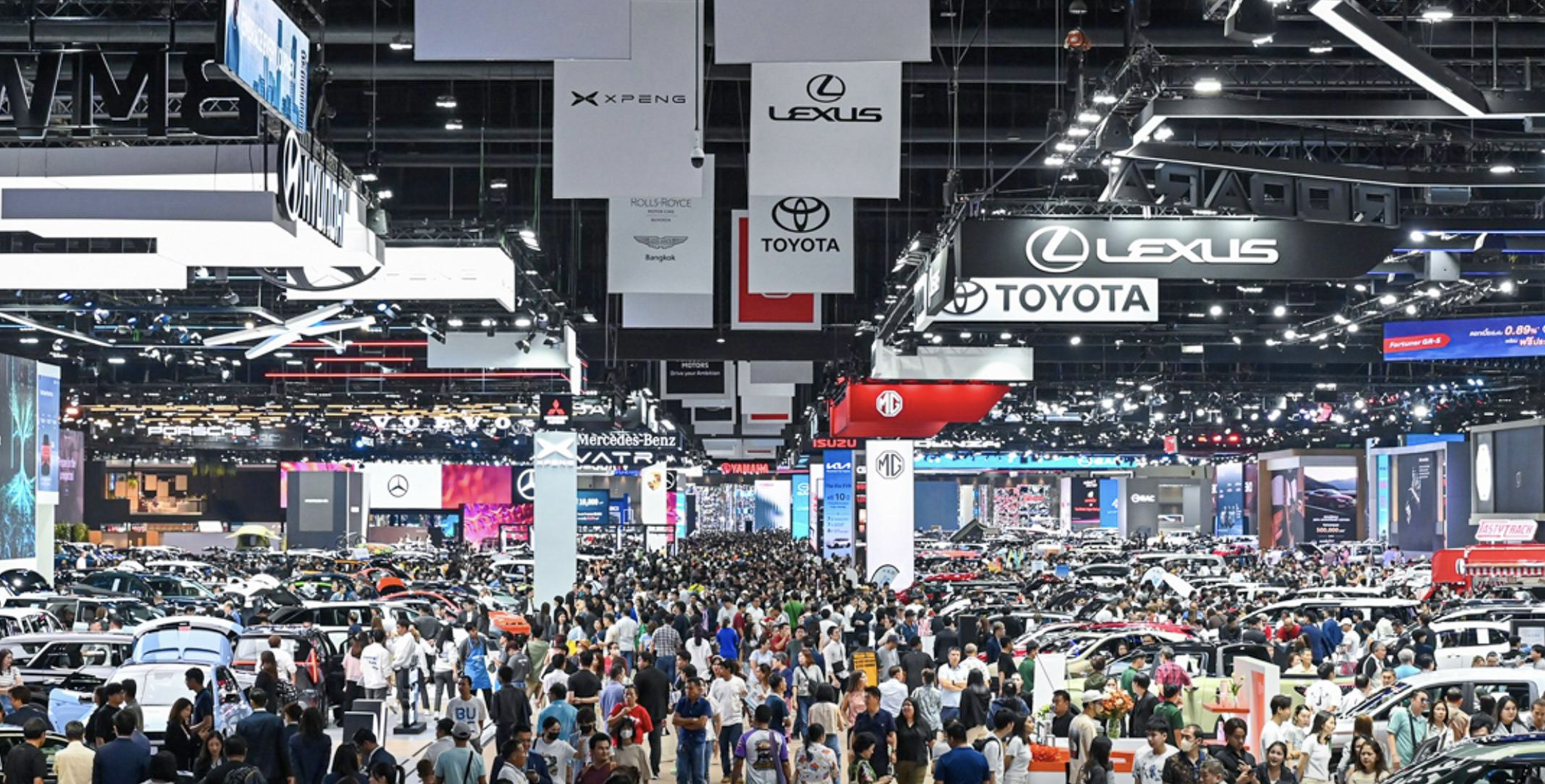
The traffic outside IMPACT Muang Thong Thani was, as usual, a stationary monument to the internal combustion engine. I was twenty minutes late for the first press conference of the 47th Bangkok International Motor Show (BIMS 2026), and as I scrambled through the Media Center doors, the air was thick with the scent of “new car smell” and the palpable tension of a full-scale industrial retreat.
What I walked into wasn’t just a motor show; it was a theater of war. The Price War of 2025 has matured into a calculated Value War in 2026. The theme, “The Iconic Synchronicity,” felt like a polite way of saying the Japanese and Europeans have finally synchronized their watches with the Chinese blitzkrieg.
The question looming over the convention center was whether this event expresses a genuine shift in Thailand, a country whose economic identity is deeply embedded in the internal combustion engine. For decades, Thailand has been the Detroit of the East, built on the back of diesel pickups and reliable petrol sedans. Yet, the 2026 show is defined by the sub-700,000 Baht bracket.
Manufacturers are no longer just cutting prices; they are re-engineering cars to meet tax-efficient price points. With the Thai government halving the NEV purchase tax break this year, brands have slashed official guide prices by up to 30% to keep on-the-road costs stable.
This explosion in variety is perhaps the most visible evidence of the structural shift in the Thai automotive landscape. Back in 2023, the Chinese presence was spearheaded by a handful of early movers who were still in the process of establishing trust in the local ecosystem. There were roughly six major Chinese brands on the floor, led by MG, BYD, and Great Wall Motor, with Neta and Maxus beginning to find their footing. At that time, these brands were seen as speculative alternatives to the established Japanese giants who still comfortably commanded the top of the sales leaderboards.
By 2026, the floodgates have truly opened. The number of Chinese brands has more than doubled to over fifteen distinct marques. This expansion is driven not just by new players, but by parent companies launching premium and sub-brands as standalone entities to capture every possible price bracket. This numerical shift underscores the central theme of the 2026 show.
In 2023, names like Toyota, Honda, and Isuzu were the undisputed leaders in bookings. In 2026, the leaderboard has been turned upside down. BYD has officially claimed the top spot, and Chinese marques now occupy eight of the top ten positions for vehicle bookings. While Toyota and Honda struggle to maintain a foothold in the lower half of the top ten, the sheer volume and variety of Chinese options have effectively pushed the rest of the legacy establishment off the leaderboard entirely.
Chinese Brands & The Aggressor Strategy
The Chinese contingent has moved past novelty into total market saturation. Aion (GAC) launched the Aion UT, a Corolla-sized hatchback priced at 599,000 Baht (approx. $16,400), meant to take the fight to the BYD Dolphin with a 410 km range and a surprisingly premium cabin. BYD itself stole the headlines with the Atto 1, also known as the Seagull. It is the entry-level disruptor the establishment feared, offering a Blade Battery and 380 km of range for 399,900 to 459,900 Baht ($10,950 – $12,600).
Changan debuted the Nevo Q05, a smart B-SUV that looks like a sci-fi prop, alongside the Lumin L DC, which adds fast-charging to their tiny 399,000 Baht ($10,930) urban runabout. Chery opened pre-bookings for the “S-Square & Circle” styled Chery Q and the Jaecoo 5 EV, priced between 549,000 and 650,000 Baht ($15,040 – $17,800). Meanwhile, MG launched the IM5 at 1,549,000 Baht ($42,440) to rival the Tesla Model 3, and NIO’s sub-brand Firefly made its RHD debut starting at 799,000 Baht ($21,890). XPENG even brought a humanoid robot named IRON to prove they are an AI company first, alongside their X9 MPV and the G6, which starts at roughly 1,189,000 Baht ($32,570).
This year, the definition of a motor show has expanded beyond four wheels. XPENG’s IRON robot, stripped of its epidermis to reveal the intricate engineering beneath, stood as a sentinel on their stand. Mass production of these units is slated for late 2026 with a target of 1,000 units per month. Not to be outdone, AVATR introduced the 11 Royal to the Thai market, a high-luxury dual-motor beast with 544 horsepower and a VIP cabin inspired by the Royal Opera, priced at approximately $88,000.
Japanese Brands & The Counter Attack
The Japanese giants, long accused of dragging their feet, have finally launched a credible counter-attack. Honda stopped playing defense with the e:N2 SUV, a 1,429,000 Baht ($39,150) stake in the ground with a 530 km range and sharp, futuristic styling. They also disrupted the two-wheel market with the WN7 electric motorcycle, a lightweight EV with the torque of a 1000cc bike, retailing for approximately $17,500.
Nissan focused on the Kicks e-POWER hybrid but teased the future with a Micra EV prototype. Toyota launched the Land Cruiser FJ, based on the Hilux Champ, at a stunning 1,289,000 Baht ($35,315) to distract from the EV noise, though the bZ3 sedan remains their primary electric focus. Perhaps the most significant evidence of a Thai shift is the Isuzu D-Max EV. This is the production-ready workhorse the region has been waiting for. It retains the 3.5-ton towing capacity and 1,000 kg payload of its diesel counterparts but replaces the engine with a 66.9 kWh battery and dual-motor 4WD. Priced between 1,500,000 and 1,700,000 Baht ($41,100 – $46,570), it is a direct appeal to the backbone of the Thai economy.
European Defense & Global Challengers
The Europeans are reinforcing their premium walls. BMW showcased the iX3 Neue Klasse, a radical departure with an 800 km range estimated at 2,620,000 Baht ($71,950). Mercedes-Benz gave a regional premiere to the CLA Electric, featuring an 800V architecture for ultra-fast charging, with an estimated entry point of 2,100,000 Baht ($57,500). Porsche held the high ground with the Cayenne Electric, proving that 1,000-plus horsepower is the new luxury standard.
Tesla’s booth felt less like a car dealership and more like a laboratory for the near future. The crowd was packed three-deep around the Optimus Gen 2 humanoid robot, a 57 kg marvel of FSD-derived AI that Tesla plans to bring to mass production by the end of the year. But the real volume driver was the regional debut of the Model Y “Juniper” refresh. The redesign is comprehensive, featuring a lower, more aerodynamic nose with a “Horizon” cross-car lightbar and a cabin that is 25 percent quieter thanks to acoustic glass.
The highlight for the Thai market was the new Model Y L, a six-seater variant specifically engineered for family mobility. Priced at 1,999,000 Baht ($54,760), it offers 681 km of WLTP range and a redesigned second-row experience with a dedicated 8-inch touchscreen and 65W charging for laptops. For a brand that once relied solely on prestige, Tesla is now competing on the granular level of passenger comfort and local utility.
If Tesla is selling the future of AI, VinFast is selling a new kind of regional luxury. The Vietnamese automaker used BIMS 2026 to launch Lac Hong, an ultra-luxury sub-brand named after the mythical ancestors of the Vietnamese people. The Lac Hong 900S flagship is an unapologetic bid for the high-end market, featuring a starlight headliner, a privacy partition, and a tri-motor powertrain that positions it as a “Rolls-Royce of EVs” for the ASEAN elite.
Beyond the glitz of Lac Hong, VinFast’s volume play was the VF MPV 7. This seven-seater family mover, designed for the rapid growth of the middle class in Thailand and the Philippines, offers 450 km of NEDC range and a 201 hp front-wheel-drive system. To sweeten the deal, VinFast is leaning into its “V-Green” ecosystem, offering three years of free charging and an 80% resale value guarantee. It is an aggressive, comprehensive strategy designed to remove every remaining barrier to EV ownership in the region.
By the time I sat down to write this, the show floor was buzzing with a realization that transcends simple sales figures. For years, the conversation in Thailand was about if the country would transition. BIMS 2026 has changed the question to how fast that transition will happen. When the most conservative Japanese manufacturers begin electrifying the pickup trucks that feed the nation, and Chinese brands bring the price of a high-tech EV down to that of a basic subcompact, the shift is no longer a forecast. It is the current reality. The entry-level EV is no longer a compromise; in the eyes of the Thai consumer, it has finally become a choice.
Sign up for CleanTechnica’s Weekly Substack for Zach and Scott’s in-depth analyses and high level summaries, sign up for our daily newsletter, and follow us on Google News!
Have a tip for CleanTechnica? Want to advertise? Want to suggest a guest for our CleanTech Talk podcast? Contact us here.
Sign up for our daily newsletter for 15 new cleantech stories a day. Or sign up for our weekly one on top stories of the week if daily is too frequent.
CleanTechnica uses affiliate links. See our policy here.
CleanTechnica’s Comment Policy
cleantechnica.com
#Bangkok #Motor #Show #Reveal #Tipping #Point #Thailand


