


Support CleanTechnica’s work through a Substack subscription or on Stripe.
We’re now two months into Trump’s latest imperial adventure. The sudden attack on Iran’s leadership on February 28th (amidst ongoing negotiations between Iran and the US) led to a series of escalatory measures from both sides that have most notably caused the closure of the globe’s most important energy corridor: the Hormuz Strait.
Hopes for a quick resolution of this conflict are over and the damage from the closure has compounded through the weeks and rippled all over the world’s economy. It’s now all but certain that even if the crisis were to be solved tomorrow somehow, the lost barrels and damaged infrastructure mean we’d require months, perhaps years, to get back to any semblance of pre-war normality. And the longer it goes on, the more that the fossil fuel-based energy system — and by extent the world economy — will suffer.
Yet this is not the first time the world has faced such an energy shock. The “twin crises” from the 1970s eerily mimic the double shock of the Russia–Ukraine war and the US/Israel–Iran war, and because of this, a deeper comparison is worth looking into. After all, those who don’t know their history are doomed to repeat it, aren’t they?
For those who may not know what exactly are we talking about, the “twin crises” were the Oil Embargo of 1973 and the Islamic Revolution in Iran in 1979, the first of which ended a long period of very low oil prices and tripled them in a matter of weeks, the second of which compounded on the previous disruption and brought oil prices to levels thought impossible in those years. Both moments can be clearly seen if you look at historic oil prices, adjusting for inflation:
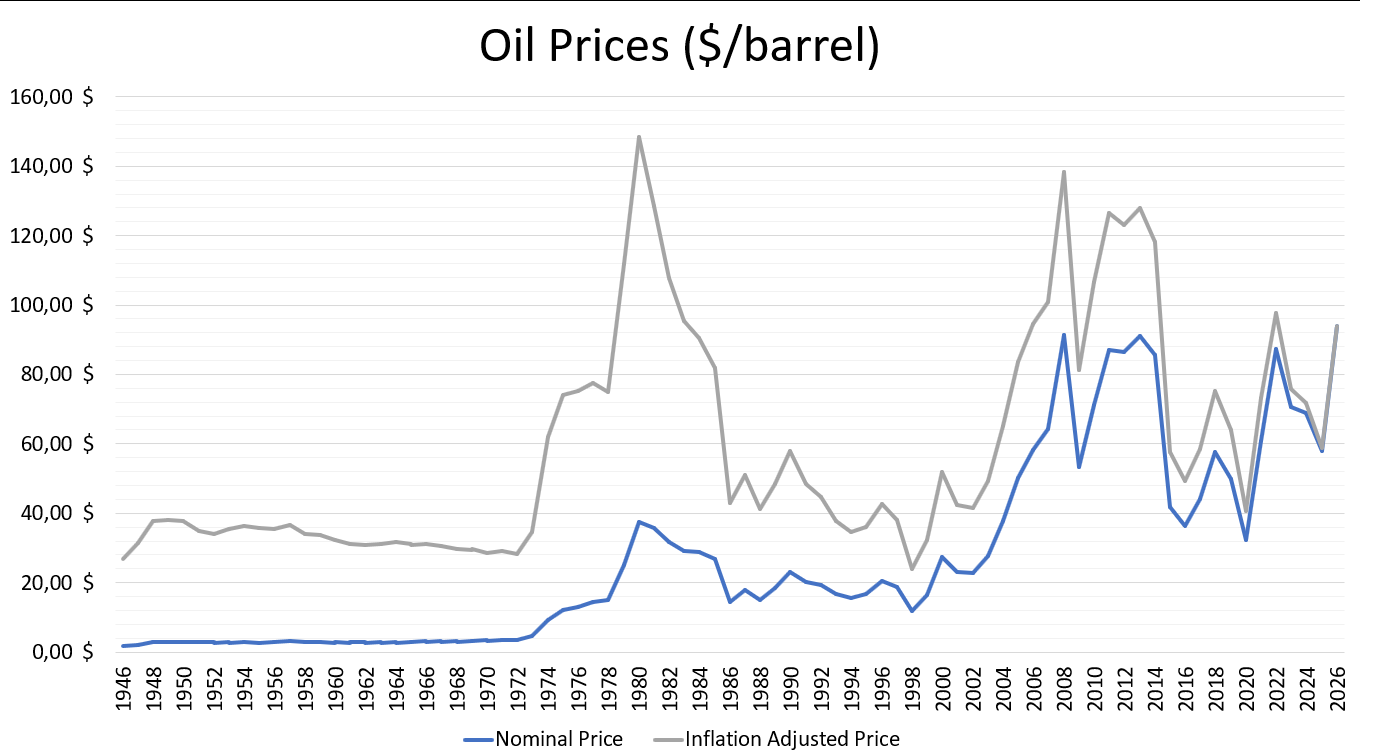
These two crises fundamentally reshaped the world’s economy. By understanding how that happened, we can try to predict how the current crisis may do the same.
The Twin Crises, Part I: The 1973 Oil Embargo
In 1973, several Arab nations imposed an embargo on the countries supporting Israel’s war efforts during the Yom Kippur War, most important of all the United States, which had just provided a massive weapons lift for the Israelis.
Crucially, this happened at a critical juncture: for decades, the US had been the “swing producer”, capable of increasing or decreasing production to fit changes in World Demand. But by the 1960’s it was clear that US production could not grow for much longer, and in 1972 it peaked, meaning the US lost the capability to be a “swing producer” and, from there on (up until the golden age of fracking in the 2010s), the country would depend on Middle East countries to cover its thirst for fuel.
All in all, some 4.5 million barrels, or around 7% of global oil demand, stopped being available for Western countries (though, they didn’t necessarily vanish for the markets), and since US production had peaked, there was no alternative source to supply them. Oil prices promptly reacted, nearly tripling from previous levels. As seen in the previous chart, they went from around $26/barrel in today’s dollars to around $71 in a matter of five months.
This is the story most people know about, but something far more important happened afterwards. On March 17, 1974, less than 10 months after it started, the embargo was lifted and Middle Eastern oil once again arrived in Western countries… but the price did not follow. Prices would stay in the $70–80 range for the next few years, and would never again reach such low prices on a consistent basis.
The Twin Crises, Part II: The 1979 Islamic Revolution
In 1979, the Sha of Iran was deposed by a generalizes revolt of the Iranian population, and in its place a cadre of religious scholars founded the Islamic Republic, a theocratic government that has since been governing the country.
The energy crisis actually started a bit earlier, in late 1978, when — as part of the generalized protests happening in the country — a strike from Iranian oil workers brought oil production down from 6 million barrels a day (mbd) to less than 1.5. This, alongside lost production after the ousting of the Sha due to foreign professionals leaving, and further losses down the line caused by the Iran-Iraq War, meant that at a point some 5 million barrels were lost — again, around 7% of global oil demand.
Once again, this meant that the previous equilibrium broke, and oil prices, already tripling their pre-1973 average, more than doubled once again, going from $72 (adjusted for inflation) in early 1979 to a record of $160 in early 1980. Prices would not come down to previous levels until 1985, and they would never again hover around $25–35 as they did before 1973.
A Brave New World After The Oil Crunch
The twin crisis fundamentally changed the way the World Economy works.
From the supply side, they triggered massive investments in alternative sources of oil, including Alaska, Alberta, the North Sea, Venezuela, Brazil, the Caspian Sea, and the Caucasus. This permanently broke the influence of Middle Eastern countries, who went from over 35% of global production to less than 25%.
But the most interesting changes came from the demand side. Oil demand stagnated for nearly a decade, only surpassing the levels of 1979 in 1988. Economies pivoted away from oil in every sector where alternatives existed, mainly electricity generation (these were the years when France’s nuclear fleet was planned, with gas and coal also gaining massively), and there where oil was essential, more efficient methods of using it were developed. These were the malaise years for the US automotive industry, as it could not compete with nimbler, more efficient vehicles coming from Japan and later South Korea, the likes of which became extremely popular as gasoline prices kept going up.

There was also a significant shift in developed economies that moved away from industry — heavily reliant on energy — into services, thus lowering the overall oil required to generate a certain amount of economic growth (this is, the oil-intensity of the economy). A secondary effect in the medium term was the implementation of neoliberal policies in many countries, most important of all the US, which led to a massive pivot to third-world manufacturing, particularly Chinese, which was heavily reliant on coal, more than oil.
And thanks to these deep changes in the way the economy worked, this led to several fundamental changes in trend: first, the definitive peak on per-capita global oil consumption, which until then had been growing non-stop for decades; second, the definitive peak for the oil-intensity in the economy:

As seen in this chart, global per-capita oil consumption had been growing steadily since the 1960s (and actually since the end of WWII), but it hit a peak in 1973, and despite a recovery in 1975–1979, its growth ceased permanently after 1980, never to recover.

Likewise, in the years prior to 1973, there’s almost an exact correlation between the size of the economy and oil demand; however, this trend completely breaks after that year, with economic growth effectively decoupling from oil consumption (this is, with a reduction in the oil-intensity of the economy). I cut the graph in 1990 because it diverged even more after that date, making it difficult to see the correlation prior to 1973.
With oil demand cratering and significant investment in new oilfields, the 1980s were characterized by a growing oil glut that further materialized as Saudi Arabia flooded the market in late 1985. This meant continuously lower prices, largely staying between $25 and $55 in today’s dollars between 1986 and 2003 … but that did not change the fundamental trends: oil consumption per capita stayed stagnant and the oil-intensity of the economy kept falling.
Or, in other words, the crisis fundamentally reshaped the economy at a permanent level, making a return to the “old normal” impossible, even as oil prices went back down. This lesson, as we will see, provides a critical insight: a return to normalcy rarely means a return to pre-crisis trends.
The 2020’s “Twin Crisis:” The Invasion of Ukraine And The Attacks On Iran
The first oil crisis in our decade happened after Russia’s invasion of Ukraine, but it was mostly a virtual one: Russian production was still there, it was just not being purchased by countries complying with the US and Europe’s sanctions. Still, it was enough to bring prices to over $120 in some months, averaging $97 for the whole year 2022.
This means the 2022 crisis was mostly a supply-chain disruption. Oil demand had fallen dramatically in 2020 due to the Covid pandemic, forcing producers to shut down wells and cut investment in exploration and drilling. By 2022, the economic recovery was in full swing, and oil demand was rapidly catching up with sluggish supply (due to the aforementioned cuts on investment), meaning when Russia invaded Ukraine, and Europe + the US decided to impose sanctions, there was no alternative source to rely on. However, that this disruption was virtual (and not material) can be seen in the fact that demand kept growing through 2022 and 2023, going from 97 mbd in 2021 to 102 mbd in 2023.
The 2026 oil crisis, caused by the US and Israel’s attack on Iran, is cut from a completely different cloth. The Iranian regime responded to the attacks by shutting down the Strait of Hormuz, a critical chokepoint that accounts for some 20 mbd coming from the oilfields of Saudi Arabia, Qatar, the UAE, Oman, Iraq, and Iran itself — plus a quarter of the global LNG and a significant portion of fertilizer and helium, materials that will severely disrupt plenty of other industries.
But today we’re focusing on oil.
Some of this production, probably around half of it, has been diverted through alternative routes, mainly Saudi Arabia’s East-West pipeline, the UAE’s Habshan-Fujairah pipeline, and Iraq’s Iraq-Türkiye pipeline. Still, this means around 10 million barrels a day, or 9.5% of global demand, have evaporated from the global markets: unlike in 2022, this is not a virtual crisis or a supply-chain disruption, this is a material shortage that will have to be reckoned with sooner or later.
As Paul Krugman refers in his Substack, these 10 million barrels of oil a day will need to disappear from global demand, and the price will have to go up as high as required to do the trick. So far, according to the IEA, demand has fallen 800,000 barrels a day in March, and will keep falling by 2.5 mbd in April, which is a staggering amount, but still only ¼ of what’s needed to bring balance to the markets.
If this is the case, then why aren’t prices skyrocketing right now? It’s hard to give a precise answer, but the reason is likely twofold:
- First, there was a significant buffer. As much as a billion barrels may have been released from storage by the OECD and China, plus there were “barrels in storage” in the sea from sanctioned Iranian and Russian oil and from regular vessels transporting crude, some of which departed before the blockade started and have just arrived in their destination in the last couple weeks. Also, if you remember our articles about Oil Demand from last year, oil production was forecasted to be over 2mbd in excess of demand this year.
- Second, the market remains stubbornly optimistic in a sudden resolution of the blockade. This can be seen in oil futures, which are nowadays some $30 cheaper than physical barrels for immediate delivery.
But this can only buy the world so much time. Eventually, either production will ramp up to meet those 10 million missing barrels (which, unless the Strait is fully reopened, is simply not possible), or demand will have to come down to those levels.
Echoes of the past: lessons to be learned and consequences to be expected.
As Mark Twain said, history does not repeat itself, but it often rhymes.
6 years passed between the Oil Embargo and the Islamic Revolution; 4 passed between Russia’s invasion of Ukraine and the US/Israel attack on Iran. In both cases, the consequences from the former crisis compounded in the latter; in both, the latter had a more direct and material impact than the former; and if I may take out my crystal ball, in both the world was (or will be) changed forever.
The 1973s oil crisis brings a first lesson, and perhaps the most interesting one: even when a crisis ends, it can bring a new normal. Prices did not go back down after the end of the oil embargo, and even in the depths of the oil glut of the 1980s, it only occasionally reached the low levels that had been the norm in the pre-1973 world.
This is something very likely to repeat this time. The factors that have kept the market afloat in this crisis, mainly related to massive storage that did not exist in 1973, are also likely to keep pressure on demand in years to come. Even if the strait was reopened tomorrow, oil tankers would have to go back all the way, replenish, and restart their routes, meaning physical oil won’t arrive at its destination until late May or June. OECD and Chinese storage will also have to be replenished: at 400 million barrels so far for the OECD, that would require an excess oil production of 2 mbd for 200 days, and since China has probably released a similar amount, and since US storage was already low when this crisis started, we are at best two years away from the pre-war base.
The 1970s also brought significant changes in world oil geopolitics. The Middle East lost ground, and new regions became important players, most important of all the USSR, but also the US and Northern Europe. This time, it seems South America could be one of the main beneficiaries, as well as US shale and Alberta’s tar sands, which were having some financial issues prior to the crisis.
But perhaps the most interesting lessons can be found in oil demand and permanent changes in the economic structure of the world. Back in the 1970s, the crisis triggered massive investments in alternative sources of energy and more efficient means of using whatever oil was available: merely one month into our crisis, we’re already seeing booming EV sales in many markets and historically high exports for Chinese solar panels.
Back in the 1970s, the oil crisis was enough to permanently change the trajectory of several European cities, most notable of all Amsterdam, which took a pro-bike path ever since, preventing the use of probably billions of barrels of oil through the last five decades. We don’t know how long this disruption will last, but the longer it is, the deeper the effects will be felt, and we’re past the point the world could go back to the pre-war normality in any case.
The same, but different
Back in the 1970s, there were very few alternatives for oil in transportation, and thus the changes that brought oil demand down to the material supply levels had to do with policy (such as speed limits), efficiency (such as those smaller, more efficient Japanese cars), and urbanism (such as investments in public transportation and bike-friendly cities). These alternatives, though extremely important, could only go so far, and demand for fuel for road transportation has increased a lot since 1979.
But in areas where there were alternatives, the changes were quick and permanent. Oil used to be a main part of electricity generation, and by the ’80s it had been all but abandoned, as nuclear, gas, and coal made up for better alternatives: today, oil represents a mere 2.6% of global electricity production.
The difference is that this time we have plenty of alternatives we did not have in the 1970s, and in particular, that transport that could not be viably electrified in that decade can be today. This means there’s a chance this war will break the proverbial back of oil, accelerating the trend towards mobility alternatives fueled by a Chinese industry that for many years was accused of “overcapacity” but that nowadays can supply as many EVs and solar panels as the world needs.
While the 1970s twin crises broke the trend and brought us a peak in per-capita oil consumption and a far less oil-intensive economy, I believe the 2020s twin crises have the potential of ending oil demand growth for good. This is something mirrored in several oil and energy outlets I follow, which this week started warning about permanent demand destruction if the disruption is not over soon. Of course, the longer the war, the more dramatic the impact, but I believe two months (plus the two years it will take us to recover from those two months) will be enough to create a shift, even though every week that this disruption remains that shift will accelerate.
Oh, and of course, all of this also applies for LNG, which will feel more pressure from solar panel deployment as countries find out, once again, how dangerous it is to depend for the basis of your economy on a foreign product you have no control over.
But a last question remains. Will demand destruction continue once the crises end? Will EV growth cut into oil demand fast enough to overcome other sources of growth? And if this happens, will we see oil prices plummet?
Because, see, the last crisis also ended oil price stability. What used to be a predictable and steady market became a roller coaster of highs and lows. So given the possible scenario I just presented, an additional impact of thes crises could be even more volatility as the market violently pivots between oversupply and scarcity.
This could mean some very bad years in the future for Big Oil … something ironic if we think that all this mess was brought to us by the most pro-oil candidate in a generation.
Sign up for CleanTechnica’s Weekly Substack for Zach and Scott’s in-depth analyses and high level summaries, sign up for our daily newsletter, and follow us on Google News!
Have a tip for CleanTechnica? Want to advertise? Want to suggest a guest for our CleanTech Talk podcast? Contact us here.
Sign up for our daily newsletter for 15 new cleantech stories a day. Or sign up for our weekly one on top stories of the week if daily is too frequent.
CleanTechnica uses affiliate links. See our policy here.
CleanTechnica’s Comment Policy
cleantechnica.com
#Echoes #Twin #Oil #Crises #1970s #Teach #Coming #Impacts #Hormuzs #Blockade


