


Support CleanTechnica’s work through a Substack subscription or on Stripe.
What follows is a draft roadmap for a decarbonized O’ahu. This roadmap does not appear out of nowhere. It follows a long chain of analysis that rebuilt Oʻahu’s energy system piece by piece. Earlier articles stripped away overseas aviation fuel, international maritime bunkering, and military demand to isolate the island’s civilian energy needs. From there the work electrified transportation, buildings, and industry, examined district cooling, demand management, biomethane, solar, wind, waste-to-energy, and the remaining role of imported low-carbon fuels for long-haul travel. The result was a coherent end-state rather than a collection of disconnected technologies. This article takes the next step and organizes that end-state into an aggressive time-phased roadmap.
The framework is the same one I previously used for Ireland’s draft transformation roadmap because it forces the transition to be treated as a full system rather than as a list of projects. It breaks the work into five categories across each time horizon: Policy and Regulation, Technology and Innovation, Infrastructure and System Integration, Market Mechanisms and Finance, and Organization and Workforce. That structure matters because energy transitions fail when they are treated only as engineering problems. The technologies may be known, but without the right rules, financing, institutions, and human capacity, the system does not get built.
It is adapted to Hawaiʻi’s actual conditions: a statutory 100% renewable electricity target by 2045, a statewide net-negative emissions target by 2045, a utility still operating a heavily oil-based Oʻahu fleet, a 2030 renewable milestone that Hawaiian Electric says is 40%, and a state energy strategy that already prioritizes faster permitting, more distributed energy, and transport-sector fuel transition planning. The philosophy is simple: it is better to press hard and fall short than to aim low and miss.
The sequencing matters. The no-regret actions are the ones that reduce cost, peak demand, or oil dependence even if later elements slip. Those are the immediate priorities through 2030. The 2030s are the scale-up decade, when Oʻahu should eliminate oil generation, close out H-POWER as a power resource, and move from “high-renewable” to “essentially zero-carbon domestic electricity.” The 2040s are about completing the harder transport and fuels transitions, hardening the system against rare stress events, and replacing first-generation assets while keeping the zero-carbon system stable.
What I have done here is a thought exercise intended to be useful to Hawaiians, not a prescription handed down from outside. It is a contribution to a discussion and a set of decisions that Hawaiʻi’s people, institutions, and communities will have to make for themselves. The goal has been to work through the arithmetic, test the boundaries, and clarify the art of the possible. That is valuable, but it is not the same thing as local judgment, democratic choice, or lived experience. The system described here is not offered as technocratic perfection. It is offered with humility as a grounded attempt to show that a coherent, deeply decarbonized future is possible, and that the real work now is deciding which parts of it Hawaiʻi wants to build and how.
Today’s Energy System

O’ahu is the hardest of the islands to decarbonize by far, with the most people and more limited options, hence the focus of this series. Decarbonize O’ahu, and the rest of the islands are easy by comparison, with a subset of solutions. This is the starting point for our journey, O’ahu’s energy flows in GWh, showing all of the primary energy, energy services, rejected energy and energy services. As an early article made clear, that’s still not the right frame for the discussion, as so much of it is outside of domestic control. Crossing oceans will require a global market for biofuels for ships and airplanes. Military jets and ships are also outside of the control of the state, and should be excluded from this. The military will decarbonize or not on its own schedule. Those energy flows are still in this Sankey diagram, making the problem seem more intractable than it is. It’s expressed in GWh, the energy units of the future, not the energy units of the past.
2026 to 2030
Policy & Regulation
The immediate policy agenda should focus on actions that unlock deployment speed and reduce peak demand before trying to solve every long-range question. Hawaiian Electric and the Public Utilities Commission should make time-of-use pricing the default for most Oʻahu customers with opt-out protection, not a niche tariff. Interconnection for rooftop solar, batteries, and bidirectional chargers should move to published service-level timelines with simple technical templates and fast-track approval for standard systems. The state should treat parking canopies, rooftops, brownfields, and repowering existing wind sites as priority low-conflict surfaces and fast-track them through permitting.
Oʻahu should explicitly reject LNG as a planning assumption for domestic electricity and instead adopt a “no new long-lived fossil gas infrastructure” rule for the civilian grid, especially as the HSEO/HDR study was flawed and unreliable across its alternatives. At the state level, the immediate transport policy actions should be a Hawaiʻi clean fuel standard feasibility decision, enactment of a Hawaiʻi SAF support mechanism, and marine fuel-transition legislation aligned with HDOT’s Energy Security and Waste Reduction Plan. The goal by 2030 should be a rulebook that makes distributed clean energy and clean-fuel logistics easy to build and oil-reliant infrastructure hard to justify.
Technology & Innovation
The immediate technology push should focus on mature systems, not speculative ones. That means rooftop PV, parking canopy PV, behind-the-meter batteries, community batteries, utility batteries, grid-interactive heat pump water heaters, smart EV charging, vehicle-to-home, building EMS for pre-cooling, and the design and first deployment of seawater district cooling in the Waikīkī-Kakaʻako-downtown corridor.
The technology-watch list should include floating offshore wind, longer-duration storage, and low-carbon fuel technologies for shipping and aviation, but those should not be on the critical path to 2030. By 2030, the state should have field-tested V2H at neighborhood scale, have real operating experience with dispatchable flexible loads, and have demonstrated that parking canopy solar and customer-side storage can function as infrastructure rather than as isolated customer upgrades.
Infrastructure & System Integration
This is the build decade for the first major wave of distributed and balancing infrastructure. By 2030, Oʻahu should aggressively expand rooftop and commercial solar, but the signature build should be parking canopies over shopping centers, workplaces, schools, campuses, parks, and destination parking. The state already set a target of 50,000 distributed renewable energy installations by 2030, and Oʻahu should carry the bulk of that with a strong battery component. Utility-scale batteries should be built into the 2GWh to 3GWh range by 2030, with behind-the-meter and community storage adding another 0.5GWh to 1GWh and V2H contributing an emerging flexible layer. Onshore wind should focus on repowering and modest additions rather than new high-conflict sites.
Seawater district cooling should move from feasibility to a first real district phase. Wastewater-to-biomethane should scale from the Honouliuli proof point to a broader Oʻahu wastewater and organics platform. Airport and harbor planning should start the physical preparation for imported SAF and low-carbon marine fuels, including storage, blending, and bunkering design. No refinery expansion, no new oil generation, and no new LNG terminal assumptions should survive this period.
Market Mechanisms & Finance
The market design for 2026 to 2030 should be built around peak shaving, distributed value, and cost of capital reduction. The utility should compensate customer batteries, V2H-capable EVs, smart water heaters, and commercial thermal storage through transparent flexibility and capacity products, not ad hoc incentives that expire unpredictably. Green-bank style capital or public credit support should be aimed at canopy solar, multifamily charging, community batteries, and district cooling, which all have strong system value but messy early-stage financing. Renewable procurement should shift toward portfolio procurement with explicit value for daytime generation plus evening flexibility, rather than technology-silo auctions.
Hawaiʻi’s fuel-transition finance should focus on airport and harbor bunkering readiness and on imported low-carbon fuels for ships and aircraft, not on recreating a local fossil-refining or LNG future. The near-term objective should be to make the cheapest customer and community-side solutions deploy first and visibly reduce bills and system peaks before the biggest central-system costs arrive.
Organization & Workforce
The people-side agenda through 2030 should be treated as infrastructure too. Hawaiʻi’s Clean Energy Sector Partnership already exists, but Oʻahu needs a specific delivery unit that coordinates utility planning, permitting, community engagement, district cooling, waste reform, airport and harbor fuel logistics, and workforce training. Community colleges and apprenticeship pathways should be aligned to the actual build sequence: electricians, lineworkers, controls technicians, battery specialists, heat pump installers, wastewater and biomethane operators, district-cooling mechanics, and port and airport fuel-handling staff.
A just-transition strategy should be built now for refinery and H-POWER-adjacent workers so that by the time those facilities wind down as energy assets, the labor transition has somewhere to go. By 2030, the aim should be a workforce pipeline that is no longer the main excuse for delay.
An interim view of fully electrified energy services
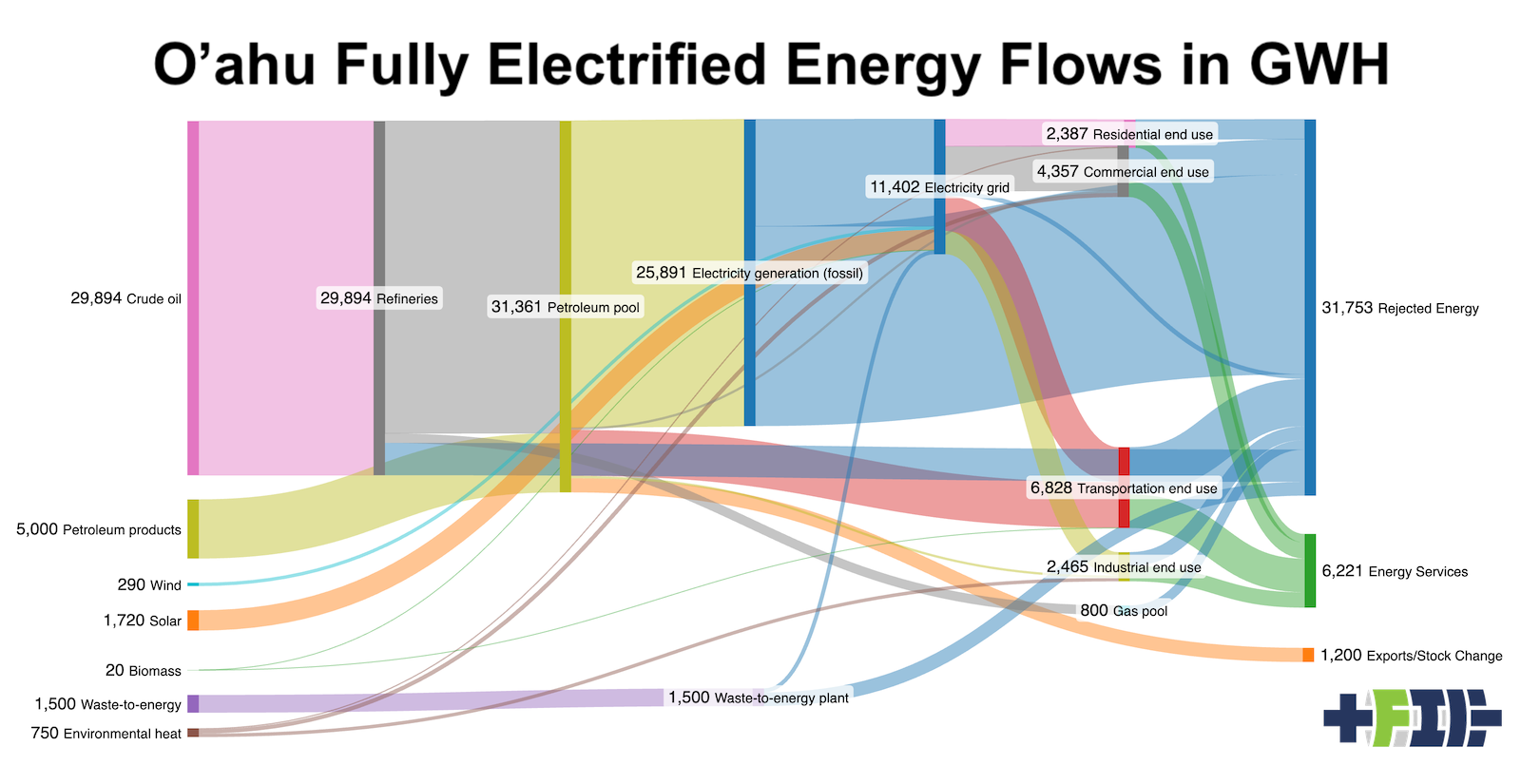
As noted before the 2026-2030 action plan, narrowing down the requirement to exclude the energy for crossing oceans and military jets and ships is the appropriate view for transforming the domestic economy. An interim vision is one in which all energy services are electrified, something entirely viable. This view doesn’t attempt to strip out fossil fuel, but to explore how much electricity is required across residential, commercial, transportation and industrial energy services.
2030 to 2040
Policy & Regulation
The 2030s are when the policy posture should shift from enabling deployment to enforcing phase-out. By the early 2030s, Oʻahu should have binding retirement schedules for the remaining oil-fired generation fleet and a formal end to H-POWER as a power resource, even if some elements of the waste system transition are still being completed. Any remaining regulatory ambiguity around V2H, community batteries, flexible load aggregation, and district cooling should be gone.
The state should also have a mature clean-fuel framework at airport and harbor level, including whatever SAF and marine-fuel standards or incentives proved workable in the late 2020s. The central policy objective for the decade should be to make the zero-carbon domestic-electricity end-state legally unavoidable, with the only remaining uncertainty being how quickly imported long-haul fuels decarbonize.
Technology & Innovation
The technology focus in the 2030s should move from proving concepts to standardizing them. Parking canopy solar should be boring by then. V2H should be a normal part of home charging in detached houses and increasingly in multifamily shared systems. Grid-interactive heat pump water heaters and commercial pre-cooling should be standard utility flexibility resources. District cooling should expand from pilot district to urban-core platform.
The innovation agenda should shift to areas still uncertain in the 2020s: long-duration storage if needed, next-generation grid controls, and perhaps selective floating offshore wind if economics, maintenance, and social license improve materially. But the core system should not depend on any of those breakthroughs. It should be largely finished with known technologies by the late 2030s.
Infrastructure & System Integration
This is the decade when Oʻahu should complete the physical shift away from oil power. By the middle to late 2030s, the island should reach the end-state we modeled: roughly 7,650GWh/year of solar generation, heavily weighted toward canopies and distributed surfaces, about 770GWh/year of onshore wind, around 68GWh/year of electricity from a modest biomethane reserve, and enough storage and flexible demand to balance the system without routine thermal generation. Stationary batteries should land around 5GWh central, with some room to go higher if demand management underperforms and lower if V2H overperforms.
Seawater district cooling should be fully built out across the viable dense coastal districts. The refinery should be reduced to whatever residual imported-fuel storage and handling functions remain necessary for aviation and marine bunkering, not electricity. H-POWER’s 340GWh/year should be fully replaced with solar and batteries, while the waste stream itself is handled through plastic reduction, organics diversion, anaerobic digestion, composting, and residual landfill. Airport and harbor low-carbon fuel logistics should be live by now, because long-haul transport decarbonization must be underway even if not complete.
Market Mechanisms & Finance
By the 2030s, most early subsidies should give way to durable market structures. The electricity market should value flexibility, fast response, and locational distribution benefits as a matter of routine. Capacity and ancillary-value streams should reward batteries, aggregated flexible loads, V2H, and biomethane reserve generation appropriately. Financing should shift from “how do we get the first projects built” to “how do we refinance mature infrastructure at the lowest possible cost of capital.”
For transport fuels, the key financial task is not subsidizing the domestic grid but ensuring that imported low-carbon liquid fuels for aviation and shipping can be blended, stored, and bunkered at scale without turning Hawaiʻi into a high-cost fuel island by policy design. The market objective by 2040 should be simple: the cheapest way to stay clean should also be the easiest way to operate.
Organization & Workforce
Institutionally, the 2030s are about durable delivery rather than startup mode. The transition office or equivalent coordinating body should no longer be improvising. By then it should be managing replacement cycles, compliance schedules, waste-system reform, airport and harbor fuel logistics, and resilience planning as one integrated portfolio. The workforce system should have matured from pilot training programs into normal labor-market infrastructure.
Hawaiʻi’s community colleges, unions, utilities, and contractors should be turning out enough skilled people to maintain and replace the system without depending heavily on imported labor. The 2030s should be the decade when clean energy in Oʻahu moves from “special transition program” to “how the island runs.”
The fully decarbonized O’ahu of the future
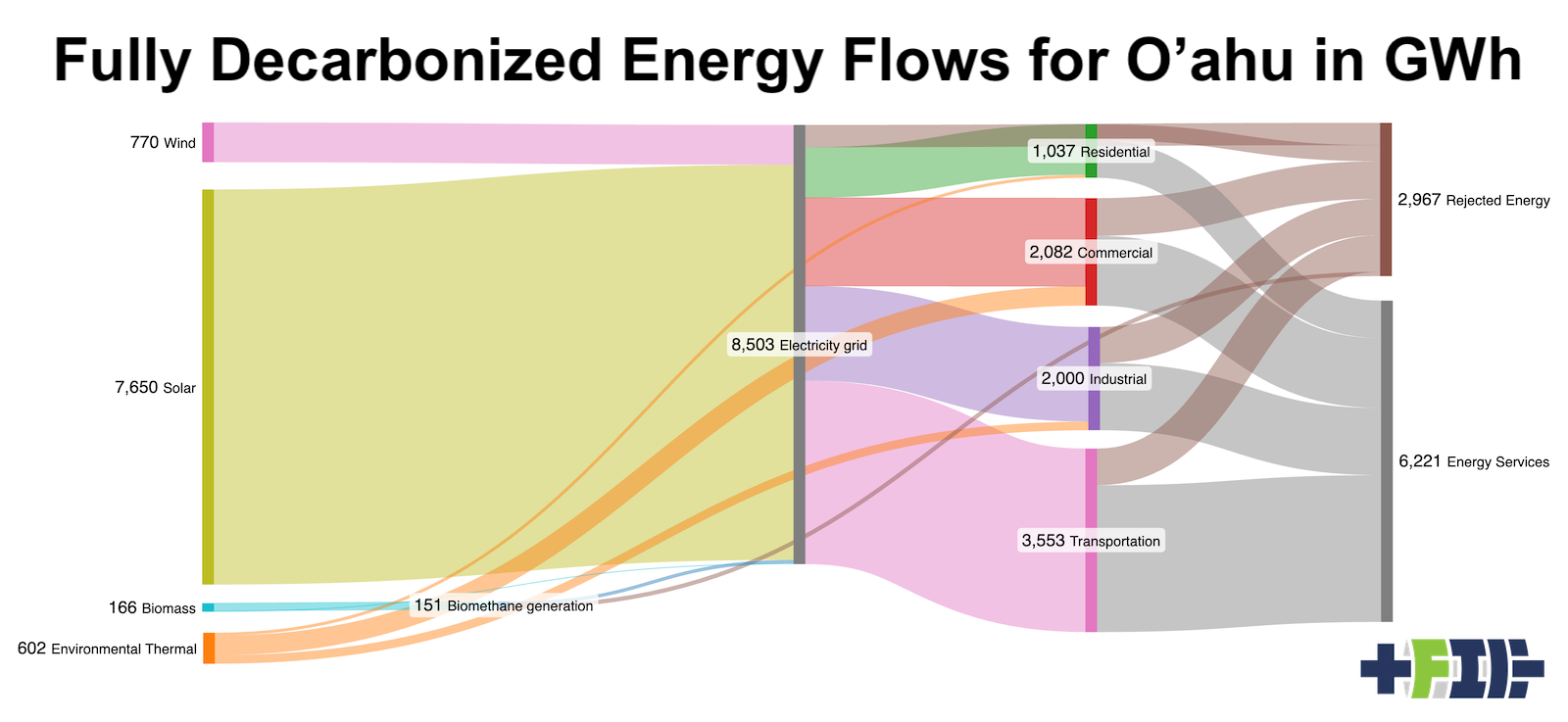
This is the end state energy flows, expected to be achieved in the final segment of the roadmap. Note that energy services remain the same, but rejected energy plummets. There is no need for hairs hirts in the decarbonized society of the future. Flying between islands, pleasure boating, comfortable interiors and driving for shopping are all preserved, just electrified. Solar dominates the mix, of course, but mostly from canopy solar over parking lots, providing relief for drivers and cooler urban areas as well as electricity and vehicle charging. The energy required to cross oceans is still excluded, but as noted in the road map, expected to be provided by biofuels from the global market.
2040 to 2050
Policy & Regulation
The 2040s should be about hardening and finishing rather than discovering new ambition. Hawaiʻi’s law already points to 100% renewable electricity by 2045 and net-negative emissions by 2045. By this period, Oʻahu’s domestic civilian system should already be there or very close. Policy should therefore focus on preventing backsliding, tightening lifecycle accounting for imported fuels, and making sure the remaining hard-to-abate transport sectors continue to decarbonize rather than claiming temporary exemptions forever. If floating offshore wind or some later technology proves compelling, the state can adopt it, but it should not be the linchpin of the decade. The regulatory mission becomes stewardship, not reinvention.
Technology & Innovation
The 2040s are the period when Oʻahu should be selective about new technology rather than hungry for it. Offshore floating wind may or may not make sense by then. It should be adopted only if maintenance economics, social license, and grid value become compelling. Likewise, long-duration storage, synthetic fuels, or other late-emerging options should be used only if they beat the already-built system on cost and resilience.
The main technology task is replacement cycles: second-generation batteries, repowered wind, upgraded inverters, and deeper integration of controls. This is also the period when interisland aviation and marine transport should be close to full electrification or highly efficient hybridization, leaving long-haul aircraft and ocean-crossing ships as the main remaining liquid-fuel users.
Infrastructure & System Integration
Infrastructure in the 2040s should focus on full resilience under stress rather than on gross expansion. The domestic grid should already be oil-free and H-POWER-free. The key work is to replace aging first-generation batteries, expand resilience at the feeder and community level, and complete whatever airport and harbor infrastructure is needed to handle imported low-carbon marine fuels and SAF at mature volumes. If district cooling proves operationally and economically strong, this is the decade to widen its footprint within the coastal urban core.
The biomethane reserve system should be fully integrated with organics management and operated as a true strategic reserve, not a routine generation resource. The ultimate infrastructure outcome by 2050 is an Oʻahu whose domestic economy is served by a highly distributed renewable electrical system, with only the airport and harbor remaining as major liquid-fuel interfaces.
Market Mechanisms & Finance
By the 2040s, the financing challenge is no longer “can we fund the transition” but “can we keep the mature system cheap.” The answer should be yes if the 2020s and 2030s were sequenced properly. Solar and batteries should by then be normal infrastructure with low operating costs. Market design should make sure their value is captured without unnecessary rents or stranded fossil assets.
For long-haul aviation and shipping, the state should be using whatever clean-fuel policy instruments proved durable in the prior decade to keep the airport and harbor supplied without pretending Hawaiʻi can control global fuel markets. The cost focus should shift from buildout capex to minimizing total system cost and protecting households from volatility.
Organization & Workforce
The 2040s are when the transition should stop being a special category altogether. Clean-energy operations, maintenance, waste reform, airport and harbor fuel logistics, and resilience planning should be embedded in ordinary institutions and ordinary career pathways. Workforce shortages should be treated as management failures by then, not unavoidable transition friction. The remaining institutional challenge is continuity: ensuring that the state can replace assets, adapt to technology change, and keep public trust without having to re-litigate the whole transition every few years. That is what a mature energy system looks like.
If I boil this down to the shortest possible version, the roadmap is this. Through 2030, remove excuses and build the no-regret stack: rooftop and canopy solar, batteries, flexible demand, EV charging, V2H, wastewater and food-waste digestion, and the first district-cooling and clean-fuel logistics projects. Through the 2030s, use those foundations to eliminate oil generation and H-POWER as a power source while scaling the system to its modeled end-state. Through the 2040s, finish the harder liquid-fuel decarbonization at the airport and harbor and harden the now-mature clean system. It is aggressive. It is unlikely to be followed exactly. But it is still the right way to plan, because aiming for a partial transition is the surest way to get a partial outcome.
This roadmap is not an argument for a single ideology or a single moral language. It is an attempt to show that Oʻahu’s energy future can be understood in ways that speak to care, fairness, loyalty, authority, sanctity, and liberty at the same time. It can reduce harm, lower long-term costs, strengthen local resilience, respect land and community, and reduce dependence on imported fossil fuels.
But none of that matters unless Hawaiians decide that the transition reflects what they value and how they want to live. The arithmetic can clarify what is possible, but it cannot choose what is legitimate. The next steps are not mine to prescribe. They belong to Hawaiʻi’s communities, workers, institutions, and leaders, who will decide which pathways earn consent, which tradeoffs are acceptable, and how this possible future becomes a lived one.
Sign up for CleanTechnica’s Weekly Substack for Zach and Scott’s in-depth analyses and high level summaries, sign up for our daily newsletter, and follow us on Google News!
Have a tip for CleanTechnica? Want to advertise? Want to suggest a guest for our CleanTech Talk podcast? Contact us here.
Sign up for our daily newsletter for 15 new cleantech stories a day. Or sign up for our weekly one on top stories of the week if daily is too frequent.
CleanTechnica uses affiliate links. See our policy here.
CleanTechnica’s Comment Policy
cleantechnica.com
#Oʻahu #HardCharging #Roadmap #ZeroCarbon #Energy #System


