


Support CleanTechnica’s work through a Substack subscription or on Stripe.
The debate over LNG in Hawaiʻi persists because it sounds like a practical answer to a familiar problem. Oʻahu still relies heavily on imported fuel for electricity, so a different imported fuel can appear to be a reasonable bridge. LNG is marketed as dispatchable, cleaner than oil, and compatible with thermal power plants that utilities already understand. But that framing compares LNG to the wrong system. The real comparison is not between LNG and today’s oil-heavy grid. It is between LNG and the fully electrified, solar-heavy, battery-rich, demand-managed Oʻahu system that emerges once the island’s actual domestic energy needs are isolated and the major efficiency gains are captured. When that comparison is made honestly, the case for LNG collapses.
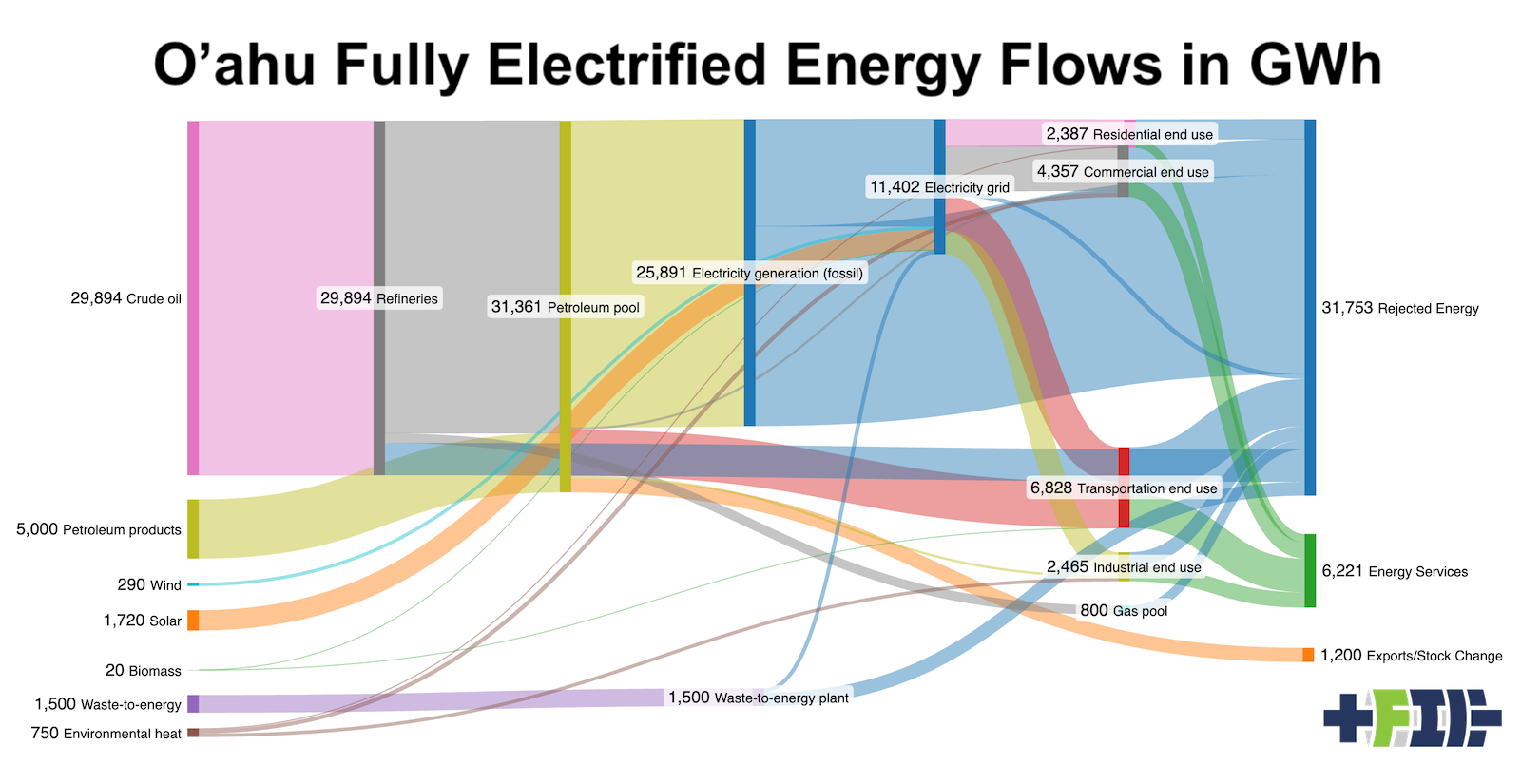
The starting point is the fully electrified Oʻahu energy system developed across the earlier analyses in this series. That work removed overseas aviation fuel, fuel bunkered for ships leaving Hawaiʻi, and military energy consumption from the island’s civilian balance. Aviation and shipping will be dealt with in another article in the series, and in any event LNG is mostly irrelevant to them. Military energy will not be addressed, as it remains unpredictable, as recent events that have sharpened the LNG debate have proven once again.
It then electrified ground transportation, inter-island aviation, local marine transport, buildings, and industry. Once combustion losses disappear, the scale of the island’s energy system shrinks sharply. The useful energy services that matter to households, businesses, and local industry amount to about 6,000 GWh per year, not the vastly larger fossil primary-energy flows that once moved through refineries, pipelines, fuel farms, and engines. That number is the foundation for every subsequent decision.
Focusing on Oʻahu is not a dismissal of the other islands or the people who live on them. Each island has its own energy system, geography, cultural priorities, and development path, and those differences matter. But Oʻahu is where the hardest version of Hawaiʻi’s energy problem is concentrated. Roughly 70% of the state’s population lives there, most of the commercial building stock and major institutions are there, the largest airport and harbor are there, and the island carries the greatest electricity demand and the most complex load profile. Further, unlike the Big Island, it is long dormant, so the opportunity for geothermal generation—regardless of whether it could get past cultural barriers to adoption—isn’t available. If a deeply electrified, highly renewable, resilient system can be made to work on Oʻahu, the case for the rest of the state becomes much easier. In that sense Oʻahu is not the whole story of Hawaiʻi’s energy future, but it is the part of the story where the arithmetic is toughest and the stakes are highest.
This matters because LNG only appears necessary if people keep the old fossil system in their heads. If the mental model is a world of gasoline cars, diesel trucks, oil-fired boilers, and thermal plants meeting unmanaged evening peaks, then a new gas supply can sound prudent. But once transport is electric, buildings are electric, cooling loads are reduced with seawater district systems where they make sense, and demand is reshaped to follow the sun, the amount of combustible fuel required by the island becomes very small. The primary energy fallacy lurks in the background of this discussion. It is easy to think that because the old system burned a large amount of oil, the new system must find another large combustion fuel. It does not. Only the useful services need to be preserved. The wasted heat does not.
The sequence of the analysis matters. The island does not start by searching for a new thermal fuel and then asking how much renewable energy can be layered around it. It starts by shrinking demand through electrification and efficiency. It then reshapes demand with rates, controls, thermal storage, and batteries. Only after that does it replace the residual fossil electricity supply with renewable generation and a small amount of strategic firming. That sequence is what makes the numbers work. It is also what makes LNG unnecessary. Note that this isn’t the sequence of the transition, which will be incrementing all solutions simultaneously for the next 25 years.
Transport is the biggest first move. In the earlier work, replacing gasoline and diesel vehicles with electric drivetrains reduced the energy required to provide the same mobility services by more than half. The useful motion remains. The rejected heat from engines disappears. Oʻahu is also well suited to using electric vehicles as part of the grid solution rather than treating them only as loads. Daily driving on Oʻahu averages about 23 miles. A typical efficient electric vehicle uses roughly 0.3kWh per mile, so daily driving requires about 7kWh. The average Oʻahu household uses about 500kWh per month, or roughly 16kWh per day. That means a car with a 50 to 60kWh battery can serve mobility needs and still have enough energy to supply the house through the evening peak. About 46% of households in Honolulu County live in detached homes, the easiest context for vehicle-to-home systems. If even half of those homes shifted about 10kWh from midday charging into evening household use, the island would gain roughly 770 MWh of daily flexibility, equivalent to about 190MW across a four-hour evening peak. That is not a niche effect. It is infrastructure.
Interisland aviation and local marine transport also proved manageable in the earlier analyses. The longest routine commercial interisland flight is short by regional aviation standards, and emerging hybrid-electric aircraft are already targeting roughly 1,000km of range. Local ferries and short-sea vessels are also moving into the battery-electric envelope, as shown by large battery ferries entering service elsewhere and 700 TEU electric container ships operating in China. The result is that even those transport segments, often left behind in casual decarbonization discussions, can be shifted out of liquid fuel demand and into the electrical system without implausible assumptions.
Buildings and industry are the next large reduction. Once fossil water heating, commercial heating, and low-temperature industrial heat are electrified, the absolute amount of energy required falls because heat pumps move heat rather than generating it from combustion. The environment is being used as a thermal resource, both as a heat source for water heating and as a cooling sink in district cooling applications. The system does not simply swap fossil molecules for electrons. It changes the thermodynamics of how services are delivered.
This is clearest in Oʻahu’s urban cooling load. Oʻahu is not a generic island with a generic HVAC problem. It has dense coastal districts, especially Waikīkī, downtown Honolulu, and Kakaʻako, that sit near deep cold seawater. Hawaiʻi’s own seawater air conditioning feasibility analysis found more than 50,000 tons of cooling opportunity in those districts and more than 226,000 MWh per year of electricity savings against conventional cooling systems in the reference case studies. Adjusted down to reflect a modern electrified baseline rather than legacy chillers, a reasonable planning estimate is still about 160 GWh of electricity savings per year. That does not transform the whole island, but it materially cuts peak cooling demand in the places where grid constraints and building density are greatest. That is one more reason LNG is unnecessary. The problem is being made smaller before anyone talks about replacement fuel.
Demand management is where the system begins to look very different from the conventional LNG framing. In a solar-heavy island grid, shifting when electricity is used matters almost as much as how it is generated. Oʻahu is already moving in this direction. Hawaiian Electric’s time-of-use tariffs make midday hours cheaper and evening hours more expensive. Public EV charging on those tariffs is already disproportionately occurring in the solar-rich midday period. The utility’s advanced metering rollout is almost complete. The island already operates significant direct load control and customer battery dispatch programs.
In the fully electrified scenario, the flexible-load stack becomes one of the largest grid resources on the island. Smart charging of electric vehicles can shift on the order of 200MW to 300MW away from the evening peak. Grid-interactive heat pump water heaters can plausibly provide 50MW to 70MW of peak relief if deployed at scale. Commercial pre-cooling, thermal storage, and district chilled-water systems can remove another 25MW to 50MW of routine peak load and perhaps another 20MW to 40MW in the dense urban core. Large-customer emergency demand response can add 75MW to 100MW of interruptible load in very rare events. The aggregate peak reduction from demand management lands in the rough range of 400MW to 550MW relative to unmanaged electrification. In a grid where evening peaks might otherwise push toward 1,000MW, that is a structural change. A few hundred megawatts of peak load simply disappear from the problem.
Batteries remain central, but not in the simplistic sense often invoked in critiques of renewable systems. Oʻahu already operates more than 1,000 MWh of grid-scale battery storage and has additional projects in development. Hawaiian Electric’s own grid-needs work showed solar-heavy cases with about 5,039 MWh of batteries in one case and 6,965 MWh in a more storage-heavy case. Carrying forward the later V2H and flexible-load analysis, the planning target for stationary batteries settles in the range of about 4 GWh to 6 GWh, not because the island lacks the ability to build more, but because it does not need to solve every evening problem with dedicated stationary storage. Roughly 3.5 GWh of that can sit at utility scale and about 1.5 GWh in behind-the-meter and community batteries, with vehicle batteries providing another large distributed buffer. This is another place where LNG’s logic breaks down. The more the rest of the system is coordinated, the less need remains for a large imported thermal backup fuel.
Solar then becomes the main annual energy source. Earlier analysis showed that Oʻahu has more than enough solar potential to meet annual demand, even after avoiding fantasy assumptions that every flat surface will be covered. The key insight was the underappreciated scale of parking canopy solar in a hot, car-dominated island economy. Utility-scale solar remains important, as do rooftops, commercial roofs, brownfields, agrivoltaics, and some vertical facade installations. But parking canopy solar is the distinctive Oʻahu opportunity because it converts already-paved surfaces into generation, provides shade, reduces heat loads in vehicles, and creates natural daytime charging sites.
The planning allocation for the future Oʻahu system uses about 7,650 GWh per year of solar generation. Of that, about 4,200 GWh comes from parking canopies, 1,900 GWh from rooftop and other behind-the-meter solar, 1,050 GWh from utility-scale solar, 350 GWh from agrivoltaics, and about 150 GWh from brownfield and facade-type surfaces. This is a strong solar build, but it is not absurd in the context of the island’s land-constrained but infrastructure-rich environment. It is also paired with a demand profile deliberately shifted toward midday charging and midday thermal storage. The island is not trying to jam a conventional evening-heavy load curve under a solar supply curve. It is redesigning the load to fit the sun.
Wind adds diversity but not dominance. Onshore wind on Oʻahu is real, but tightly constrained by land use, visual impacts, and wildlife issues. The existing projects show that good sites can produce solid capacity factors, and repowering older projects with modern turbines is more plausible than building many new ridgeline wind farms. The reasonable upper range is about 250MW total onshore capacity, producing about 770 GWh per year at a 35% capacity factor. Floating offshore wind has technical potential because of strong winds in deep waters, but the same deep bathymetry that makes it possible also pushes the island into the expensive floating-wind category. The maintenance economics are poor for a one-off isolated project thousands of kilometers from major offshore-wind service clusters. Offshore wind is therefore a possible long-term supplement, but not something Oʻahu needs in order to avoid LNG in the near to medium term. In fact, increasing onshore wind through repowering and modest expansion is much more likely than any offshore deployment.
Biomethane is the last resort combustion layer, and its small size is exactly why it fits. Oʻahu’s practical biomethane resource from wastewater sludge, landfill gas, and source-separated food waste is on the order of 4 to 6 million therms per year. A central estimate of about 5.2 million therms corresponds to roughly 151 GWh of methane energy, which becomes about 68 GWh of electricity at 45% conversion efficiency. That is tiny relative to annual demand, and that is the point. Biomethane is not trying to be a new baseload fuel. It is a strategic reserve for rare low-renewable or forced-outage events.
H-POWER, Oʻahu’s waste-to-energy plant, does not rescue the LNG case either. It is a waste-disposal facility that happens to generate about 340 GWh per year, not a climate solution. Hawaiʻi’s own greenhouse gas inventory shows that waste incineration is a meaningful source of fossil CO2 because the waste stream contains significant amounts of plastic and other petrochemical material. Replacing H-POWER’s electricity contribution requires only about 170MW to 195MW of solar, plus a modest amount of additional storage integrated into the island’s broader battery fleet. The hard problem is waste management, not electricity replacement. Plastic reduction, organics separation, anaerobic digestion, composting, and appropriate landfill use are the real replacement strategy. Burning plastic is a waste-disposal choice, not a clean-energy one.
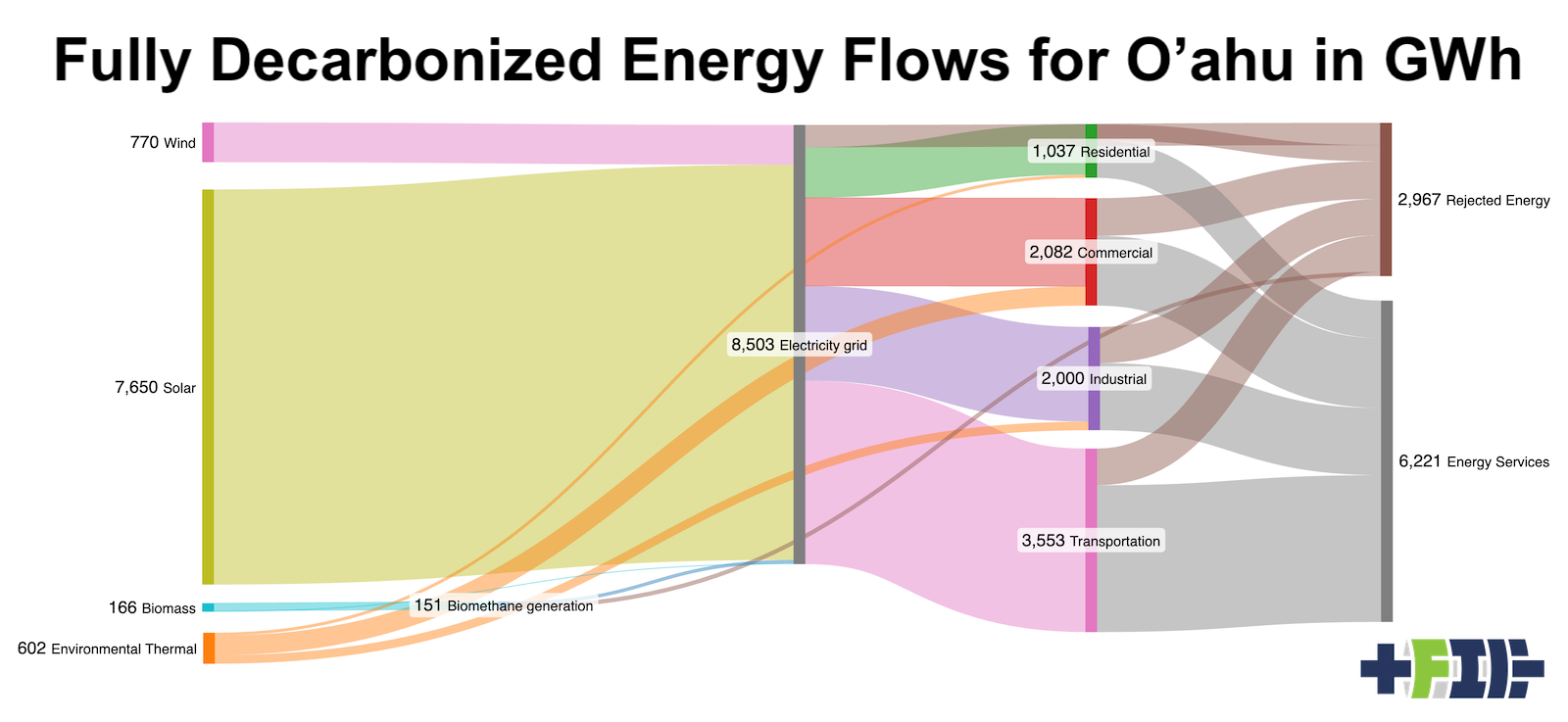
The resulting future Oʻahu Sankey is straightforward. Useful energy services remain at 6,221 GWh per year. Residential services remain 726 GWh, commercial 1,353 GWh, industrial 1,300 GWh, and transportation 2,842 GWh. Environmental thermal inputs, mostly from heat pumps and seawater cooling, total about 602 GWh per year. Delivered electricity to end uses totals about 8,070 GWh per year. After adding roughly 433 GWh of T&D and stationary-storage losses, the grid needs about 8,503 GWh of annual supply. That is provided by 7,650 GWh of solar, 770 GWh of onshore wind, 68 GWh of electricity from biomethane generation, and 15 GWh of other biomass. Every node balances. No oil generation remains. No refinery remains. No gas pool remains. No waste-to-energy generation remains.
That future system also survives a stress test. The closest analogue Oʻahu has had in the past decade to a renewable-weather stress case was not a hot and still summer period. It was a winter low-pressure event with cloud and reduced renewable output, typified by the January 8, 2024 period when rolling outages occurred. Even that event was primarily caused by unexpected outages at thermal units and H-POWER rather than a renewable drought. In a future system like the one described here, a January 8-type day with solar cut to 30% of average and wind cut to 50% of average would still leave a large energy gap. But that gap is exactly what the battery fleet, V2H layer, demand response stack, and biomethane reserve are designed to bridge. One or two days of that weather are manageable. Even a longer event remains within the scale of a small strategic reserve. This is not a continental-style dunkelflaute problem. Hawaiʻi’s worst renewable weather is shorter and less tightly coupled to heat peaks than what northern systems face.
So what would LNG actually do in this future system? It would add infrastructure cost, imported fuel dependence, methane leakage concerns, and long-lived fossil lock-in to solve a problem that has already been solved more cleanly by other means. The more successful the rest of the system becomes, the worse LNG’s economics become. If solar, demand management, batteries, district cooling, wind, and biomethane all do their jobs, LNG plants sit idle. If LNG plants run often enough to justify themselves financially, it means the cleaner parts of the system have been underbuilt or displaced. That’s likely why the optimistic LNG scenario from proponents includes eliminating a lot of utility scale solar. Either way, LNG is not a bridge. It is a detour, and likely a cul de sac.
That is why the debate keeps feeling strangely detached from the facts. LNG sounds sensible because it resembles the older thermal systems utilities and policymakers have lived with for decades. It feels dispatchable, familiar, and serious. But Oʻahu is not trying to decarbonize a conventional mainland grid with large seasonal swings, long transmission corridors, and weak solar resources. It is an island with extraordinary solar potential, modest fully electrified demand, strong opportunities for demand shaping, and only a small need for strategic firm capacity. In that context the right answer is not another imported fossil fuel. It is a smaller, smarter, more coordinated electrical system.
The phrase “LNG need not apply” is not rhetorical flourish. It is the result of following the arithmetic all the way through. Shrink demand through electrification and efficiency. Shift demand to follow the sun. Use solar as the dominant annual supply. Add onshore wind where it is reasonable. Use seawater cooling where the urban geometry makes it pay. Keep a small biomethane reserve for rare events. Replace H-POWER with better waste policy and a modest amount of clean generation. Then test the system against the worst weather Oʻahu is likely to see. Once that is done, there is no missing block that requires LNG. The island does not need a new fossil bridge. It needs to keep building the clean system already visible in the numbers.
Sign up for CleanTechnica’s Weekly Substack for Zach and Scott’s in-depth analyses and high level summaries, sign up for our daily newsletter, and follow us on Google News!
Have a tip for CleanTechnica? Want to advertise? Want to suggest a guest for our CleanTech Talk podcast? Contact us here.
Sign up for our daily newsletter for 15 new cleantech stories a day. Or sign up for our weekly one on top stories of the week if daily is too frequent.
CleanTechnica uses affiliate links. See our policy here.
CleanTechnica’s Comment Policy
cleantechnica.com
#LNG #Apply #Math #Oʻahus #Clean #Energy #Future


