


Support CleanTechnica’s work through a Substack subscription or on Stripe.
The final piece of Hawaiʻi’s decarbonization puzzle is not on Oʻahu’s domestic grid. That part of the work is already largely bounded. In the earlier articles in this series, I stripped out overseas aviation fuel, ocean-crossing ship bunkering, and military energy use, then electrified ground transportation, local marine transport, buildings, and industry. The resulting civilian Oʻahu system settled into roughly 6,000 GWh of annual electricity demand, with solar carrying most of the energy, batteries and demand management shaping it across the day, district cooling trimming urban peaks, a modest amount of onshore wind adding diversity, and a small biomethane reserve providing rare-event firming. That part of the arithmetic is hard, but it is no longer mysterious. What remains are the energy demands that still need dense liquid fuels because they cross oceans.
That distinction matters because the LNG debate in Hawaiʻi is often framed at too high a level, as a general solution to energy security and reliability. In practice, the island’s domestic electricity system, long-haul aviation, ocean shipping and military fuels have very different requirements, and only one of them is even a reasonable candidate for LNG. Once the categories are separated properly, the domestic grid no longer needs LNG, and the sectors that still require liquid fuels are not good candidates for LNG if the goal is decarbonization. The state’s own planning documents point in this direction. The Hawaiʻi State Energy Office’s 2025 Alternative Fuels Study explicitly treats aviation and marine fuels as hard-to-electrify sectors and emphasizes clean-fuel pathways, while HDOT’s energy security planning explicitly calls for incentives and infrastructure to support the production, blending, and import of sustainable aviation fuel and clean marine fuels.
Shipping is the easier part of the remaining liquid-fuel problem. The reason is simple. Fuel costs are spread across large payloads, and vessel hybridization can reduce fuel burn before the fuel switch even begins. In my recent shipping work, I argued that deep-sea shipping is converging on hybrid architectures with batteries plus alcohol fuels, especially methanol, and that LNG remains oversold as a climate solution rather than a durable end state. That is not an ideological claim. It is an engineering, economics and climate impacts claim. If hybridization cuts fuel burn materially and the remaining fuel can be biomethanol or ethanol, then the carbon problem shrinks without blowing up freight rates. A shipping line can absorb higher fuel costs because they are amortized across thousands of tons of cargo. Even if low-carbon fuel costs rise materially, the price increase per ton of goods is modest. Hawaiʻi should treat that as a supply-chain issue, not as a macroeconomic threat.
LNG is often presented as a lower-carbon option for shipping, but the evidence does not support it as a climate solution. The International Council on Clean Transportation’s FUMES study measured methane emissions from LNG-fueled ships in real operating conditions and found that methane slip from engines and fuel systems is far higher than earlier estimates. Because methane is a potent greenhouse gas, even small leakage rates erode most of the theoretical CO2 advantage of LNG. When these real-world emissions are accounted for, LNG typically delivers only modest lifecycle greenhouse gas reductions compared with conventional marine fuels, and in some cases will be higher than just bunkering VLSFO. That makes LNG a poor fit for a sector that must ultimately move to near-zero emissions, especially when alternatives such as hybrid electric systems paired with low-carbon liquid fuels like biomethanol or ethanol provide a clearer pathway to deep decarbonization without locking in another fossil fuel dependency.
That is not the case for aviation. Long-haul aircraft do not have a realistic electrification pathway within the time horizon that matters for Hawaiʻi’s economy, and possibly ever. Hydrogen remains deeply problematic for long-haul commercial aviation because of cost, storage volume, aircraft redesign, airport infrastructure, and safety system implications. That leaves sustainable aviation fuels and similar low-carbon liquid drop-ins as the practical decarbonization path for mainland and international flying.
In my earlier SAF work, I argued that long-haul aviation will get more expensive because airlines have fewer technical alternatives and because SAF premiums hit a sector in which the fuel must remain a very specific molecule. Hawaiʻi’s own transport planning echoes that reality. HDOT’s decarbonization work treats long-haul aviation as a liquid-fuel problem and specifically calls for a Hawaiʻi SAF tax credit to support production, blending, and import of sustainable aviation fuel into the state. That is the right framing. For Hawaiʻi, aviation decarbonization is not mainly a technology issue. It is a strategic tourism issue.
That asymmetry between ships and planes is central to the policy story. Shipping decarbonization matters for the cost of goods and for port logistics, but the effect on consumer prices per ton of imported material is likely to be modest because the fuel cost is spread so widely and because batteries can displace some of the fuel burn. Aviation is different. Ticket prices are far more exposed to fuel costs, especially on long-haul routes where alternatives are limited. Hawaiʻi’s leadership should pay attention to that distinction. The decarbonization of shipping is unlikely to be what changes the state’s economic model. The decarbonization of aviation could affect visitor volumes, visitor mix, and the elasticity of leisure travel demand. That does not mean the transition should be resisted. It means it should be treated as a strategic issue rather than as an afterthought.
This also clarifies the infrastructure question. Hawaiʻi won’t become a major producer or refiner of the liquid biofuels needed for aviation and deep-sea shipping. Its future role will be that of an importer, blender, certifier, and bunkering location. The state’s official documents already point in that direction. HDOT’s energy security roadmap is explicit that the state should plan for the necessary airport and harbor infrastructure to support clean-fuel imports and bunkering. That is a very different proposition from recreating a local refining industry around biofuels. It is a logistics and storage problem, not a refinery renaissance. For Hawaiʻi, the most realistic version of decarbonized long-distance transport is imported bio-SAF at the airport and imported bio-methanol or ethanol at the port, not local fuel self-sufficiency.
That distinction also helps place biomethane in its correct niche. Oʻahu’s local biomethane resource from wastewater sludge, landfill gas, and source-separated food waste is useful, but it is too small to matter for long-haul aviation or ocean shipping. In the earlier biomethane analysis, the practical Oʻahu resource was around 4 to 6 million therms per year, with a central estimate around 5.2 million therms, equal to about 151 GWh of gas energy and only about 68 GWh of electricity at reasonable generator efficiencies. That is enough for a small strategic reserve on the domestic grid, not for bunkering intercontinental aircraft or Pacific cargo ships. That is not a weakness. It is exactly the right scale for a reserve resource. The same Hawaiʻi analysis that supports those numbers also makes clear that wastewater, landfill gas, and food waste are the core feedstocks, while livestock manure and agricultural residues are small. Biomethane belongs in the domestic resilience layer, not in the long-haul transport solution set.
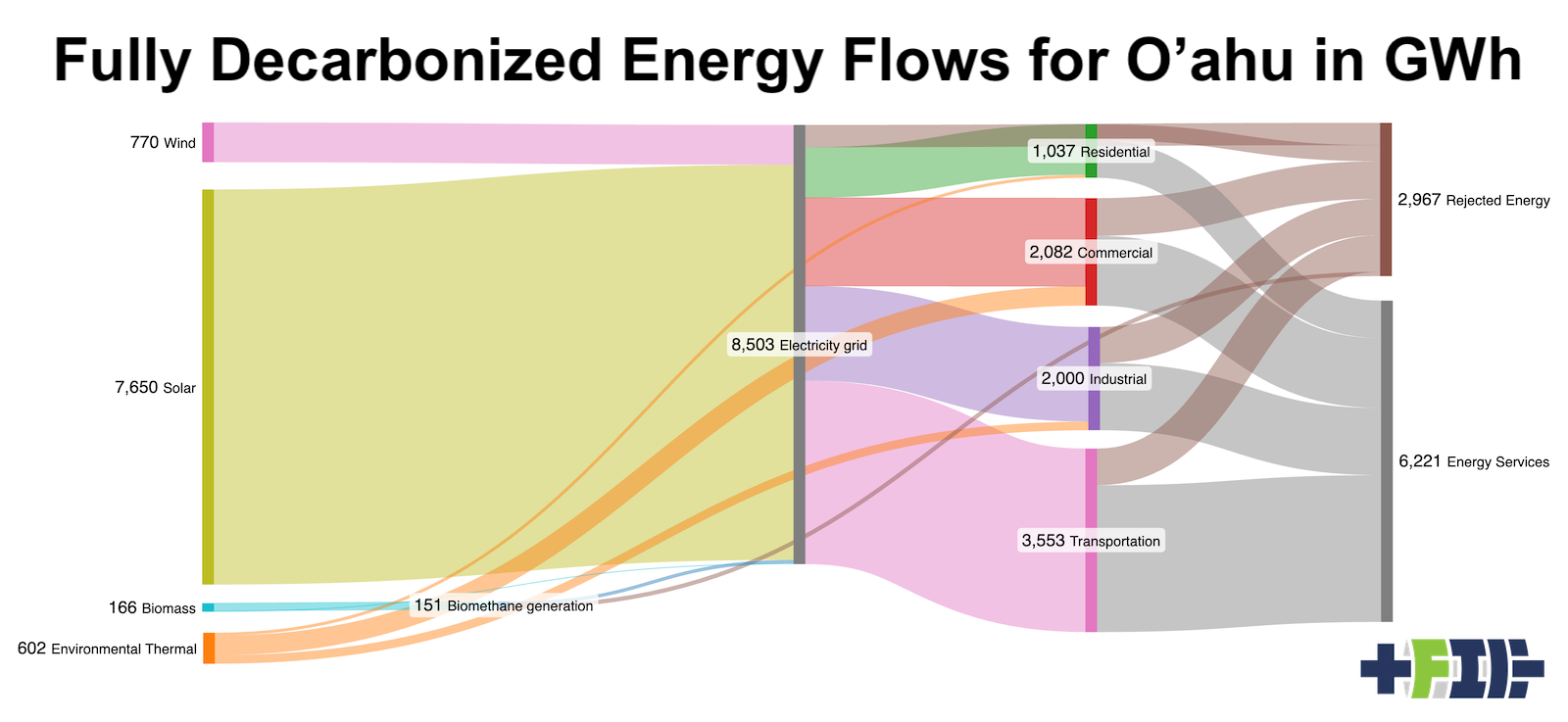
Put together, the resulting picture is coherent. The domestic Oʻahu system electrifies and runs primarily on solar. Daily balancing comes from utility-scale batteries, behind-the-meter batteries, vehicle-to-home systems, grid-interactive water heating, commercial pre-cooling, chilled-water or thermal storage, and a modest amount of onshore wind. Rare firming comes from a small biomethane reserve sized to the island’s actual risk profile, not from a large imported fossil gas system.
Cross-ocean shipping and long-haul aviation are then treated separately as imported liquid-fuel problems that decarbonize with biofuels over time. This is not a patchwork of unrelated ideas. It is a proper separation of different thermodynamic and infrastructure problems.
That separation is what makes the LNG question easy to answer. LNG only looks necessary if the domestic grid, waste combustion, and hard-to-electrify global transport are all mashed into one problem and then compared against today’s oil-heavy system. Once the domestic grid is rebuilt around electrification, solar, storage, and flexibility, there is no large combustion hole left for LNG to fill. LNG then becomes what it really is in this context, a new long-lived fossil infrastructure proposal that would duplicate capabilities already provided more cleanly by other parts of the system.
There is one category intentionally left out of this otherwise closed loop, and that is military aviation and naval operations. That omission is not a blind spot. It is a recognition of what can and cannot be forecast or governed at the state level. Military fuel use is strategically opaque, driven by national security decisions, and subject to operational patterns that are not predictable from civilian planning documents. Hawaiʻi can and should account for military emissions in broad climate inventories, but it cannot design a practical civilian roadmap around military ship movements or aircraft sortie patterns. Leaving that category aside is a matter of analytic discipline.
So the loop closes cleanly. Oʻahu’s domestic civilian energy system is an electrification problem, not a gas problem. The remaining cross-ocean transport energy needs are liquid-fuel import and bunkering problems, not local refining problems. Biomethane is a small strategic reserve. H-POWER is a waste-policy challenge. Military energy remains outside the planning frame. Once those categories are kept separate, the state’s roadmap becomes much easier to understand and much harder to distort. Hawaiʻi does not need to choose between climate ambition and reliability. It needs to stop asking LNG to solve problems that LNG was never the right answer for in the first place.
Sign up for CleanTechnica’s Weekly Substack for Zach and Scott’s in-depth analyses and high level summaries, sign up for our daily newsletter, and follow us on Google News!
Have a tip for CleanTechnica? Want to advertise? Want to suggest a guest for our CleanTech Talk podcast? Contact us here.
Sign up for our daily newsletter for 15 new cleantech stories a day. Or sign up for our weekly one on top stories of the week if daily is too frequent.
CleanTechnica uses affiliate links. See our policy here.
CleanTechnica’s Comment Policy
cleantechnica.com
#Solar #Home #Imported #Biofuels #Crossing #Oceans #Hawaiʻis #Real #Energy #Strategy

