


Pretty much every product, device or subsystem involved in power conversion, both on- and off-board anw EV, will have to comply with both safety and ElectroMagnetic Compatibility (EMC) regulations.
And while most power electronics engineers find the safety regulations to be relatively straightforward, I’d wager that few feel the same about the EMC ones. EMC compliance is not entirely a dark art, however—a good understanding of the basic physics involved will allow one to sidestep most EMC issues in the design phase, and for the rest there are plenty of purveyors of noise filtering components that are very effective (so long as one is not trying to slap a proverbial bandage on an arterial wound).
Regardless of the specific set of EMC regulations that might be enforced on a given device or product, compliance with them will generally consist of four components: minimizing the emission of, and maximizing the immunity to, both conducted and radiated noise over a specified frequency range (e.g. 150 kHz to 2.5 GHz).
Compliance with EMC regulations will generally consist of four components: minimizing the emission of, and maximizing the immunity to, both conducted and radiated noise over a specified frequency range.
Radiation is the dominant route for EMI into or out of a device at higher frequencies, because wiring length and enclosure openings will be more likely to approach half a wavelength (where wavelength, λ, in meters = 300 / f in MHz), which happens to make for a very efficient antenna. Conversely, the attenuation caused by the various stray series inductances and shunt capacitances in wiring, PCB traces, etc, will decline with frequency, hence the conduction of EMI prevails at the low end of the range. While there isn’t a hard line of demarcation in frequency between the two mechanisms in reality, most EMC testing standards worry about conduction below 30 MHz and radiation above it.
Since the cost of formal EMC compliance testing typically runs into the kilodollars/hr range, it is well worth the effort to find and address noise problems before scheduling time at the testing facility. Fortunately, a surprising amount of troubleshooting can be done at modest cost with a set of near-field EMC probes and a spectrum analyzer (ideally one with a built-in tracking generator).
Since the cost of formal EMC compliance testing typically runs into the kilodollars/hr range, it is well worth the effort to find and address noise problems before scheduling time at the testing facility.
Near-field probes are actually much better suited to pinpointing radiated emissions and immunity problems than the antenna-based setup that will be used in the formal tests, and they can also tell you whether such problems are the result of RF currents or voltages (that is, H- or E-field, respectively).
H-field probes can also be used to ferret out immunity problems by driving them with an external RF source (such as a spectrum analyzer’s tracking generator) to subject PCB traces, wiring and even enclosure openings to relatively high field strength levels with just a few mW of power, versus the several W of power needed if driving an antenna in the far field (though to be fair, the latter is how the certified test lab will do immunity testing, so this is a bit of an apples/oranges situation).
Evaluating conducted emissions and immunity requires a specialized filter to decouple the power supply from the Device Under Test (DUT), typically referred to as a Line Impedance Stabilization Network (LISN), and while you can certainly make such yourself, these filters are also commercially available at reasonable cost. Conducted emissions are measured with a spectrum analyzer by passing one or more power or signal wires to the DUT through a wideband current transformer that is specified for EMC testing. Conducted immunity is tested by injecting RF current into one or more wires to the DUT via an inductive (or, less commonly, capacitive) coupler, otherwise known as Bulk Current Injection (BCI).
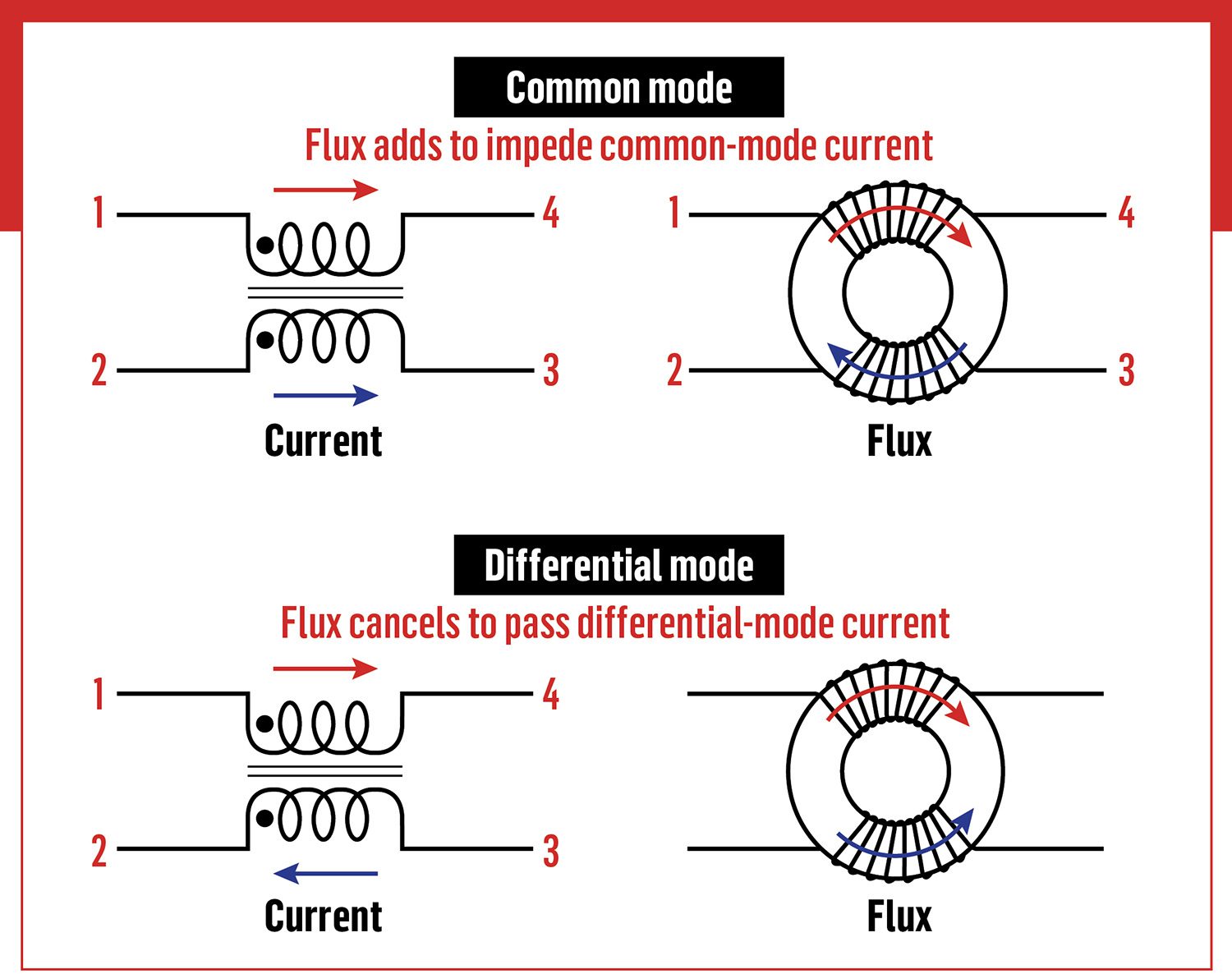
Most noise problems are the result of common-mode voltages or currents (that is, of similar amplitude and in phase on all wires), but differential mode noise can be measured or injected by reversing the direction of either the forward or return wire as it passes through the current transformer or BCI, respectively (in which case the measured/injected value should be reduced by 3 dB). For those interested in (or in desperate need of) more information, I highly recommend a 3-part book series on EMC by Kenneth Wyatt as well as EMC for Product Designers by Tim Williams. Two smaller YouTube channels that are particularly helpful are Hans Rosenberg and Dr. EMC.
Most noise problems are the result of common mode voltages or currents—that is, of similar amplitude and in phase on all wires.
Avoiding EMC emissions and immunity problems through judicious design is far better than troubleshooting and then ameliorating them, and a high-level design decision that can really pay off here is to go with a “soft-switching” (aka quasi-resonant) or a fully resonant converter topology. While these converters can be trickier to get working, they will usually exhibit much less ringing at the switching transitions, which would otherwise be a major cause of EMC testing failure, and they’re often more efficient to boot.
Moving on to the board level, making one of the inner layers of a multilayer board a solid ground/return plane is the closest thing there is to the proverbial silver bullet. A solid ground plane in close proximity to signal/power traces cancels out almost all of the H-field that might otherwise radiate from (or impinge upon) them, both reducing noise emissions and susceptibility to such, with the bonus effect of lowering trace inductance.
A corollary to this rule is to not split or otherwise interrupt this ground plane except for galvanic isolation reasons. This runs counter to the advice from yesteryear that ground planes between noisy power or digital circuits and quiet analog ones should be split, with only a single jumper or trace connecting them, but unless you can be absolutely sure that no high-frequency signals/currents will have to traverse that trace, it’s best to just use one big ground plane for everything (again, except for galvanic isolation). Galvanically isolated ground planes can be quieted by providing a return path for high-frequency common-mode currents through one or more Y capacitors (i.e. safety agency-rated for line-to-earth use) that tie back to the main (earthed) ground plane.
Another helpful tip is to always use some kind of termination on traces or wires carrying high-speed digital signals—either a series resistor at the sending end or “split termination” at the receiving end (or to enable pin-level termination, as is usually an option with FPGAs and most DSPs). Finally, be very wary of capacitively coupling high dV/dt from the drain tab of any switch operating at high frequency and voltage to the outside world. Clamping a GaN HEMT that is switching > 300 V at 1 MHz onto the inside of an aluminum enclosure to use the latter as a heat sink may very well turn said enclosure into the E-field radiator of the year.
At the wiring level, any board-to-board interconnects inside a device with a high-power switchmode converter—which is pretty much every major device related to EVs—should either use differential signaling or else pair up every singled-ended signal wire with a return wire. Ribbon cable makes either option exceptionally easy, and it is even available with twisted-pair construction, which is yet another way to minimize EMC problems (though differential signaling is needed to get the most out of twisted-pair). Cable shielding can be very effective at blocking EMI, but it can also be a major source of such.
The two main rules here are that the shield should be treated as if it were part of the enclosure, and not a return path for high-frequency current, and that the shield should be bonded over its full circumference at the enclosure ends, and not through a soldered pigtail. Then there is the classic panacea for minimizing wiring EMC problem: the clip-on (or molded-on) common-mode choke (CMC) made of a lossy ferrite material. While the “it can’t hurt” philosophy more or less applies here, a CMC works best on wires/cables that are operating at a low impedance, particularly if emissions are the main concern (conducted or radiated).
Also note that the impedance of a half-wave antenna is lowest at the ends, hence the CMC should be placed there on a cable, rather than somewhere in the middle. Similarly, AC or DC power inputs and DC outputs will almost certainly need a common-mode filter of some type, and note that the AC mains type will also need safety agency certification, so this is definitely a case in which going with an off-the-shelf product makes the most sense.
At the device/enclosure level, the most maddening (and often unavoidable) cause of EMC problems are slots, holes and poorly bonded seams in the enclosure. In this regard, rectangular openings (including poorly bonded seams) make for better antennas than round holes, but in all cases the usual thumb rule is to keep the longest dimension of any opening in the enclosure below λ / 20, though λ / 50 is ideal, relative to the highest frequency found (or expected) to be an issue. This thumb rule seems eminently reasonable at face value, as that would mean that no opening should exceed 24 cm (~9.5 in) if the highest frequency inside a device is a 25 MHz clock, for one common example. If 2.4 GHz cellular/WiFi signals turn out to be a problem, however, then the maximum permissible opening is now a mere 6.25 mm (~0.25 in)!
The issue of poorly bonded seams (e.g. between enclosure and lid) is especially common with aluminum due to the inevitable oxide layer that is present—whether this oxide layer is formed naturally from atmospheric oxygen, or intentionally from anodizing—but careless painting/powder coating, or simply relying on too few fasteners to assemble the enclosure, can cause the same problems with any metal. One very effective, albeit pricey, solution is to use a metal mesh gasket (like an O-ring made out of steel wool) between any seams, but if all else fails, then nickel plating aluminum will guarantee good contact even without a ridiculous number of fasteners (or pricey metal gasketing).
The last resort for reducing EMC problems is metal shielding, as it tends to be rather costly from an assembly labor standpoint, but there are times when it will be difficult to avoid.
The last resort for reducing EMC problems is metal shielding, as it tends to be rather costly from an assembly labor standpoint, but there are times when it will be difficult to avoid. For example, an LCD display is likely to require an opening in the enclosure that lets out (or in) too much EMI, and if the display can’t be moved to a quieter (or more immune) location, then a metal shield may very well be the only effective solution. The good news is that even very thin shielding will reliably block high-frequency E- or EM-fields as long as it is highly conductive and solidly bonded to ground (read: with minimal inductance). For H-fields, the shielding mechanism shifts from being dependent more on material permeability at low frequencies to the induction of eddy currents as frequency goes up, but in all cases the amount of attenuation afforded by shielding will be proportional to the thickness of the shield itself.
The same guidelines as for traces/wiring apply here, but some of the biggest H-field offenders are E-core magnetic components with a discrete gap (especially if the gap extends across the legs). Besides confining the gap to the center post only, another effective solution is a “flux band,” which is a metal shield consisting of a single wrap of copper foil that encloses the coil former and legs. Note that any metal shield (including a flux band) needs to be solidly bonded to the enclosure or PCB ground plane, just as with cable shields, to provide a return path for any induced noise currents—failing to do so will turn the shield into an antenna, which is the exact opposite of what you want!
This article first appeared in Issue 74: October-December 2025 – Subscribe now.
chargedevs.com
#Charged #EVs #EMI #filters #noisemitigation #techniques #powerelectronics


