


The Bhagwant Mann-led Aam Aadmi government in Punjab is all set to roll out its much-hyped Mukh Mantri Sehat Bima Yojana (MMSBY), promising an insurance cover of ₹10 lakh per family, this month.
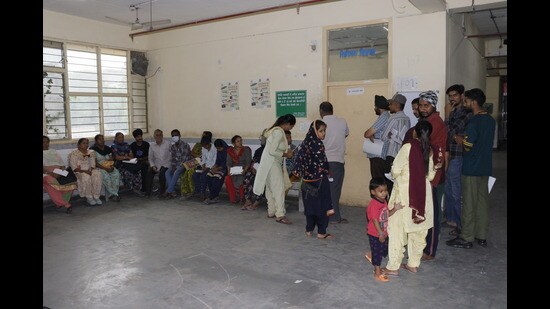
Touted as the flagship welfare initiative, that comes barely a year ahead of the crucial state assembly polls, aims to provide cashless treatment to all Punjab residents at government and empanelled private hospitals across the state and capital Chandigarh. The major challenge, however, for the cash-strapped government will be to tackle the scheme’s financial implications. HT gives its readers a lowdown on the key scheme.
Who all are covered?
A: Any bonafide resident of Punjab and his/her family members shall be an eligible beneficiary under MMSBY. However, in order to register under the scheme, the resident must possess an Aadhar Card and a voter ID as proof of residence. For beneficiaries under 18 years, an Aadhar card of self and voter ID of either of the parents or voter ID of the guardian establishing residence in Punjab shall be sufficient to become eligible under the scheme. Those registered under the central and state-sponsored Ayushman Bharat Scheme of health insurance of ₹5 lakh will get an additional top-up of ₹5 lakh under the scheme.
How to register?
A: The government is organising special camps to register the beneficiaries under the scheme, after which the beneficiaries will be issued MMS cards. Around 16.60 lakh families whose funding is derived from the Centre and are registered under the Ayushman Bharat scheme will be issued cards in accordance with National Health Agency guidelines. The premium for 16.65 lakh getting benefit under Aayushman Bharat scheme selected through Social Economics and Caste Census (SECC)-2011 is borne by the central and state governments in a 60:40 ratio.
What is the definition of the family under the scheme?
A: Family under the scheme consists of the head of the family, spouse, unmarried children, parents, a widow/divorcee person and their minor children, a widowed daughter-in-law and her minor children. There shall be no ceiling on the size of the registered family unit. Any member of the family who falls within the definition of family shall be eligible to be registered, irrespective of the number of already existing family members. However, any one individual cannot be registered in more than one family.
Are government and private sector employees covered?
A The employees engaged on an outsourcing, contractual, consultancy basis with the departments, organisations, societies, corporations, trusts, etc. under the government of Punjab shall be eligible to become a beneficiary of MMSBY. In addition, pensioners and regular employees of the Punjab government shall also be eligible under the scheme. However, any beneficiary covered under ESI/CGHS/other central or state government insurance/reimbursement schemes can avail benefits only under one of the schemes.
How is this scheme different from the previous scheme, providing ₹5 lakh cover per family?
A: According to health minister Dr Balbir Singh, the scheme adopts the latest health benefit package (HBP 2.2)- the package defined by the national health agency for the Ayushman Bharat scheme. Whereas 1,669 different procedures were covered under the previous schemes, the MMSY ensures comprehensive coverage through more than 2,000 selected treatment packages. Beneficiaries can access secondary and tertiary care across a robust network of 824 empanelled hospitals, which currently includes 212 public hospitals, eight government of India hospitals, including the PGIMR-Chandigarh and over 600 private hospitals. More private hospitals are expected to be empanelled as the scheme progresses.
Financial implications of the scheme?
A: The scheme is to be implemented in a hybrid mode, wherein the selected insurance company, United India Insurance, shall be responsible for the settlement of all claims up to ₹1 lakh for both public and private hospitals. For claims above ₹1 lakh, the insurance company shall be responsible for the authentication and processing of claims, while the financial liability beyond ₹1 lakh for such claims shall be borne by the state health agency (SHA). Payment for claims beyond ₹1 lakh shall be made directly by SHA to the concerned hospitals at the sum insured and package rates. The government is likely to dedicate a special corpus for the SHA to pay for the scheme.
The biggest challenge in its implementation?
A: The previous scheme of providing ₹5 lakh cover had time and again run into controversies, and the treatments were stopped because of the delay in payment of dues to the private hospitals. With the state’s coffers already under stress, it would be challenging for the government to smoothly run the scheme.
www.hindustantimes.com
#HTExplainer #10lakh #Sehat #Bima #points #mind


