


Support CleanTechnica’s work through a Substack subscription or on Stripe.
In December 2025, 10,384 battery electric vehicles (BEVs) were sold into the Australian market, and 5,919 plugin hybrids were sold. In total, out of 101,513 passenger vehicles sold, 16, 303 came with a plug. This achieved a penetration rate of 16.7%. This is the highest rate of EV penetration so far and compares with 14% in November 2025 and year on year about 10% in December 2024.

Although the electric vehicle transition in Australia is progressing slower than most of us would hope, it is amazing how well it is doing with the headwinds provided by entrenched automaker-sponsored FUD. There really are enough chargers! Have confidence!
It is important to keep a long-term view to avoid frustration. It is also worth looking at things globally. As part of the rest of the world, Australia is doing its part. The BEV:PHEV ratio is about 2 to 1, similar to that in many global markets. It appears that PHEVs are doing the heavy lifting here in Australia, particularly the BYD Shark.
Charts provided by Drive.com provide confirmation that since 2020, petrol- and diesel-only drivetrains are steadily declining while electrified models slowly eat into market share. The market share of BEVs has gone from near zero in 2020 to 9%, PHEVs have gone from near zero to 4.6%, and from 8% to 16% over the 2025 calendar year. The transitions of mature markets like Norway show that HEVs and PHEVs soon leave the scene as BEVs take over the market.
With the top-selling Ford Ranger, Toyota RAV4, and Toyota HiLux losing sales, the Australian market is ripe for PHEV utes (like the BYD Shark and Great Wall Motor’s Cannon Alpha). 2026 will see more PHEV and BEV utes launched.
Here are the top ten selling BEVs in Australia for December 2025:
- BYD Sealion 7 — 2,546 sales — year to date 13,410
- Tesla Model Y — 1,998 sales — 22,239
- Tesla Model 3 — 587 sales — 6,617
- BYD Atto 2 — 531 sales — 896
- BYD Seal — 413 sales — 3,784
- Zeekr 7X — 293 sales — 1,206
- BYD Atto 3 — 270 sales — 3,861
- BYD Dolphin — 265 sales — 3,248
- Kia EV5 — 246 sales — 4,787
- Toyota bZ4X — 183 sales — 1,041
It is interesting to note who is missing from the table. There are no models from Ford or General Motors, only one Korean and one Japanese. In fact, Australia’s chart is looking more and more like the Chinese top ten, with only the Kia EV5 and Toyota Bz4X not made in China. If we go a little deeper, we can find a German brand struggling to keep up with the Chinese competitors. The Volkswagen ID.4 came in at number 15. The beginning of the tail for those interested: Kia EV3 — 181 units sold, XPENG G6 — 175, Geely EX5 — 174, MG S5 — 169, VW ID.4 — 141.
Over the full 2025, looking at the brand top ten, BYD came in at number 8. BYD has grown over 150% this year. Meanwhile, the Model Y was reported as the 10th best-selling car in Australia. Which car comments further regarding full year sales: “Battery electric vehicles recorded 103,269 sales from all sources, accounting for 8.3 per cent of the total market. Despite more than 100 EV models now available locally, growth in the segment has been slower than previously forecast. Market share has increased by just 1.1 percentage.”
Another 100,000 BEVs were added to the domestic fleet in 2025. The average Australian driver travels 15,000 km per year. That’s a likely 1.5 billion kilometres of electric driving. New passenger cars average about 7 litres per hundred km driven. That means that the 100,000 BEVS newly added would have saved 105 million litres of petrol. The numbers are starting to add up. EVs would have saved the Australian motorist about AU$200 million in 2025 alone. Add this to the 300,000 electric vehicles already on the roads and we are going to see significant changes in the petrol car ecosystem.
Australia imports all of its fuel. Surely this reduction in fossil fuel use will have an impact on national Balance of Payments? The possibility of a road user tax (RUC) is getting more likely as federal government income from fuel tax (roughly 30% of the price) diminishes.
The view in the rear vision mirror: Over the past twelve months, Majella and I have checked out the following cars: In January, we checked out the BMW electric range, in particular the iX1. We were impressed with the thorough explanation given us by the sales rep. On the same day, we popped across the road and spent quality time with the Polestar 4. Great car with many new features, but we queried whether it could save the Polestar brand. Sadly, still struggling.
Then the BYD Shark 6 arrived and started a feeding frenzy. Sales have gone from strength to strength, and mirror the reduction in numbers of petrol and diesel utes sold into the Australian market. In contrast, Renault’s dependency on its reputation, rather than build quality, meant that the Megane E-Tech did not last long in the competitive Australian market.
Geely (who also owns Volvo and Polestar) launched under its own brand and we got a preview. The EX5 is selling well — making it into the December top 15. The XPENG G6 showed up at our coffee morning and wowed us with its ability to remotely self-park. This led me to ask the question: Did the XPENG G6 have better tech than a Tesla?
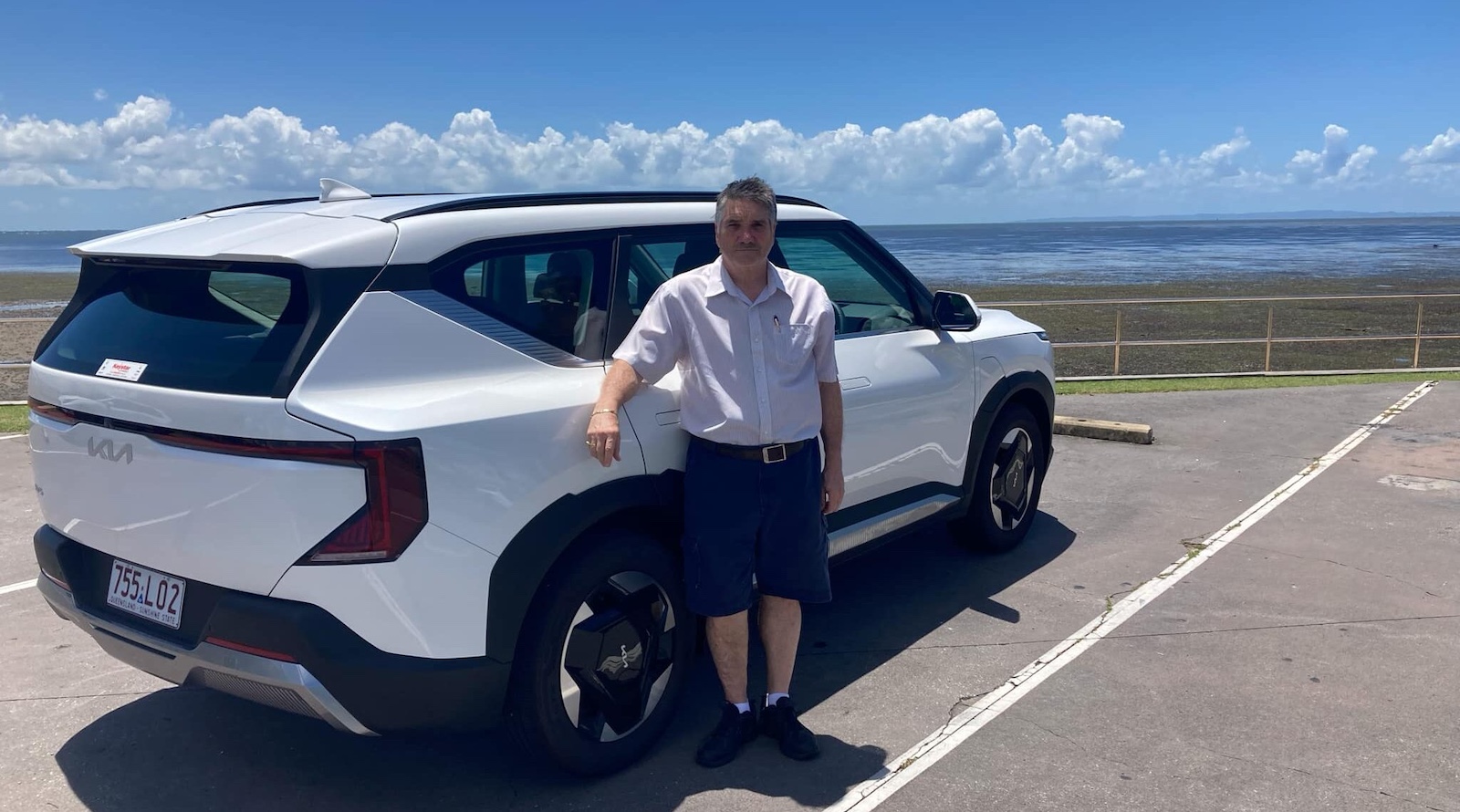
Kia continued its offerings with the launch of the EV5. We took one to the beach and were very impressed with its fit out. Though, we thought it a little overpriced at the time.
April saw the launch of the facelifted Tesla Model Y. Everyone hoped this would lead to a resurgence of Tesla sales, and there was some clawback. However, as you can see from the top ten for December, Australia, like the rest of the world, is turning to other EV makers for their new cars. Specifically, to BYD.
Deepal (owned by Changan Automobile) launched into the Australian market with the SO7. We had fun driving it through the city of Brisbane up to the local lookout. Although launching with great fanfare, Deepal has only been able to sell 287 units throughout the year. Since the dealership also handles Lotus and Peugeot, we had a quick look at the Eletre and the e-308.

Hyundai Motor Group is working hard to establish itself as a quality alternative in the EV space. The Hyundai Inster is a great little niche filler. I described it as Grannie’s “Ultimate Urban Assault Vehicle” to handle the chores in the cut and thrust of congested traffic. And Kia launched the “World Car of the Year” — the EV3 — doing well at number 11 in December 2025.
Six months ago, the Cannon Alpha PHEV ute joined the Shark’s mission to erode the sales of petrol-only utes. It appears to have been less successful than the BYD, but has still accumulated a band of loyal followers.
The second half of 2025 brought more launches of EVs. MG lifted its game significantly by bringing out the MG S5, a great step up from the MG ZS EV, which seems to have disappeared from Australian showrooms. Deepal brought out its innovative EO7 — which can be used as a sedan, a station wagon, or a ute. Sadly, Australians seem to have spurned this versatile offering and stuck with utes that are utes and more and more SUVs. Boring lot!
Volkswagen finally got into the game with the ID.4 and the ID.Buzz in August.
It appears that in Australia, the Europeans are fighting a rearguard action against the Chinese auto onslaught. VW is selling well at home but is struggling in this particular export market. Stellantis may be onto a winner with it’s Leapmotor affiliate. We were very impressed with the C10 as a value-for-money proposition and by a few new gadgets we hadn’t seen before. To cover all bases, the Leapmotor C10 comes in a BEV and a EREV version.
Another new Chinese brand appeared with a great value product — the Zeekr 7X. Again, we were wowed at our monthly coffee meetup when we were able to have a close look and chat to the owners.
As the year drew to a close, we were excited by the news from BYD of the arrival of the Atto 2 and Atto 1. Unfortunately, the Atto 1 launch was delayed. We are going to look at it this afternoon — stay tuned — but the Atto 2 has hit the ground running. Debuting in November at number 6, and this month moving up to number 4, another niche is being conquered. Who said Australians only want big, hulking SUVs?
It is good to take time to reflect on progress. As we move further into 2026, the future is exciting and electric.
Sign up for CleanTechnica’s Weekly Substack for Zach and Scott’s in-depth analyses and high level summaries, sign up for our daily newsletter, and follow us on Google News!
Have a tip for CleanTechnica? Want to advertise? Want to suggest a guest for our CleanTech Talk podcast? Contact us here.
Sign up for our daily newsletter for 15 new cleantech stories a day. Or sign up for our weekly one on top stories of the week if daily is too frequent.
CleanTechnica uses affiliate links. See our policy here.
CleanTechnica’s Comment Policy
cleantechnica.com
#Ends #Uptick #Australian #Plugin #Vehicle #Sales


