


Support CleanTechnica’s work through a Substack subscription or on Stripe.
Francisco Shi has a problem. He has a lot of spare parts left over from his battery building project. You can read here about his home power plant constructed from BYD Atto 3 electric vehicle batteries from wrecked cars. The answer? Create a Super i-MiEV, “hot up” the old Mitsubishi i-MiEVs by giving a Chinese heart to this iconic Japanese EV.

The car made a visit to our end-of-year Coffee, Cake, and EVs. We all lined up and took turns going for joy rides in the large TAFE car park at the bottom of the hill. The Super i-MiEV almost stands up on its back legs. Check out this video below. Francisco tells me that, just for fun, he and his wife go “Bogun Hunting.” That is: they cruise the streets looking for V8s to drag off. They get a lot of surprised drivers. Of course, they only go up to the speed limit.
This meant that I had another excuse to visit Francisco’s Aladdin’s cave of EV car parts to find out more. He told me that he found the drive unit conversion pretty easy — just needed some brackets. “Like a backyard petrol engine swap?” I asked. He agreed. “The more people that do these conversions, the easier it will get.” The tools and adapters are available.
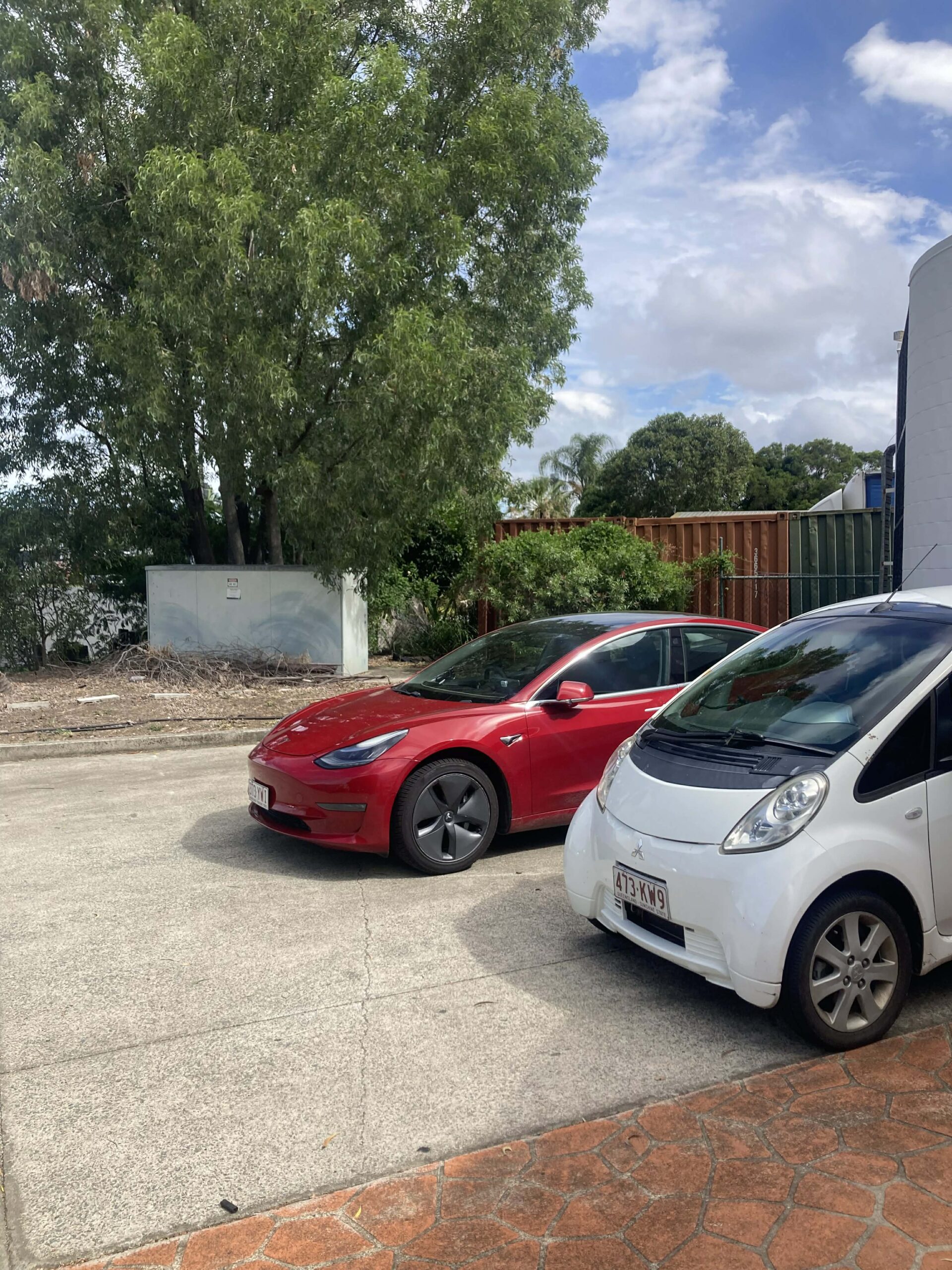
As well as the drive swap, Francisco has replaced the original 16kWh i-MiEV battery with a 30 kWh one. He tells me that it appears to have the same range, but much more power. I suggested that would be the case if he floored it at every set of lights! He confesses that it is hard to drive the Super i-MiEV gently. He suspects that it may have increased range, but he has not tested it under original i-MiEV conditions.
Why? Francisco is looking for a market for his “leftover” Atto 3 drivetrains. I should mention that he has help from friends who are also working on the project. The Super i-MiEV being modified is a loaner from one friend who collects i-MiEVs. Another friend has made the brackets to fit the Atto 3 drivetrain into the i-MiEV — almost like a subframe.
He is still working on the problems involved with getting the motor and the rest of the car to talk to each other. He believes he is 90% there in achieving the aim of creating a “conversion kit.” The decision to upgrade an existing EV to a more powerful machine is based more on emotion than on financial considerations. “You need to love the car in order to make the conversion worth it,” Francisco explains. “Emotion makes it value for money.” Second-hand EVs are approaching what a conversion would cost. A quick google search reveals that a 5-year-old MG ZS EV can be had for less than AU$20,000. A second-hand i-MiEV can be bought for less than AU$10,000. The 13-year-old car is advertised as: “own a part of EV history!”
As an aside, Francisco believes that second-hand EVs will eventually rise in price as the driving public realise how long the vehicles last — particularly the batteries. For example, a second-hand MG ZS EV even with battery degradation still makes a good runabout. Total cost of ownership goes down relatively quickly.
Francisco has already proven that he can run an Atto 3 drivetrain without using a BYD battery. The 10% to go includes working out the final protocols to “keep the car happy.” Just some annoying little things, like the check engine light, to sort out. The car has two charging ports, for type 1 and CHAdeMO. Francisco wants to be able to use both. He also wants to get a panel beater to fit a CCS2 charge port.

Hopefully, by the end of 2026, Francisco will be able to start selling conversion kits to i-MiEV owners. He believes that he has already produced the “proof of concept” with a machine conversion that would suit the enthusiast. His target price is about AU$6,000 for a BYD Atto 3 drive unit. So far, he estimates he has spent over 100 hours on his little project. If he is able to sell 10–20 kits, it should cover the time he has spent.
He tells me about some of the experiences he has had on the road dragging off Bogans driving V8’s. “I leave them behind, then they catch up, revving, speeding, hitting the red line, perhaps they will blow up their motors. Sometimes we meet up at the next set of lights and they try again, but it doesn’t work.”
Francisco sees the death of the i-MiEV in 2015 as a missed opportunity for Mitsubishi. “If only they had put in a modern battery, they could have achieved 400 km of range.” Those of you who are interested in more of the technicalities might like to check out this video. Watch to the end to see the racing guinea pigs!
Francisco is generous with his knowledge. When asked about the canbus addresses for the i-MiEV, he reveals you need IDs 0x288, 0x298, 0x29A, 0x564, 0x75A, 0x75B. You need to get a circuit diagram from the service manual for the CAN bus connections. Another viewer asks about the improvements from the upgrade and is told by an enthusiast: “Old: 47kW, 180Nm, maximum charge rate 3.3kW AC and 50kW DC using Chademo plug. New: 150kW, 310Nm, maximum charge rate 7.4kW AC, 88kW DC using type 2 CCS plug.” He adds the appropriate comment: “This is old school hot-rodding in the modern age.”
Tell me about the olden days, grandad, when you had to shave the head, install dual carby’s, and install a hot rod exhaust? I just hotted up my EV using an app on my mobile phone. Smart aleck teenagers!
Sign up for CleanTechnica’s Weekly Substack for Zach and Scott’s in-depth analyses and high level summaries, sign up for our daily newsletter, and follow us on Google News!
Have a tip for CleanTechnica? Want to advertise? Want to suggest a guest for our CleanTech Talk podcast? Contact us here.
Sign up for our daily newsletter for 15 new cleantech stories a day. Or sign up for our weekly one on top stories of the week if daily is too frequent.
CleanTechnica uses affiliate links. See our policy here.
CleanTechnica’s Comment Policy
cleantechnica.com
#Super #iMiEV #Japanese #Car #Chinese #Heart


