


Support CleanTechnica’s work through a Substack subscription or on Stripe.
There may be a lesson for clean vehicle advocates in the announcement this week by Peterbilt that it has added three new battery-powered trucks to its lineup of models. Why is that significant? Because Peterbilt is owned by PACCAR. Along with Daimler Trucks North America, International, and Volvo Trucks, PACCAR is embroiled in a legal dispute with the state of California about its emission rules for medium and heavy duty trucks.
In 2023, the four companies signed an agreement with the California Air Resources Board called the Clean Truck Partnership, in which the manufacturers agreed to meet California’s Advanced Clean Trucks and Omnibus regulations regardless of federal legal outcomes, and to refrain from challenging California’s authority to set stricter emissions rules.
California has a legitimate interest in those rules, since about 40% of all containerized imports enter the US through ports in southern California. From there, thousands of snorting diesel-powered trucks haul them to freight distribution centers, where they are sorted and consigned to other diesel trucks to be distributed throughout the US.
The caravan of heavy trucks going up and down California highways never stops and the crud spilling out of all those exhaust pipes has made living near those highways a life threatening experience for residents. It’s not so much the carbon dioxide emissions as it is the high concentration of fine particulates and oxides of nitrogen that make people sick.
The MAGA crowd loves to beat their breasts and crow about “states rights,” but once in power they delight in shoving their policies down the throats of the states. Somehow, the voters never tumble to this charade. Earlier this year, the federal government revoked California’s waiver that allowed it to set emissions standards that were higher than federal standards.
Subsequently, the Department of Justice sent a letter to the truck manufacturers that said, “because CARB’s regulations are pre-empted, the Clean Truck Partnership is pre-empted and unlawful. You must therefore immediately cease and desist your compliance with both the Clean Truck Partnership and its pre-empted state vehicle emission regulations.”
It is unclear to what extent the federal government can invalidate a private contract entered into in good faith by all interested parties, and so the manufacturers immediately filed suit asking a court to decide what they can and cannot do. That litigation is ongoing and is likely to be protracted. Most of us will probably see one or more birthdays before it is resolved.
It is interesting that in the middle of all this difficulty, Peterbilt has just announced the addition of several battery-powered medium duty trucks to its model lineup. Why, when it is fighting over emissions standards, would it do that? The answer has a lot to do with whether mandates or economic considerations are the most effective means of implementing policy goals.
Four Electric Trucks From Peterbilt

In a press release, Peterbilt said its medium duty models — 536EV, 537EV, and 548EV — “broaden its zero-emissions application coverage and further addresses customer needs. The new EVs are built on proven platforms with zero tailpipe emissions and are supported by the latest safety technologies.”
Erik Johnson, the company’s assistant general manager, said “Optimized for the demands of the medium duty segment, the next generation of Peterbilt electric vehicles deliver excellent efficiency, rapid charging and versatile configurations elevating customer productivity across a wide range of applications. The all-new Models 536EV, 537EV and 548EV offer zero-emissions technology to support ease and adaptability for customers focused on cleaner operations and leveraging the versatility, efficiency, and comfort Peterbilt offers.”
The 536EV and 537EV models are optimized for regional delivery as well as service and utility trucks, while the new Class 8 548EV supports 4×2 tractors and vocational configurations with PTOs, such as dump trucks. PTO stands for power takeoff, the feature that allows the powertrain to support not only lift bodies but trash trucks and other specialized trucks such as tilt bed vehicle haulers.
Customers can choose either of two battery packs — 250 kWh, for up to 200 miles of range, and 375 kWh for up to 280 miles of range. Both use LFP battery cells, which have proven to be durable and reliable in commercial service. DC fast charging of up to 350 kW enables charging in 60 to 80 minutes, says Truck News.
All of the new models are equipped with the Bendix Fusion Stop & Auto-Go Advanced driver assistance package with pedestrian detection and high beam assist. The system makes use of a suite of cameras and radars to keep the driver informed about other vehicles on the side of or behind the vehicle. In addition, drivers may select from three levels of regenerative braking.
PACCAR Powertrain
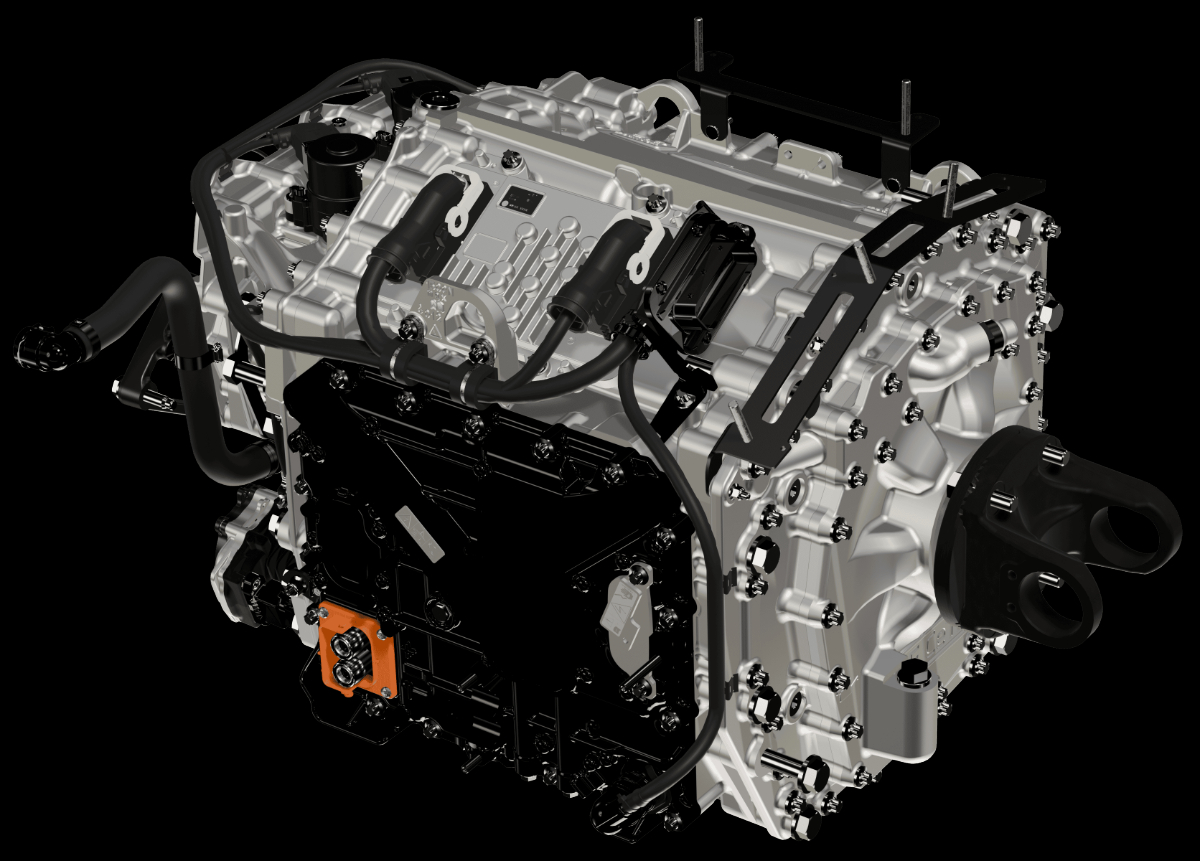
All the new models use the PACCAR ePowertrain, which features centrally mounted dual electric motors and an integrated three-speed transmission that delivers seamless shifting with no torque interruption. Several power options are available, from 170 kW (230 hp continuous, 335 hp peak) up to 350 kW (470 hp continuous, 605 hp peak), with peak torque ranging from 1,100 to 1,850 lb-ft of torque.
The ePowertrain is suitable for a variety of truck applications, from single to dual rear axle configurations and any wheelbase of 163 inches or longer and maximum loads up to 82,000 lb GCW. To support its electric truck customers, Peterbilt has partnered with industry-leading providers of charging infrastructure services such as QMerit and Schneider Electric.
Peterbilt Is Meeting The Demand
Many readers by now will be asking themselves, “Why is Peterbilt doing this?” The answer, of course, is there is a demand for these trucks from commercial customers. When Mr. and Mrs. America go shopping for a new car, they are 100% focused on the price and the monthly payment. A sales representative can talk at length about depreciation, trade-in value, or reliability, but if they have their hearts set on that harvest gold Belchfire 5000 on the showroom floor, then all those appeals to logic will be wasted.
Commercial customers figure their costs down the tenth of a penny per mile. They are more interested in whether a truck will be in service, ready to work every day, rather than the color of the interior. Total cost of ownership means little to new car shoppers, but it is the Holy Grail for fleet managers.
What that means is the word about electric trucks is getting around in trade circles. Fleet manager A is hearing from fleet manager B that electric trucks are cheaper to operate and more durable than their diesel equivalents. which means fleet manager A is calling his truck dealer and asking about electric trucks.
In addition, drivers are telling other drivers about the advantages of electric trucks, which are quieter in operation, leading to less fatigue at the end of the work day. They also become unwitting apostles for things like regenerative braking that makes driving easier. That knowledge gets passes on to managers, as well as family and friends, who then have a more open mind about electric vehicles in general. And so the EV revolution moves forward another notch.
The lesson is that market forces and word of mouth may be more powerful tools than mandates. One makes people want to drive electric vehicles while the other makes people feel they are being forced to do so. If the climate emergency were not so dire, allowing the EV revolution to move forward more slowly might be fine.
It’s a conundrum with no easy answer, but the mere fact that PACCAR is developing battery-electric powertrains for commercial vehicles and Peterbilt is incorporating those powertrains into its vehicles is a hopeful sign that all is not lost, despite the policy insanity flowing out of Washington.
Sign up for CleanTechnica’s Weekly Substack for Zach and Scott’s in-depth analyses and high level summaries, sign up for our daily newsletter, and follow us on Google News!
Have a tip for CleanTechnica? Want to advertise? Want to suggest a guest for our CleanTech Talk podcast? Contact us here.
Sign up for our daily newsletter for 15 new cleantech stories a day. Or sign up for our weekly one on top stories of the week if daily is too frequent.
CleanTechnica uses affiliate links. See our policy here.
CleanTechnica’s Comment Policy
cleantechnica.com
#Peterbilt #Unveils #Electric #Truck #Models #Dispute #California #Continues


