


Support CleanTechnica’s work through a Substack subscription or on Stripe.
Managers of very large companies are very smart people. With the right information, they will make the best decision within the world as they know it. So, why are European carmakers digging their own graves? Make no mistake, asking for a stay in the end of sales of ICE vehicles in the EU is exactly that. It is either that they do not know the automotive world, or they have the wrong information. Perhaps a bit of both.
Their organization, ACEA, publishes relevant data every month. And the numbers they have for their members are far more detailed than what is told to the public at large. But numbers are just data, not information. They have data analysts to create information using the data from ACEA and every other source they can find. That used to be my profession, and I loved it.
In IT we used to say: Garbage in; Garbage out. Collectively making such a bad decision, venting so many wrong opinions, it is clear that there is a garbage out situation. The detailed data, aka facts or measurements, are good enough. I use them also and I get a clear diagnosis of the Osborne effect. The problem must be in the meta-data and the rules.
Among the meta-data are the classes the detail data belong to. The rules tell the analysts how to bind data to classes. There are hundreds of classes, like the date of sale, location, type of location, buyer, buyer’s income, education, family, beside things like a few dozen characteristics of the vehicle. It starts with validating the data, trying to understand what information one can distill from the data, what it means, and whether it is relevant for the question you want to answer with the data. Then, you use all the rules to combine the data with the metadata and decide on the relationships between the data. Next, you prepare the data for the many queries you are going to ask from the data. We get an explosion of answers. You describe everything that happened in the market and how all those events relate to each other, or caused each other.
Dear reader, if you are lost, you get the problem. Too many details with too many questions with too many answers. The result is often that it is difficult to see the forest for the trees.
My job in this is far easier. I am only interested in the passenger vehicle transition to EVs and only in Europe. I have nearly a decade of recognizing all the noise that disguises the valuable information in the data. The transition is towards zero emission vehicles. The only zero-emissions vehicles that matter are BEVs. The transition is away from everything with an internal combustion engine. ACEA produces data for 31 countries and 6 types of energy for the cars: BEV, PHEV, hybrid, other, petrol, diesel. In the “other” column, you have LNG, CNG, LPG, FCHEV, and really exotic means of energy. Luckily, there is a column for “Total.” My job was to load the BEV column into my spreadsheet, compute Total-/-BEV to find tailpipe vehicles, look for outliers in the country group, like Germany after it dropped subsidies unexpectedly, and look at the bigger picture. With only a few trees, I can see the forest.
Because Germany is by far the largest market for BEVs, the drop in sales in Germany did skew the overall statistics of the 31 markets. I made an overview with and without Germany. I see that 2024 was a difficult year for BEV sales, with just ~7% growth in 30 countries, but not the disaster that was reported in the media. For the same reason, I ignore the statistics of 2020, 2021, and 2022. Only in the second half of 2023 did most markets start to look normal. For me, the 2023 numbers are good enough to use. Using 2019 as a starting point, the last year with a normal market, and 2023, 2024, and 2025 to look at trends, I see a clear picture for Europe.
But it is not so easy for insiders of the automotive industry and EU policymakers. For decades, they have been talking about ways to get transport cleaner. All types of alternate fuels and technical solutions have been seen as a possible way forward. Diesel did produce less CO2 per kilometer. I even bought a diesel with environmental subsidy in 2010. But then they realized that diesel produced more soot, particles, and nitrogen. Bosch developed “clean diesel” technology, but it was expensive to implement and it would lower power and torque. More expensive with less performance is not easy to sell, but the very manageable NEDC test method allowed one to produce clean diesel outcomes without a clean diesel engine. As we now know, that test method was not legal in the USA, and “dieselgate” was the result.
This is not a discussion of all the alternate fuels that were tried and failed to bring road transport closer to net-zero driving. But for the industry, they see petrol and diesel as the normal fuels, and all the rest as members of the class of alternate fuel solutions. A remnant of that thinking is the EAFO (European Alternate Fuels Observatory), where they dutifully register the alternative fuels the EU has named in its regulations.
All in all, in the last three decades, the industry has been considering at least a dozen alternate fuels to make driving less of a burden to the environment, the climate, and human health. There were also dozens of technical improvements to make cars more efficient. For the industry, it is logical to look at those alternatives at a time when the old fuels are not selling and the promised new savior is not performing as expected. Asking for extra time to follow the route using some of the many other alternate fuel pathways is the most logical thing to do for the industry.
With so many data points and stories told by influencers and lobbyists, it is understandable they do not recognize the classic Osborne effect the market is experiencing.
These are three graphs of new technologies replacing old ones. The first is without any disruption for most. The volumes sold stay the same, just a different product sold.
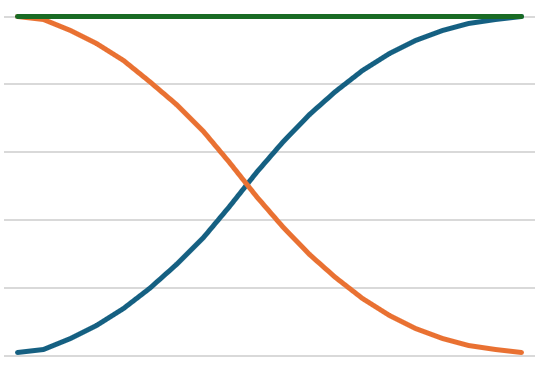
The second is a disruption the market really likes. All the previously bought products are being replaced faster than normal wear and tear would dictate.

The third is the dreaded Osborne effect. Sales of the old technology shrink, but the new technology is not fully ready yet. A very problematic drop in sales results.

And with the right diagnosis, the solution is easy. Launch more BEV models, models more capable of the use cases Europeans want from their cars; models more affordable after a few years of inflation and stagnating income. This is a clear message for industry and government that the future is electric and that future is now. No reason to wait any longer.
Simple.
Sign up for CleanTechnica’s Weekly Substack for Zach and Scott’s in-depth analyses and high level summaries, sign up for our daily newsletter, and follow us on Google News!
Have a tip for CleanTechnica? Want to advertise? Want to suggest a guest for our CleanTech Talk podcast? Contact us here.
Sign up for our daily newsletter for 15 new cleantech stories a day. Or sign up for our weekly one on top stories of the week if daily is too frequent.
CleanTechnica uses affiliate links. See our policy here.
CleanTechnica’s Comment Policy
cleantechnica.com
#Carmakers #Digging #Graves #Misunderstanding


