


Slow-moving e-rickshaws increasingly sharing road space with fast-moving vehicles, creating a speed gap of over 60 kmph, is turning highways passing through Lucknow into risk zones.
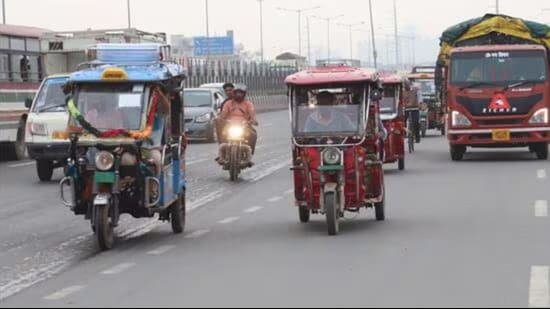
On national highways, vehicles typically run at 80–100 kmph, while speeds on state highways range between 60–80 kmph, as per norms set by the ministry of road transport and highways. In contrast, e-rickshaws operate at just 20–25 kmph, often slower when overloaded and being used like a commercial vehicle to carry load. When they try to match the speed of more powerful vehicles, it leads to accidents.
The stark difference in operating speeds is now visible across key stretches, including Rae Bareli Road (NH 30), Kanpur Road (NH 27), Lucknow Outer Ring Road (NH 230) and Lucknow–Sultanpur–Varanasi Marg (NH 731). Similar movement has been reported on Bani–Mohan Road and New Jail Road (SH 136), Mohanlalganj–Unnao Marg (SH 173), SH 172 and the Barabanki bypass (NH 27).
Traffic police officials said e-rickshaws are not permitted on highways, but enforcement remains a challenge. “These vehicles are meant for short-distance travel within city limits. Their movement on highways creates safety issues,” a traffic sub inspector said.
Transport experts flagged the sharp speed difference as a major risk factor. “Highways are designed for uniform speeds. A vehicle moving at 20 kmph amid traffic at 80–100 kmph creates conflict points and raises accident risk,” said Rohit Baluja, president, Institute of Road Traffic Education.
“Two departments are highly responsible for this, first the transport department and second the police. It’s the duty of the transport department to restrict routes of e-rickshaws, define them, and even enforce them, but due to the lack of manpower, it is still to happen. It’s also the duty of the police to make sure the rules are enforced,” Baluja added.
Baluja also opined that there should be a separate ‘municipal police’ to enforce such traffic rules in the city.
“Truck and bus drivers frequently encounter e-rickshaws moving slowly or changing lanes abruptly, forcing sudden braking. At high speeds, even a small error can lead to a crash. It’s high time they are organised and their numbers are contained with their routes clearly defined, like for auto rickshaws,” said Pankaj Dixit, president of LARTS (Lucknow Autorickshaw Three Wheeler Association).
When Hindustan Times contacted Raveena Tyagi, DCP, traffic, for a comment, she remained unavailable.
According to Prabhat Pandey, RTO (Enforcement), E-rickshaws don’t have defined routes in rules and that’s why they ply on all roads as they are not prohibited from plying. “However, police have banned them from plying on certain roads in the city as it’s under their jurisdiction,” he added.
Pandey also mentioned that in 2014 they were brought under last mile commuting vehicles, but over the time they started growing in number and their current number stands between 60-70,000 and have started plying across all roads in the city.
www.hindustantimes.com
#kmph #speed #gap #Omnipresent #Erickshaws #mishap #magnets #Lko #highways


